PublicSphere Live
Editorial
EDITORIAL:NLNG Dividends: Between Presidency’s Numbers And Makinde’s Demand For Accountability
The controversy between the Presidency and Oyo State Governor Seyi Makinde over alleged withheld Nigerian Liquefied Natural Gas (NLNG) dividends is another reminder that public finance must be governed by facts, accountability and institutional openness rather than political accusations.
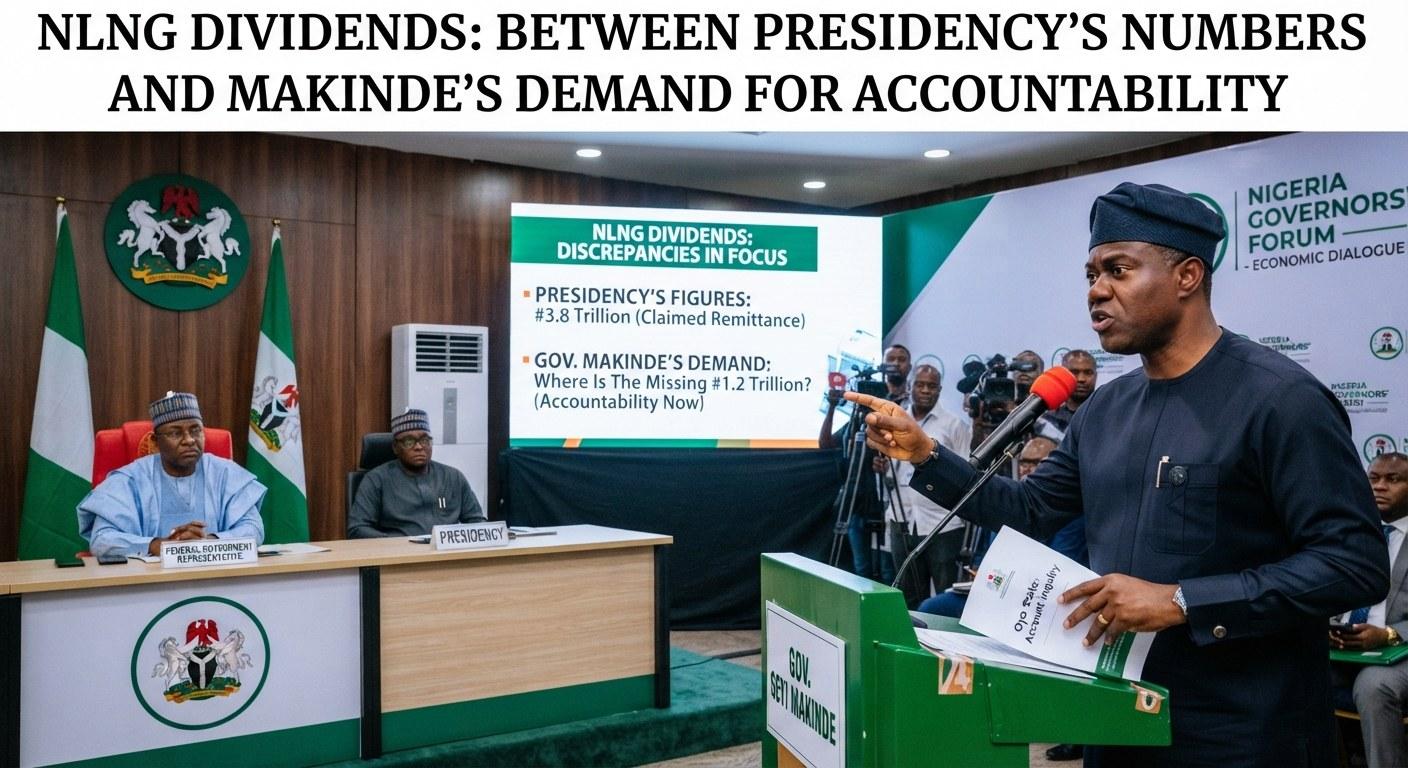
Nigeria’s recurring disputes over the distribution of public revenue reveal a fundamental weakness in the country’s fiscal governance: citizens are frequently left to choose between competing political claims when what they deserve is transparent, verifiable information about the money that belongs to the federation. The controversy between the Presidency and Oyo State Governor Seyi Makinde over alleged withheld Nigerian Liquefied Natural Gas (NLNG) dividends is another reminder that public finance must be governed by facts, accountability and institutional openness rather than political accusations.
The Presidency, through its Special Adviser on Information and Strategy, Bayo Onanuga, has rejected Makinde’s claim that the Federal Government is withholding ₦250 billion in NLNG dividends for each state of the federation pending the conclusion of the 2027 general elections. In a statement issued on October 18, 2026, Onanuga described the governor’s assertion as false, arguing that the figures involved are inconsistent with the historical dividend payments of NLNG and the established revenue-sharing formula.
The governor, on his part, reportedly raised the issue at the 2027 Budget Stakeholders’ Consultative Engagement at the University of Ibadan, expressing concern that money expected by the states would not be released until after the elections. He said Oyo State had already identified projects that could expand its economy and questioned whether the electoral calendar should take precedence over the needs of the people.
These are serious allegations and equally serious rebuttals. Neither should be accepted or dismissed merely because of the political identities of those involved. The appropriate response is to examine the financial figures, establish precisely what revenue is being discussed and demand documentary evidence from the relevant authorities.
The Mathematics Behind The Dispute
The strongest part of the Presidency’s response is its attempt to test Makinde’s claim against the arithmetic of Nigeria’s revenue-allocation system.
According to Onanuga, a payment of ₦250 billion to each of the 36 states would amount to ₦9 trillion. This calculation is correct: multiplying ₦250 billion by 36 produces ₦9 trillion, without including the Federal Capital Territory or the 774 local government areas.
The Presidency further argues that, under the Federation Account allocation formula cited in its statement, states receive 26.72 per cent of distributable Federation Account revenue. On that basis, it estimates that the total revenue required to generate ₦9 trillion for the states would exceed ₦33.68 trillion.
The implication is straightforward. If Makinde’s claim means that every state is individually entitled to receive ₦250 billion from a single NLNG dividend distribution, the amount involved would be enormous and would require compelling documentary evidence.
Onanuga also states that NLNG has distributed approximately $21.5 billion in dividends to the Federation over 25 years, with less than $3 billion realised since President Bola Tinubu assumed office. If these figures are accurate and refer to the same category of dividend payments, they provide a substantial basis for questioning whether a single payout could support the governor’s description.
However, sound analysis requires a distinction between challenging a claim and establishing the complete facts of a financial transaction.
The Presidency’s arithmetic is persuasive against the interpretation that every state is owed ₦250 billion from one dividend payout. But the statement, by itself, does not establish whether Makinde was referring to a single distribution, cumulative receipts, an exceptional revenue arrangement or another figure that may have been presented differently in the course of the discussion.
The distinction matters because public finance disputes cannot be conclusively settled by arithmetic alone. The underlying transaction, the period covered, the amount received and the applicable distribution arrangements must also be established.
The Presidency is therefore justified in demanding that such a substantial claim be supported by verifiable figures. At the same time, the public deserves access to the documents that would settle the matter conclusively.
What Exactly Did The Governor Mean?
Makinde’s reported statement raises questions that require clear answers. Was he claiming that ₦250 billion had been approved for every state, that the states had already been informed of an impending distribution, or that an amount was expected but had subsequently been deferred?
These are different propositions with different financial and legal implications.
If the governor was referring to a specific allocation formally communicated to the states, the relevant evidence should include the official notification, the amount involved, the source of the revenue and the conditions governing its distribution. If, however, the figure was an estimate, a projection or an interpretation of a broader revenue arrangement, that distinction should be made explicit.
Similarly, his assertion that the money would not be released until after the 2027 elections is particularly consequential. Such a claim, if supported by evidence, would raise legitimate questions about whether the timing of public revenue distribution was being influenced by political considerations.
But if no formal decision to postpone payment exists, the allegation risks creating unnecessary suspicion about the Federal Government and the management of the Federation Account.
The public should not have to infer the existence of a withholding decision from a political speech. The governor should provide whatever documentary evidence supports his assertion, including any communication from the Federal Government or the relevant financial authorities.
This is not an unreasonable demand. A governor occupies a position that carries significant responsibility for the accuracy of public statements, especially those concerning billions of naira in public revenue.
Yet the same standard must apply to the Presidency. If it declares the allegation false, it should provide sufficient supporting information to demonstrate the actual status of the dividend revenue in question.
The Presidency Must Also Be Transparent
The Federal Government is correct to insist that claims about public revenue should be subjected to scrutiny. Its response, however, should not be reduced to a political rebuke of an opposition figure with presidential ambitions.
Onanuga’s statement goes beyond disputing the financial figures. It accuses Makinde of making misleading claims since embarking on his presidential bid and recalls the governor’s earlier description of financial flows from the Federation Account to states as “voodoo”.
Such comments may be part of the political contest, but they do little to resolve the central question: what happened to the NLNG dividend revenue, and what amounts, if any, remain due for distribution?
The Presidency is the institution best positioned to provide the Federal Government’s account of the matter. It should therefore concentrate on the transaction rather than the political character or ambitions of the person raising the allegation.
If the dividends have been received, the relevant records should identify the amount, the date of receipt, the account into which the funds were paid and the amount subsequently distributed. If the revenue has not been received, that should also be stated clearly. If the funds have been received but are subject to a separate legal or administrative process, the nature of that process should be disclosed.
There is also a need to distinguish between money belonging to the Federation and revenue that has already been assessed, allocated or formally approved for distribution. The existence of a dividend payment does not, by itself, establish that every state is entitled to a predetermined amount from it.
The Federation Account Allocation Committee and the relevant fiscal authorities should be able to clarify these matters through official records and explanations.
Transparency would serve the Federal Government’s interests as much as those of the states. It would help prevent an unsubstantiated allegation from gaining credibility and reassure citizens that public resources are being administered according to established rules.
The States’ Financial Expectations
The controversy also draws attention to a broader question about the financial relationship between the Federal Government and the states.
State governments have substantial responsibilities for infrastructure, education, healthcare, water supply, rural development and other public services. Their ability to fulfil these obligations depends partly on the resources available to them through statutory allocations, internally generated revenue, borrowing where appropriate and other legitimate sources.
When a governor says that anticipated funds have been incorporated into development plans, the statement deserves careful examination. Budgeting frequently involves estimates of future revenue, but an anticipated receipt is not necessarily money already available for expenditure.
Responsible fiscal management requires state governments to distinguish between confirmed revenue and projections. Projects should be prioritised according to realistic funding expectations, while contingent receipts should be treated cautiously until the relevant amounts and timelines are established.
If Oyo State had genuinely planned major projects around an expected NLNG dividend distribution, the state government should explain the assumptions behind those plans. Were the funds included in an approved budget? Had the state received a formal notification? Were the proposed projects dependent entirely on the anticipated payment, or could they proceed through other funding arrangements?
Such questions are not intended to undermine Makinde’s development agenda. They are necessary to assess whether the state’s planning process was based on confirmed financial commitments or expectations that remained uncertain.
The governor is entitled to demand the resources legally due to his state. He is also responsible for ensuring that the public understands the difference between an entitlement, a forecast and a payment that has actually been approved.
Revenue Sharing Should Not Become An Election Issue
The timing of the dispute makes it especially sensitive. Nigeria is moving towards another general election, and disagreements over federal revenue, state allocations and public expenditure are likely to feature prominently in political campaigns.
Opposition politicians have a legitimate role in questioning government decisions, demanding accountability and challenging policies they consider harmful to the public interest. Such scrutiny is essential to democratic government.
The Presidency, equally, has the right and responsibility to correct inaccurate claims about its administration. Allowing demonstrably incorrect financial information to circulate without a response could undermine public understanding of the country’s fiscal arrangements.
The danger arises when both responsibilities become subordinated to political advantage.
If Makinde has evidence that a legally due payment is being withheld until after the elections, he should present it. A claim of this magnitude cannot rest solely on suspicion or an interpretation of events. If the Presidency has evidence that no such withholding has occurred, it should publish the relevant records and explain the actual position.
Neither side should expect Nigerians to accept its version simply because it has been delivered confidently or accompanied by accusations against the other.
Public money belongs to the federation and must be administered in accordance with the law. The question of when revenue is received and distributed should be determined by applicable rules and financial realities, not by the electoral interests of any political party or candidate.
The Need For An Independently Verifiable Account
The most constructive way out of this controversy is for the relevant institutions to publish a clear account of the NLNG dividend revenue at the centre of the disagreement.
Such an account should establish the total dividends declared and paid, the dates of payment, the amounts received by the Federation, the treatment of the revenue under the applicable fiscal framework and the sums, if any, allocated or awaiting distribution.
It should also clarify whether any payment has been formally deferred and, if so, the legal and administrative reasons for that decision.
This would enable Nigerians to distinguish between a genuine dispute over an outstanding allocation and a disagreement arising from the interpretation of figures.
It would also help prevent the same controversy from recurring whenever the country approaches an election.
The public should not be left to depend on political statements to understand how billions of naira in national revenue are managed. The relevant records should be accessible, intelligible and capable of independent verification by journalists, financial analysts, civil society organisations and other interested citizens.
The National Assembly and the appropriate oversight institutions also have a responsibility to ensure that the Federation Account is managed transparently and that the rules governing the distribution of public revenue are consistently applied.
Beyond The Political Exchange
Ultimately, this controversy should be an opportunity to strengthen Nigeria’s fiscal accountability rather than another episode in the escalating political exchanges ahead of 2027.
The Presidency has presented a numerical argument that raises serious doubts about the interpretation that every state is entitled to ₦250 billion from a single NLNG dividend payout. Its reference to the company’s historical dividend payments provides a reasonable basis for demanding clarification.
Makinde’s concern, however, touches on a legitimate principle: governments at every level should receive the revenues to which they are entitled, and no public allocation should be delayed for partisan reasons. That principle remains important even when a particular allegation has not been substantiated.
The unresolved issue is whether the governor’s description accurately reflects a specific financial commitment and whether any decision has been taken to postpone the distribution of the revenue. The material presented in the Presidency’s statement does not, on its own, supply a complete transaction-by-transaction account that independently settles every aspect of the dispute.
Both sides therefore have obligations. Makinde should substantiate his allegation with documentary evidence and clarify precisely what the ₦250 billion figure represents. The Presidency should provide the financial records necessary to demonstrate the actual position and avoid allowing personal attacks to overshadow the substantive issue.
Neither should be granted automatic credibility, and neither should be condemned without examining the evidence.
Nigeria has little to gain from turning public revenue into a contest of political assertions. What the country needs is a system in which the facts are published, the rules are clear and those entrusted with public resources can be held accountable.
The central question is not whether Makinde or the Presidency wins this exchange. It is whether Nigerians can establish, from credible records, what NLNG dividends have been paid, how the proceeds have been treated and what amounts are genuinely due to the different tiers of government.
Until those facts are made clear, restraint is preferable to political certainty, and transparency is more valuable than rhetoric. That is the standard by which both the governor and the Presidency should be judged.