PublicSphere Live
Business
Rising Tide Africa Commits $1m to Expand Used Cooking Oil Collection Network in Nigeria
The investment is expected to strengthen the infrastructure required to collect, aggregate and process used cooking oil (UCO), while creating new income opportunities for thousands of people involved in the informal waste and recycling economy
Rising Tide Africa, a women-led pan-African angel investment network, has committed up to $1 million, equivalent to about ₦1.4 billion, to support the expansion of Ororo Waste Management Limited’s used cooking oil collection network across Nigeria, with a strong focus on women, waste pickers and young people.
The investment is expected to strengthen the infrastructure required to collect, aggregate and process used cooking oil (UCO), while creating new income opportunities for thousands of people involved in the informal waste and recycling economy.
Ororo Waste, which is Lagos State’s partner for institutional-scale used cooking oil collection and export, received the first tranche of the investment through a corporate note on September 16, 2026. Further tranches may be released through December 16 to finance additional collection infrastructure and working capital.
The investment comes at a time when Nigeria is estimated to generate about 840,000 metric tonnes of used cooking oil annually, with more than 95 per cent of the potential feedstock currently going uncaptured.
Industry stakeholders say the huge volume of discarded cooking oil represents both an environmental challenge and an economic opportunity, particularly as international demand grows for certified waste-based feedstocks used in the production of biodiesel and Sustainable Aviation Fuel.
Women And Waste Pickers At The Centre Of The Supply Chain
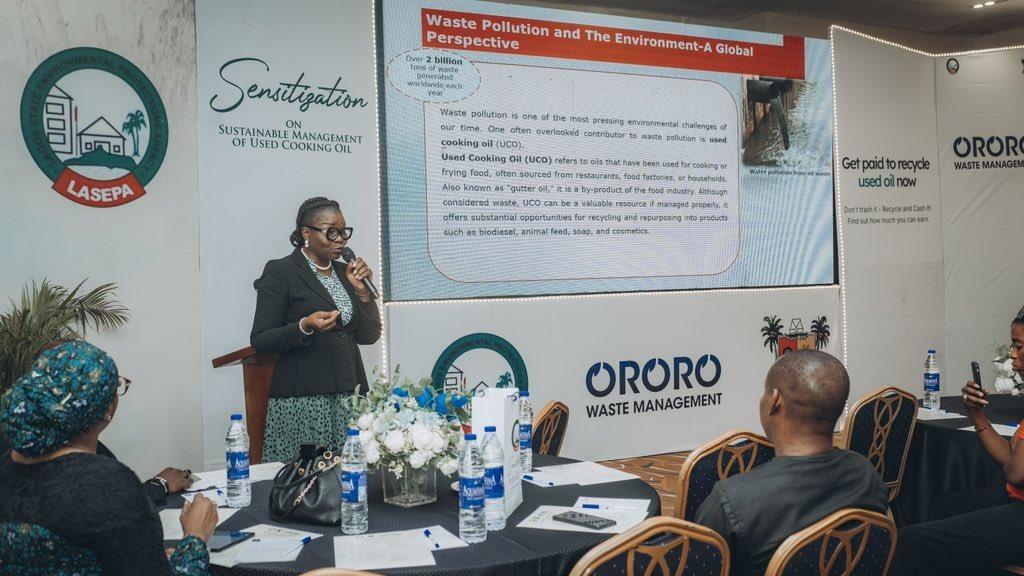
The partnership builds on a training programme conducted in July by Ororo Waste in collaboration with the Lagos State Environmental Protection Agency (LASEPA), Shell Foundation and the Waste Pickers Association of Nigeria (WAPAN).
The two-day programme, held at the Lagos Chamber of Commerce and Industry in Alausa, Ikeja, brought together approximately 250 market women, waste pickers and youths.
Participants were trained on the safe collection, handling and storage of used cooking oil, quality assurance, traceability and the commercial value of the commodity as feedstock for sustainable aviation fuel and biodiesel.
They were also introduced to the payment structure through which collectors would be compensated for the quantities of used cooking oil supplied to the network.
Olaitan Dawodu, Director of Operations at Ororo Waste, said the initiative was designed to ensure that people already participating in the informal collection of used cooking oil could become beneficiaries of a more organised and commercially viable supply chain.
“Every participant within the supply chain, including market women, waste pickers and youths, will earn income for their respective roles. This creates an inclusive circular economy that generates employment while protecting human health and the environment,” Dawodu said.
The company and its investment partner are now looking beyond the initial training programme, with plans to expand the formal collection network substantially over the next five years.
Rising Tide Africa said the investment was deliberately structured around a gender-lens approach, recognising that women operating in markets and other informal economic spaces already play an important role in the collection and aggregation of used cooking oil.
Yemi Keri, co-founder of Rising Tide Africa, said the organisation's objective was to put capital behind an existing economic activity and ensure that those creating value within the supply chain receive a fairer share of the returns.
“Market women and waste pickers already do most of the collecting. Few have ever been paid fairly for that work, and even fewer at scale,” Keri said.
She explained that the investment would finance the infrastructure required to pay collectors promptly for a commodity for which there is already significant international demand.
According to her, the initiative represents gender-lens investing in practical terms by directing capital towards an economic activity in which women are already creating value and helping them expand their participation.
From Waste To Industrial Feedstock
Used cooking oil has increasingly become an important feedstock for the global renewable fuels industry.
Discarded cooking oil can create environmental problems when poured into drains and waterways, contributing to blockages and potentially worsening flooding in urban areas. Improperly handled oil may also be reused in food preparation, creating public health concerns.
The development of an organised collection system therefore offers the possibility of addressing several problems simultaneously: reducing environmental pollution, improving waste management, creating employment and converting a largely discarded material into an internationally traded industrial commodity.
The European Union’s revised Renewable Energy Directive, known as RED III, is also expected to sustain demand for certified waste-based feedstocks.
Under the directive, member states are required by 2030 to achieve either a 29 per cent share of renewable energy in transport or a 14.5 per cent reduction in the greenhouse-gas intensity of transport fuels.
That regulatory environment has strengthened the market for certified waste-derived feedstocks that can be traced through their entire supply chain.
Ororo Waste says it has built its business around meeting that requirement through traceability, certification and quality control.
The company is International Sustainability and Carbon Certification (ISCC) certified and says it has exported thousands of metric tonnes of used cooking oil without a quality rejection.
It has operated for five years, initially collecting used cooking oil from businesses before expanding in March 2026 to households and markets.
Digital Tracking And Same-Day Payments
A major component of the Ororo model is the use of digital technology to formalise a supply chain that has historically operated largely outside the formal economy.
The company's collection platform tracks transactions using GPS and QR codes, allowing the movement of used cooking oil to be monitored from the individual collector through to the export container.
Collectors are paid through mobile money on the same day, a system the company says is designed to provide greater transparency and reduce payment delays.
Ayo Banjo, Co-CEO of Ororo Waste Management, said the company's ability to meet international buyers' requirements depended on documentation, traceability and consistent quality rather than merely having access to large quantities of used cooking oil.
“Refiners in Europe don’t buy good intentions - they buy documented, ISCC-certified tonnes,” Banjo said.
He explained that every litre exported by the company is GPS-tracked and QR-coded from the collector's drum to the export container.
According to him, the new investment would help finance what he described as the less visible but indispensable components of the business, including drums, trucks, hub storage and working capital.
Banjo said the ultimate ambition was to create dignified incomes for several hundred thousand women through the expansion of the collection network.
From Three Hubs To More Than 40
Ororo Waste currently operates collection hubs in Lagos, Abuja and Port Harcourt.
With the new capital, the company plans to expand from the three existing hubs to more than 40 hubs across Nigeria over the next five years.
The funds will be used primarily for hub infrastructure, purchasing feedstock from the collector network and meeting operating costs associated with the expanded collection system.
The planned geographical expansion could significantly increase the company's ability to reach markets, households, restaurants and institutional generators of used cooking oil in different parts of the country.
The company and Rising Tide Africa have also agreed in principle on a set of five-year development-impact targets, which are expected to be baselined in 2026 and monitored through annual reporting.
One of the most ambitious targets is to increase the formally paid collector network from approximately 5,000 people currently to more than 200,000 by 2031.
Women are expected to account for at least half of newly onboarded market-level collection points, with the possibility that their representation could rise to as much as three-quarters.
The company is also targeting annual certified used cooking oil collection of more than 150,000 metric tonnes by 2031.
That volume would represent approximately 18 per cent of Nigeria's estimated annual used cooking oil generation.
Measuring Income And Employment Impact
Beyond the number of people brought into the network, the partnership is intended to measure the actual economic impact on participating collectors.
Ororo Waste plans to complete a baseline income survey of the first formally onboarded cohort from the July 2026 training by the end of this year.
It intends to subsequently report annually on income and employment outcomes among participating women, waste pickers and youths, as well as the gender composition of its workforce and leadership.
The reporting framework is expected to be aligned with recognised gender-lens investment principles, including the 2X Global Criteria.
This approach could provide investors and development partners with measurable evidence of whether the expansion of the used cooking oil industry is translating into improved incomes and employment opportunities at the grassroots level.
Building A Formal Circular Economy
The investment also comes with an emphasis on corporate governance and environmental, social and governance standards.
Ororo Waste said it has adopted an ESG framework designed to meet the expectations of institutional and development finance investors.
The company has engaged external auditors and legal counsel, appointed independent directors and committed to regular ESG and impact reporting.
Its ESG policy is aligned with the United Nations Sustainable Development Goals, the guidelines of the National Environmental Standards and Regulations Enforcement Agency and the Nigerian Code of Corporate Governance 2018.
The company also commits to fair employment practices and gender equality in recruitment and promotion.
For Rising Tide Africa, the investment represents another step in its strategy of supporting African businesses capable of combining commercial returns with measurable social and environmental impact.
The network, founded in 2016 by Keri, has more than 122 members who are senior women investors based in seven countries. It has invested in 39 early-stage companies across sectors including fintech, healthtech, agritech, climate, proptech, edtech and essential services.
Its investment model also provides portfolio companies with mentoring, investment, networking and education.
The Ororo investment consequently places Nigeria's informal waste economy at the intersection of climate finance, women's economic empowerment and the emerging global market for sustainable fuels.
For Nigeria, where millions of people earn their livelihoods in informal economic activities and where urban waste management remains a major challenge, the formalisation of used cooking oil collection could provide a new model of how environmental problems can be converted into commercially valuable opportunities.
The success of the initiative, however, will ultimately depend on whether the ambitious targets for collector numbers, women's participation, collection volumes and nationwide infrastructure can be translated from investment commitments into sustained economic activity on the ground.
If achieved, the expansion could turn a largely neglected waste stream into a significant source of income for Nigerian households while supplying global renewable-fuel markets with certified feedstock and demonstrating the potential of Africa's circular economy.