PublicSphere Live
Business
NGX Market Analysis: Profit-Taking Deepens As Equities Market Loses N256bn, ASI Falls 0.16%
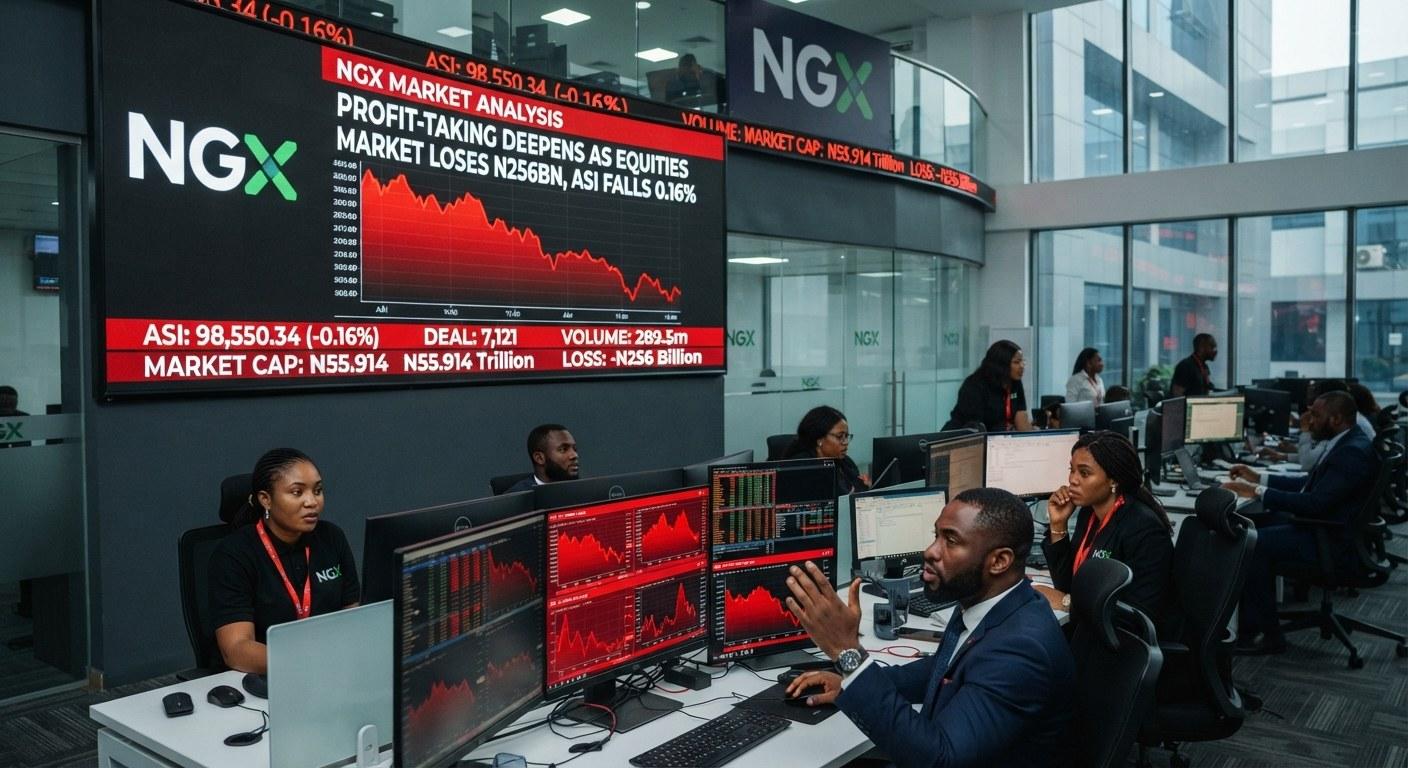
Nigeria’s equities market extended its bearish run in the latest trading session, as persistent profit-taking and renewed selling pressure on banking and other heavyweight stocks pushed the Nigerian Exchange Limited (NGX) All-Share Index further below the 250,000-point psychological threshold.
The market’s latest performance is significant not because the 0.16 per cent decline was particularly severe in isolation, but because it represented the fifth consecutive losing session for the equities market. The sequence suggests that what initially appeared to be a normal bout of profit-taking after months of spectacular gains is becoming a more pronounced period of valuation adjustment and portfolio repositioning.
At the close of Tuesday’s session, which is the latest fully verified market session available in the current reporting cycle, the NGX All-Share Index fell by 394.36 points, or 0.16 per cent, to 250,273.50 points, from 250,667.86 points in the preceding session. Market capitalisation consequently declined by N256.05 billion, from about N162.75 trillion to N162.50 trillion. Despite the recent weakness, the market remained extraordinarily strong on a year-to-date basis, with the ASI still delivering a 60.83 per cent gain for investors in 2026.
That year-to-date figure is important in understanding the psychology behind the present correction. Investors are not looking at the NGX as a market that has suddenly become fundamentally unattractive. Rather, they are dealing with a market that has produced exceptionally large returns and therefore provides considerable incentive for investors to lock in profits, particularly in stocks whose valuations have risen sharply.
The ASI And The Psychology Of The 250,000-Point Level
The movement of the All-Share Index remains the clearest indication of the market's present direction. The ASI's fall to 250,273.50 points means that the index is now hovering only marginally above the 250,000-point psychological level.
The significance of this level extends beyond the number itself. After the market crossed 250,000 points during September, the threshold became an important psychological reference point for investors. The inability of the index to maintain its upward momentum above that level reflects the increasing caution among market participants.
The market had entered October following an impressive September performance. The ASI gained about 2.87 per cent in September, rising from 244,199.39 points to 251,211.67 points, while market capitalisation increased by about N5.37 trillion during the month.
The transition from that September strength into October's weakness therefore looks increasingly like a classic consolidation phase. Investors who bought at lower levels now have a strong incentive to take money off the table, while new buyers are becoming more selective because they are no longer purchasing stocks at the depressed valuations that characterised earlier stages of the 2026 rally.
This is particularly relevant given the market's 60.83 per cent year-to-date return. The higher the accumulated return, the greater the temptation for institutional and retail investors to realise gains.
Banking Stocks Remain The Centre of The Sell-Off
The most important dimension of the latest session was the performance of banking stocks.
The NGX Banking Index fell by approximately 1.25 per cent, making it the weakest major sectoral index in the session. The decline was led by some of the market's most prominent financial stocks, with First HoldCo falling 5.09 per cent, Ecobank Transnational Incorporated declining 2.72 per cent and Stanbic IBTC Holdings losing about 1.36 per cent.
The banking sector's weakness is particularly consequential because financial stocks constitute a major component of market activity and investor portfolios on the NGX. When large banking stocks decline simultaneously, the effect on the ASI can be disproportionately significant.
First HoldCo was especially damaging to sentiment. Its 5.09 per cent decline represented one of the most substantial losses among the large-cap counters and helped drag the broader financial-services segment lower.
Yet the banking sector's performance should not necessarily be interpreted as evidence of a collapse in investor confidence in Nigerian banks. The sector has been one of the major beneficiaries of the 2026 equity-market rally, and investors may simply be taking profits after substantial appreciation.
Indeed, the market's current behaviour is consistent with a rotation in which investors are reassessing positions accumulated during the earlier rally rather than abandoning equities altogether.
Insurance Provides A Degree Of Resistance
While banking stocks came under heavy pressure, the insurance sector provided some counterweight.
The NGX Insurance Index gained approximately 0.53 per cent, making it the strongest of the major sectoral indices in the session. Sovereign Trust Insurance, Coronation Insurance and Guinea Insurance were among the notable performers, with gains of 8.23 per cent, 7.69 per cent and 7.35 per cent respectively.
The performance demonstrates an important feature of the current market: the sell-off is not completely indiscriminate.
Money is still moving into selected stocks and sectors where investors see either value or further upside potential. The strength in insurance counters therefore suggests that portfolio rotation remains an important component of the market's present dynamics.
Insurance companies have also been undergoing significant changes in response to the industry's recapitalisation requirements. That process has increased investor attention to balance-sheet strength, strategic positioning and the ability of individual companies to meet the new capital requirements.
Consumer Goods Also Feel The Pressure
The consumer goods sector was another area of weakness. The NGX Consumer Goods Index declined marginally by about 0.04 per cent in one market-data compilation, with PZ Cussons recording a strong 4.97 per cent gain while Unilever Nigeria fell 4.06 per cent.
This divergence within the same sector is revealing. It shows that investors are increasingly discriminating between individual companies rather than treating entire sectors as homogeneous investment propositions.
PZ Cussons' strong performance indicates that buying interest remains available for companies where investors perceive favourable valuation or corporate prospects. Conversely, the decline in Unilever demonstrates that profit-taking and stock-specific concerns can overwhelm broader sector sentiment.
The consumer-goods segment is particularly sensitive to Nigeria's macroeconomic environment because companies operate against the backdrop of consumer purchasing power, production costs, foreign-exchange conditions and input-price pressures.
Industrial Goods Hold Their Ground
The industrial-goods segment was considerably more resilient. Available market data show the NGX Industrial Goods Index essentially flat, with one equal-weighted sector analysis indicating industrial goods as the strongest-performing group on that basis, gaining about 1.18 per cent.
This relative resilience is important because industrial stocks have played a substantial role in the market's broader 2026 rally.
Large industrial companies, particularly cement manufacturers, have benefited from investors' appetite for businesses with significant market positions and strong earnings potential. The sector also provides exposure to Nigeria's long-term infrastructure and construction requirements.
The ability of industrial equities to resist the selling pressure that affected banks indicates that investors are not simply exiting the Nigerian market. Rather, they are reallocating capital among sectors and stocks according to perceived risk and reward.
Oil And Gas Remains Stable
The oil and gas sector was comparatively subdued. The NGX Oil & Gas Index was essentially flat, closing around 6,243.33 points, with the available historical data showing only a negligible movement.
This stability is notable considering the importance of the energy industry to Nigeria's economy and the growing investment attention surrounding domestic refining, crude production and downstream transformation.
The relative calm in the sector suggests that investors were not making major directional bets across oil and gas stocks during the session. Instead, attention remained concentrated on financial stocks and selected individual counters.
The continued development of Nigeria's domestic refining capacity, including the Dangote Petroleum Refinery, together with renewed emphasis on crude production and investment in upstream assets, nevertheless gives the sector considerable medium- to long-term importance.
Market Breadth Reveals The Real Story
Perhaps one of the most revealing indicators of the session was market breadth.
Data compiled from the NGX showed 27 advancers against 37 decliners, with 62 stocks unchanged, producing an advance/decline ratio of approximately 0.73x.
That means the weakness was broader than the movement of the ASI alone suggests.
A 0.16 per cent decline in the headline index might ordinarily appear insignificant. But when more stocks are declining than advancing, it indicates that selling pressure is spread across a meaningful portion of the market.
At the same time, the fact that 62 stocks remained unchanged shows that the market was not experiencing a wholesale panic. This is an important distinction.
The present market environment is therefore better described as cautious and defensive rather than capitulation-driven.
Trading Volume Falls Sharply
Another significant dimension was the reduction in trading activity.
Total volume declined by approximately 33.82 per cent to about 579.5 million shares, from roughly 875.7 million shares in the preceding session. The number of deals also fell by about 24 per cent to approximately 41,882, while value traded declined to about N36.15 billion.
This reduction in volume is important in interpreting the five-session decline.
A market falling on exceptionally high volume can indicate aggressive liquidation, suggesting that investors are rushing to the exit. A decline accompanied by falling volume can instead indicate that buyers are becoming less aggressive and sellers are gradually accepting lower prices.
The current pattern appears closer to the second scenario.
Investors are cautious, but there is not yet convincing evidence of wholesale panic. The market is undergoing a process of digestion after an extraordinarily strong run.
Accesscorp And Aradel Dominate Trading Activity
Trading concentration also provides insight into where investor attention was directed.
Access Corporation dominated trading by volume, accounting for about 192.58 million shares, representing roughly one-third of total market volume. Aradel Holdings led by value, with transactions worth approximately N7.63 billion. (
The concentration of activity in a relatively small number of securities illustrates the continuing importance of liquidity in the Nigerian market.
Investors entering or exiting large positions naturally prefer stocks where substantial volumes can be transacted without creating excessive price distortion. Consequently, highly liquid banking, energy and telecommunications counters continue to attract a significant proportion of institutional activity.
Gainers And Losers Show A Selective Market
At the individual-stock level, the market produced some striking movements.
Tripple Gee & Company led the gainers with a 9.77 per cent appreciation to N2.81, followed by Livestock Feeds, which gained 9.74 per cent to N10.70, while NPF Microfinance Bank rose 9.52 per cent to N4.60. Sovereign Trust Insurance and WAPIC also recorded strong advances.
On the losing side, DEAP Capital Management & Trust, formerly represented by the CMFC ticker in the cited data, fell 9.88 per cent to N3.65. ABC Transport declined 9.70 per cent, while Computer Warehouse Group lost 7.23 per cent. Zichis Agro-Allied Industries and Neimeth International Pharmaceuticals also recorded significant declines.
These movements reinforce the argument that the market is in a stock-selection phase. While some companies are being sold aggressively, others are attracting equally strong buying interest.
What The Five-Day Decline Means
The five-session losing streak deserves attention, but it should not automatically be interpreted as the beginning of a prolonged bear market.
The market has generated an extraordinary 60.83 per cent year-to-date return, meaning that a correction after such a rally is hardly unexpected.
The bigger question is whether the correction remains orderly.
For now, several indicators suggest that it does. Trading volume has declined rather than exploded; the ASI remains substantially above its level at the beginning of the year; industrial and oil-and-gas stocks have shown resilience; and selected insurance and consumer stocks continue to attract buyers.
However, the market's inability to sustain the 250,000-point level comfortably would increase the importance of subsequent sessions. If banking stocks continue to weaken and the ASI falls decisively below recent support levels, investors could become more defensive.
Conversely, renewed buying in banking, industrial and large-cap stocks could quickly restore upward momentum because the underlying market remains strongly positive on a year-to-date basis.
Outlook: Correction, Not Collapse
The Nigerian equities market is therefore at an interesting juncture.
The extraordinary rally recorded during the first nine months of 2026 has created substantial paper wealth and strengthened the market's attraction to domestic and institutional investors. But it has also produced higher valuations, making profit-taking almost inevitable.
The latest session shows that investors are increasingly demanding stronger justification for further price appreciation. Corporate earnings, recapitalisation developments, dividend expectations, macroeconomic stability and sector-specific prospects are likely to become increasingly important in determining where capital flows next.
The immediate outlook is consequently cautiously bearish, particularly for banking stocks, but the medium-term outlook remains more constructive.
What the market needs now is not necessarily another explosive rally. It needs an orderly consolidation that allows valuations to catch up with the exceptional price gains already recorded.
The most important lesson from the session is that Nigeria's equities market has entered a new phase. The easy gains of the earlier rally are becoming harder to replicate. Investors are becoming more selective, liquidity is concentrating in preferred counters, and sectors are beginning to diverge more sharply.
For investors, therefore, the NGX is no longer simply a market-wide bullish story. It is increasingly a fundamentals-and-stock-selection market in which corporate performance, valuation and sector prospects will determine the next winners.
The fifth consecutive decline should consequently be watched carefully, but it should not be exaggerated. At 250,273.50 points and with a 60.83 per cent year-to-date return, the ASI remains a powerful reminder that the broader 2026 story is still one of extraordinary appreciation, even as the market takes a breather and investors reassess how much of those gains they are prepared to retain.