PublicSphere Live
Business
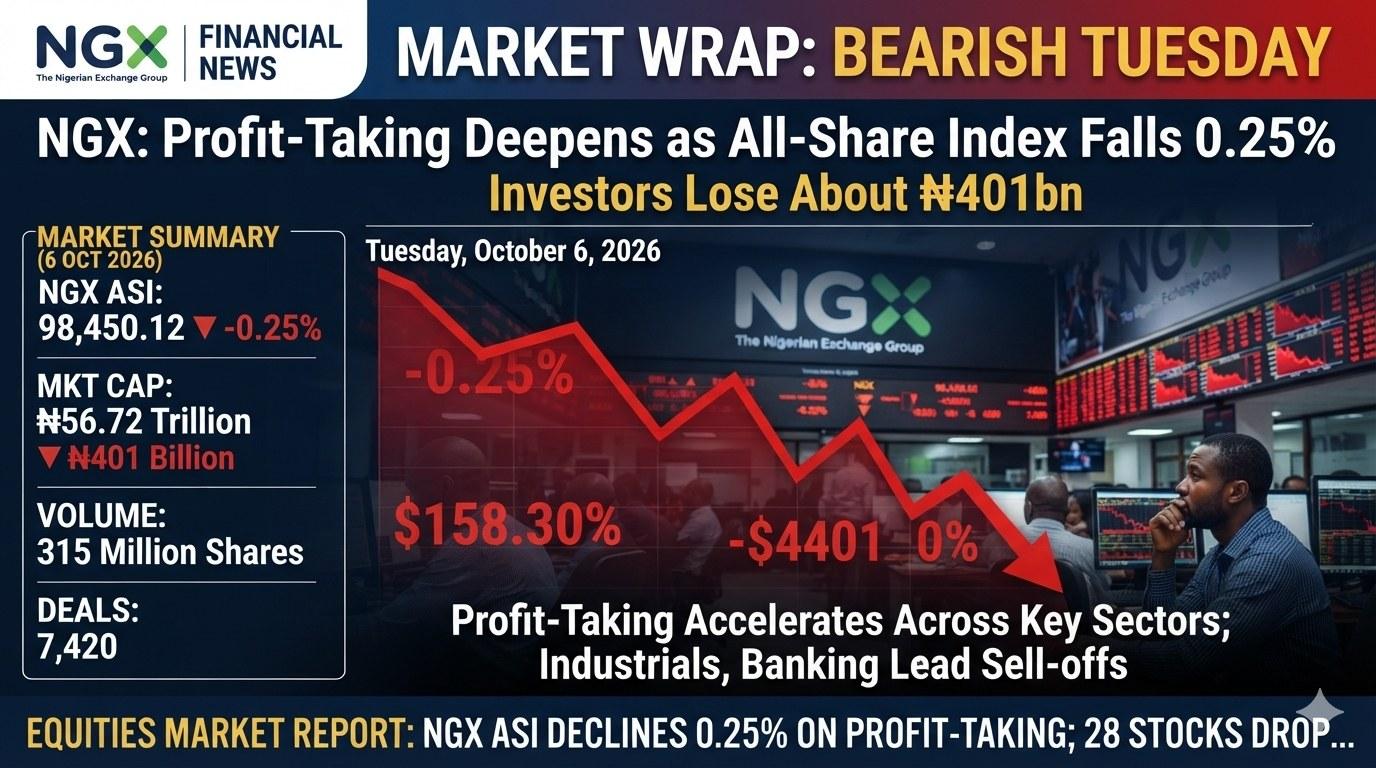
NGX: Profit-Taking Deepens as All-Share Index Falls 0.25%, Investors Lose About ₦401bn
Trading on the Nigerian Exchange Limited (NGX) turned decisively bearish on Tuesday as renewed profit-taking swept through several large-cap counters, pushing the benchmark All-Share Index below the 250,500-point psychological threshold and extending the market’s cautious opening to October
By Chris Uba
Trading on the Nigerian Exchange Limited (NGX) turned decisively bearish on Tuesday as renewed profit-taking swept through several large-cap counters, pushing the benchmark All-Share Index below the 250,500-point psychological threshold and extending the market’s cautious opening to October.
The NGX All-Share Index fell by 617.01 points, or approximately 0.25 per cent, to close at 250,050.85 points, compared with 250,667.86 points at the end of Monday’s session. Market capitalisation similarly declined from about ₦162.75 trillion to ₦162.35 trillion, representing a loss of roughly ₦401 billion in investors’ wealth in one session. The closing figures were reported by Osborne Capital Markets, which also recorded 540.70 million shares traded in 39,811 deals with a total value of ₦34.66 billion.
The significance of Tuesday’s decline goes beyond the relatively modest percentage loss. The market has now moved into a more delicate phase after the spectacular rally recorded through much of September, when the ASI climbed to an intra-month record of 252,635.11 points before retreating to 251,211.67 points at month-end. September nevertheless produced a strong 3.85 per cent monthly return and lifted the year-to-date gain to 61.43 per cent. (Invest Data) The latest weakness therefore looks more like an extension of profit-taking and portfolio rebalancing than evidence, at this stage, of a breakdown in the market's underlying bullish structure.
The most important technical development from Tuesday's session is the breach of the 250,000-point psychological territory. That level had emerged as an important support zone after the market's September rally, and its ability to hold will now become an important test of investor confidence. The September market analysis had identified 250,000 points as a significant psychological support, with the 249,800-point region providing another important cushion. A sustained movement below those levels, particularly if accompanied by rising selling volume and worsening breadth, would strengthen the case for a deeper correction. (Invest Data)
Sectoral Performance Shows A Market In Rotation
Tuesday's sectoral picture confirms that investors are not abandoning equities indiscriminately but are becoming considerably more selective. The previous session had already produced a mixed sectoral performance, with the Banking Index rising 0.07 per cent to 2,687.54 points, while the Consumer Goods Index fell 0.12 per cent, the Oil and Gas Index declined 0.05 per cent and Industrial Goods remained virtually flat. Insurance, which had been one of Monday's stronger areas, gained 1.15 per cent to 1,087.67 points. (Invest Data)
That divergence is important because it demonstrates that the present weakness is being driven principally by stock-specific selling and profit realisation rather than a wholesale flight from Nigerian equities. The banking sector, for example, continued to show relative resilience, supported by the performance of selected tier-one and second-tier institutions. Zenith Bank, Stanbic IBTC, Wema Bank and First HoldCo were among the counters that supported the Banking Index during Monday's session, although UBA, GTCO, Fidelity Bank and Access Holdings came under pressure. (Nairametrics)
The Consumer Goods segment, by contrast, has remained one of the principal sources of pressure on the broader market. Nestlé Nigeria was particularly damaging to sentiment after losing 5.17 per cent on Monday, while Cadbury Nigeria, International Breweries and Nigerian Breweries also declined. The weakness is significant because consumer stocks had attracted considerable valuation gains during the year and therefore provide an obvious target for investors seeking to lock in profits. (Nairametrics)
Industrial Goods have so far demonstrated considerably greater resilience. The sector was virtually unchanged on Monday, with the Industrial Goods Index at 10,440.31 points, while Dangote Cement and BUA Cement held their ground. That relative stability is significant because industrial stocks remain closely tied to the broader domestic investment and infrastructure cycle, and their resilience could help prevent the present correction from becoming a much broader market sell-off. (Nairametrics)
Oil and Gas stocks have also shown mixed behaviour. The Oil and Gas Index slipped marginally on Monday to 6,243.45 points, with Oando declining 1.43 per cent. Yet the medium-term picture for the sector remains considerably stronger than the immediate daily movement suggests. The Oil and Gas Index had been one of the market's strongest performers during September, supported by renewed interest in energy stocks and particularly by major transactions involving Seplat Energy. (Nairametrics)
Insurance, meanwhile, has become one of the more interesting pockets of the market. Although some insurance counters came under pressure in earlier trading, selective buying has returned to the sector. Sovereign Trust Insurance was among Tuesday's strongest gainers, while Coronation Insurance also recorded a strong advance. Osborne Capital Markets reported Sovereign Trust Insurance among the leading gainers at 10 per cent in its market data, alongside FTN Cocoa Processors, Tripple Gee, Learn Africa and Livestock Feeds.
Banking Stocks Remain The Market's Main Liquidity Engine
The behaviour of financial stocks remains central to understanding the NGX. Financial services have dominated market turnover for much of the year, and September was no exception. The sector repeatedly accounted for the bulk of trading activity, reflecting both the large market capitalisation of listed banks and the substantial institutional interest in their shares. (Invest Data)
That dominance gives the banking sector disproportionate influence over the direction of the ASI. When investors accumulate tier-one banks, the index can rise even when several smaller stocks are declining; conversely, when investors take profits in large banking positions, the resulting market-capitalisation effect can overwhelm gains elsewhere.
The latest earnings season could therefore become particularly important. Stanbic IBTC's recently released half-year results, for instance, showed profit after tax of ₦239.7 billion, up 38.2 per cent year-on-year, alongside an 80 per cent increase in its interim dividend to ₦4.50 per share. Such results reinforce the fundamental argument for continued institutional interest in quality banking stocks even as short-term traders take profits. (TRW Stockbrokers Ltd)
This creates an interesting tension in the market: valuations have risen dramatically, but corporate fundamentals in important parts of the banking sector are also improving. The result is likely to be continued rotation rather than a uniform market direction.
The Market Is Correcting, Not Collapsing
The strongest argument against interpreting Tuesday's decline as the beginning of a major bear market is the extraordinary scale of the gains accumulated this year. The NGX ASI entered October after rising more than 61 per cent year-to-date, while some individual sectors and stocks had produced substantially larger returns. The Banking Index, for example, had risen 74.22 per cent year-to-date by September 18, while the Oil and Gas Index had gained 125.94 per cent over the same period. (Invest Data)
With such returns already sitting on investors' books, profit-taking is not only inevitable but healthy. A market that rises continuously without periodically releasing excess valuations becomes increasingly vulnerable to a much more disorderly correction. The present retreat, therefore, can be interpreted as a process through which investors are crystallising gains, reassessing valuations and reallocating capital towards companies whose earnings prospects justify their current prices.
What would change that interpretation is a combination of three developments: a sustained break below 249,800 points, increasingly negative market breadth and heavy selling in the large-cap stocks that have carried the market throughout the year. For now, Tuesday's movement does not provide sufficient evidence that all three conditions have been met.
Liquidity Remains a Critical Signal
Trading activity also deserves close attention. Tuesday's 540.70 million shares valued at ₦34.66 billion across 39,811 deals represented a substantial level of activity, although below Monday's unusually heavy turnover of 875.26 million shares valued at ₦34.66 billion across 53,797 deals. Monday's volume had been heavily influenced by Access Holdings, which alone accounted for more than 440 million shares.
The contrast suggests that Tuesday's decline was not accompanied by an extraordinary escalation in panic selling. That distinction matters. A sharp fall accompanied by exceptionally heavy turnover would signal aggressive distribution, whereas a moderate decline on more restrained turnover is more consistent with portfolio adjustment and selective profit-taking.
Market breadth should consequently become an increasingly important indicator during the next few sessions. If the number of declining stocks continues to substantially exceed gainers while the ASI remains below 250,000 points, the correction could deepen. Conversely, if bargain hunters return to banking, industrial, oil and gas and selected consumer stocks while breadth improves, the market could stabilise around its present levels.
October Opens with A Different Investment Equation
The NGX is entering the final quarter of the year under conditions that are materially different from those prevailing at the beginning of 2026. The Central Bank of Nigeria has reduced the Monetary Policy Rate by 350 basis points to 23 per cent, inflation has moderated to 15.39 per cent, Treasury-bill yields have begun falling and external reserves have risen above $54 billion. These developments are changing the relative attractiveness of equities and fixed-income instruments. (Nairametrics)
For equities, lower interest rates can ultimately be supportive because declining fixed-income yields may encourage investors to search for higher returns in the stock market. But the immediate effect can be more complicated because institutional investors must reassess portfolio valuations, dividend yields and the relative risk premium between equities and government securities.
The Dangote Petroleum Refinery's ₦2.15 trillion public offer is another factor influencing liquidity and investor behaviour. The offer has already introduced a major new investment opportunity into the Nigerian capital market and may encourage some investors to rebalance existing portfolios in order to participate. September's strong market performance also coincided with considerable attention around the refinery IPO. (Invest Data)
The immediate outlook, therefore, is neither unambiguously bearish nor comfortably bullish. The NGX is moving through a period of digestion after an exceptional rally. The key question is whether the market can defend the 250,000-point psychological area and subsequently reclaim 251,000–252,000 points. If it does, Tuesday's decline could ultimately prove to be another consolidation phase within the broader bull market. If it fails to defend 249,800 points and selling pressure spreads across banking, industrial, consumer and oil and gas stocks simultaneously, the market could enter a more pronounced correction.
For now, the evidence points more strongly towards profit-taking, sector rotation and valuation adjustment than a fundamental reversal of the NGX's long-term bullish trend. The market's 2026 performance remains exceptionally strong, corporate earnings are providing support in important sectors, monetary conditions have become more accommodating, and investors continue to demonstrate appetite for selected equities. What has changed is that investors are no longer buying the market indiscriminately. They are demanding stronger earnings, better valuations and clearer catalysts before committing fresh money.
That selective behaviour is likely to define the NGX in the weeks ahead, making October less a question of whether the market can continue rising and more a question of which stocks and sectors can justify remaining at the elevated valuations created by the extraordinary rally of 2026.