PublicSphere Live
Business
States, FCT IGR Surges 40.93% to N5.15trn in 2025 as Lagos Leads Revenue Race
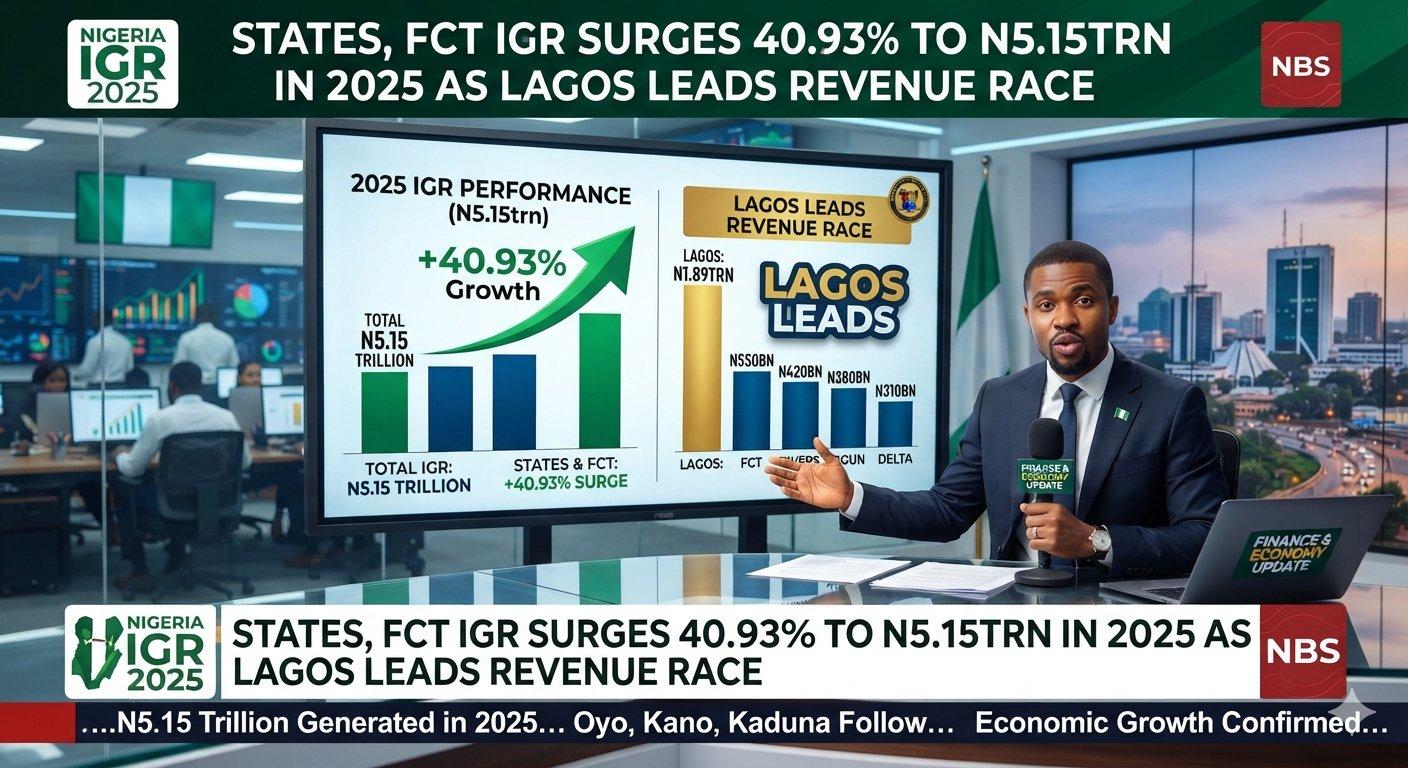
Nigeria’s 36 states and the Federal Capital Territory (FCT) generated a combined N5.15 trillion in Internally Generated Revenue (IGR) in 2025, representing a 40.93 per cent increase over the N3.65 trillion recorded in 2024.
The latest figures released by the National Bureau of Statistics (NBS) highlight a substantial expansion in the revenue generated internally by sub-national governments, although the data also reveal significant differences in the composition of revenue across the states.
The increase means that states and the FCT collectively added about N1.50 trillion to their internally generated revenue within one year, reflecting stronger revenue mobilisation across several jurisdictions.
The performance also reinforces the growing importance of internally generated revenue as state governments seek to finance infrastructure, public services, salaries and development programmes while reducing excessive dependence on statutory allocations from the Federation Account.
Lagos Remains The Dominant IGR Generator
Lagos State retained its position as the country's leading sub-national revenue generator, recording N1.77 trillion in IGR during the year.
The state's performance was driven principally by tax revenue, which contributed N1.48 trillion, while Ministries, Departments and Agencies (MDAs) generated an additional N292.64 billion.
Lagos' figure alone represents a substantial share of the combined IGR generated by all 36 states and the FCT, underscoring the scale of economic activity and the state's extensive tax base.
The state's large population, concentration of businesses, financial institutions, formal-sector employment and commercial activities provide a broad base for taxation and other internally generated revenues.
The gap between Lagos and the other states was particularly significant, with the state generating more than four times the revenue recorded by Rivers State, the second-highest generator.
Rivers, Enugu Record Strong Performances
Rivers State ranked second, generating N428.42 billion in IGR in 2025.
Unlike some states where MDA receipts constitute a substantial portion of internally generated revenue, Rivers' revenue was overwhelmingly tax-driven.
Tax revenue accounted for N414.38 billion, while MDAs contributed approximately N14.03 billion.
The figures place Rivers among the states with the strongest internally generated tax capacity, reflecting the importance of its commercial activities and economic base.
Enugu State followed with N406.77 billion, but its revenue structure was markedly different from that of Rivers.
Of Enugu's total IGR, N355.25 billion came from MDAs, while tax revenue contributed N51.52 billion.
The contrast between Rivers and Enugu illustrates an important feature of the NBS data: states can arrive at relatively high IGR totals through significantly different revenue channels.
While Rivers' performance was largely tax-based, Enugu's figure was dominated by revenue attributed to government ministries, departments and agencies.
FCT Records N356.34 Billion
The Federal Capital Territory generated N356.34 billion during the year, according to the NBS report.
The entire amount was attributed to tax revenue in the reported figures.
The FCT's performance places it among the highest internally generated revenue jurisdictions in the country, coming ahead of most of the 36 states.
Its position is partly reflective of its role as the nation's administrative and political centre, as well as the concentration of businesses, institutions, professionals and formal-sector workers within the territory.
The FCT's inclusion alongside the states provides a broader picture of internally generated revenue at the sub-national level.
Ogun Crosses N250 Billion Mark
Ogun State recorded N252.36 billion in IGR in 2025, making it another major contributor to the national sub-national revenue total.
Interestingly, the state's MDA revenue of N141.06 billion exceeded its tax revenue of N111.29 billion.
Ogun's revenue performance is significant given its growing industrial and commercial base and its proximity to Lagos.
The state has increasingly become an important industrial corridor, with manufacturing, logistics, real estate and other economic activities contributing to its revenue base.
Its revenue composition, however, shows that internally generated revenue does not necessarily come predominantly from taxation in every state.
PAYE Dominates National Tax Collection
At the national level, Pay-As-You-Earn (PAYE) remained the dominant source of state-level tax revenue in 2025.
According to the NBS, PAYE generated N2.64 trillion, representing 69.51 per cent of total tax revenue recorded during the year.
The dominance of PAYE underscores the importance of formal employment in the revenue structure of sub-national governments.
It also suggests that states with larger formal-sector employment bases and concentrations of salaried workers have significant advantages in generating recurring tax revenue.
Other sources of tax revenue included direct assessment, road taxes, stamp duties, withholding taxes and capital gains tax.
Capital gains tax contributed N12.40 billion, making it the smallest among the reported tax revenue sources.
Wide Revenue Gap Among States
Despite the overall increase in IGR, the figures show that revenue-generating capacity remains highly uneven across Nigeria's states.
While Lagos generated N1.77 trillion, several states recorded annual IGR of less than N50 billion.
Niger State generated N66.37 billion, of which about N60.3 billion came from tax revenue.
Ekiti recorded N57.09 billion, comprising N27.79 billion in tax revenue and N29.29 billion from MDAs.
Gombe generated N43.96 billion, while Nasarawa recorded N32.57 billion.
Taraba generated N28.16 billion, while Sokoto and Yobe recorded N20.48 billion and N16.01 billion, respectively.
The wide differences suggest varying levels of economic activity, formal-sector employment, taxable income, administrative capacity and revenue mobilisation across the federation.
Rising IGR and The Fiscal Pressure On States
The 40.93 per cent increase in aggregate IGR comes at a time when state governments face growing demands for infrastructure and public services.
Improving internally generated revenue can provide states with greater fiscal space and reduce the extent to which their budgets depend on transfers from the Federation Account.
However, a rise in IGR does not automatically translate into improved fiscal sustainability.
The quality and composition of the revenue are also important. Revenue generated through a broad and sustainable tax base is structurally different from one-off receipts or income associated with specific government agencies and transactions.
The differences in the revenue profiles of Lagos, Rivers, Enugu and Ogun illustrate this distinction.
Lagos and Rivers recorded substantial tax-driven revenues, while Enugu and Ogun had significant contributions from MDAs.
Tax Administration Becomes Increasingly Important
The dominance of PAYE also points to the importance of improving tax administration rather than relying solely on increases in tax rates.
For states, expanding the formal tax base, improving taxpayer identification, reducing leakages and making collection systems more efficient could potentially strengthen internally generated revenue.
At the same time, excessive taxation can create concerns for businesses and households, particularly where taxpayers face multiple levies imposed by different government authorities.
The challenge for state governments is therefore to increase revenue without undermining economic activity.
Revenue Mobilisation And State Development
The latest NBS figures provide evidence of stronger revenue mobilisation by Nigeria's sub-national governments, but they also underline the structural differences among states.
The concentration of IGR in a handful of jurisdictions remains pronounced, with Lagos standing far ahead of other states.
For many lower-revenue states, the figures point to the continuing challenge of expanding their economic bases and improving revenue collection systems.
Greater economic activity, more formal employment and stronger administrative capacity could potentially broaden the pool of taxable economic activity.
Ultimately, the significance of the N5.15 trillion figure will depend not only on how much revenue states generate, but also on how effectively the funds are deployed.
The increase in IGR gives state governments additional resources, but the impact on citizens will depend on whether the additional revenue translates into better infrastructure, healthcare, education, security, social services and other public goods.
The 2025 figures therefore present two sides of Nigeria's sub-national fiscal picture: a substantial improvement in internally generated revenue on one hand, and a continuing disparity in the revenue-generating capacity of individual states on the other.