PublicSphere Live
Politics
Uzodimma Urges South East Leaders to Negotiate Interests with FG
South East stakeholders demand restructuring, regional seaport, rail and gas infrastructure
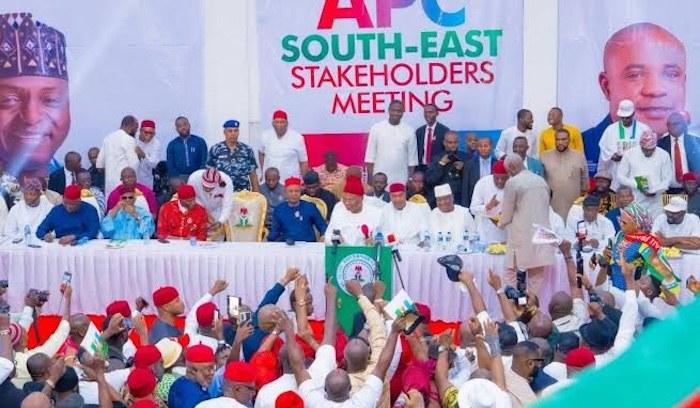
Imo State Governor, Hope Uzodimma, has urged political, traditional, religious and business leaders in the South East to unite, rethink their political strategies and negotiate the region’s interests directly with the Federal Government, rather than continually lamenting marginalisation.
Uzodimma made the call at the South East Stakeholders’ Convergence (SESC), held at the Banquet Hall of Government House, Owerri, where prominent Igbo leaders gathered to discuss regional unity, infrastructure development, political engagement and economic integration.
The meeting, convened by Rear Admiral Ebitu Ukiwe (rtd), Senator Ike Nwachukwu (rtd), Admiral Alison Madueke (rtd), Chief Ozichukwu Chukwu, Chief Gary Igariwey and Professor Uche Azikiwe, produced a nine-point communiqué outlining priorities for the region.
The governor, who hosted the gathering, said the South East must move beyond internal divisions and adopt strategic political engagement to secure its place in Nigeria’s affairs.
“Unite, rethink your political strategies and collectively negotiate the interests of the Southeast with the Federal Government,” he urged.
According to Uzodimma, the first priority should be for regional leaders to establish a common position and engage the Federal Government in negotiations over the region’s development and political interests.
“The first thing this meeting must agree on is how to sit down with the man in power and negotiate our interest,” he said.
He emphasised that political influence could only be achieved through constructive engagement, unity and a clear understanding of collective priorities.
The governor cautioned Igbo leaders against allowing personal ambitions and partisan differences to undermine the broader interests of the region, insisting that the South East must remain actively involved in Nigeria’s political process.
He also called for stronger cooperation among South East governors and other stakeholders, urging them to support the South East Development Commission in its efforts to accelerate regional development.
Uzodimma advocated closer collaboration between government and the private sector to promote investment, industrialisation, infrastructure development and economic prosperity.
Recalling the sacrifices made by Nigeria’s founding fathers, including the late Dr. Nnamdi Azikiwe, he urged contemporary Igbo leaders to preserve their legacy through active participation in the country’s political and socioeconomic development.
He also encouraged people of the South East to distinguish themselves in their respective fields, whether in the public or private sectors.
Stakeholders Demand Six-Geopolitical-Zone Restructuring
The stakeholders, in their communiqué, called for the restructuring of Nigeria into six geopolitical zones, in line with recommendations of the 2014 National Conference.
They also demanded Federal Government approval for the establishment of a privately funded seaport in the South East, describing improved maritime infrastructure as critical to unlocking the region’s economic potential.
The forum further resolved that support for presidential candidates should be tied to firm commitments to the development of railway and gas infrastructure in the region.
The stakeholders called for a unified regional voice and urged South East governors to end public disagreements and work together in advancing the interests of their people.
They also demanded a meeting with the President to discuss the region’s priorities and resolved to establish a permanent secretariat to monitor implementation of the communiqué.
The forum declared that the South East would no longer accept a subordinate position in Nigeria’s political and economic affairs, insisting that its development aspirations must receive appropriate attention.
Nwachukwu Calls For Unity Beyond Party Lines
Former military governor of old Imo State and chairman of the convergence, Senator Ike Nwachukwu, called on South East leaders to rise above partisan differences and unite in pursuing the region’s political and economic interests.
Nwachukwu said insecurity, economic hardship, political fragmentation and mutual distrust had tested the unity of the South East, making collective action imperative.
He advocated regional economic integration, improved infrastructure, industrial development and youth empowerment, stressing that South East governors must cooperate and avoid public disagreements.
The former military governor also called for the establishment of seaports in the region, improved rail and gas infrastructure, and restructuring based on the recommendations of the 2014 National Conference.
Recalling the collective effort that led to the construction of the former Imo Airport, now Sam Mbakwe International Cargo Airport, Nwachukwu said the region could achieve similar infrastructure projects through unity and determination.
“We are Ndigbo. We are South Easterners. We must move forward with one agenda, one voice and one commitment,” he declared.
He urged political leaders to prioritise regional development over party affiliations, saying the future of the South East depended on a shared commitment to progress.
Nwobodo, Anyim Advocate Strategic Engagement
Former governor of old Anambra State, Senator Jim Nwobodo, also called for unity among Igbo leaders across political parties.
Nwobodo advocated regular meetings among stakeholders, to be rotated across the South East states, to strengthen consultations and ensure inclusive participation in decisions affecting the region.
He commended Uzodimma for supporting the initiative and expressed optimism that collective efforts would produce positive results for the Igbo people.
Former Senate President Anyim Pius Anyim urged leaders to strengthen consultations and adopt strategic approaches to addressing the region’s challenges.
Anyim emphasised the importance of political calculation and constructive engagement, advising leaders to understand when to speak forcefully and when restraint would serve their interests better.
“We should know when to shout and when to keep silent,” he said.
He urged the stakeholders to identify common interests and agree on a collective path forward.
Call For Kanu’s Release, Women’s Inclusion
Former chairman of Ohanaeze Ndigbo, Chief Ozichukwu Chukwu, advocated regional economic integration, improved security, youth empowerment and strategic political engagement.
He also called for the release of detained Indigenous People of Biafra (IPOB) leader, Nnamdi Kanu, describing him as a “prisoner of conscience.”
Chukwu insisted that the South East should approach negotiations with the Federal Government from a position of unity and confidence.
“We are not beggars. We are asking for our rights,” he declared.
Other participants, including Dame Josephine Anenih and Professor Osita Ogbu, stressed that unity of purpose among Igbo leaders remained essential to addressing the region’s challenges.
Anenih called for greater inclusion of women in plans and decisions aimed at improving the fortunes of the South East.
Former Peoples Democratic Party presidential aspirant and entrepreneur, Mazi Sam Ohuabunwa, urged the stakeholders to develop a measurable implementation plan to ensure that the resolutions translated into tangible results.
Benjamin Kalu Moves Adoption Of Communiqué
The nine-point communiqué was read by former Imo State governor, Chief Ikedi Ohakim, and adopted by participants after a motion moved by Deputy Speaker of the House of Representatives, Benjamin Kalu.
Kalu thanked the organisers and Uzodimma for supporting the convergence, reiterating the importance of unity among Igbo people.
He said leaders of the region must leave behind a legacy worthy of emulation by younger generations.
According to him, unity of purpose should be among the most important values that younger Igbo leaders inherit from their predecessors.
The convergence brought together prominent political leaders, former public office holders, traditional and religious leaders, business executives and professionals, reflecting growing calls for a coordinated approach to the political and economic challenges facing the South East.
The participants expressed hope that the meeting would mark a renewed commitment to regional cooperation, strategic engagement with the Federal Government and the pursuit of development priorities capable of improving the lives of people across the five South East states