PublicSphere Live
Politics
Hamzat Unveils 100-Point Development Agenda, Pledges Accountable Leadership as Sanwo-Olu Calls for Continuity in Lagos
APC Governorship Candidate Promises 4,000 Buses, Expanded Rail Network, Affordable Housing, Stronger Security and Infrastructure Renewal
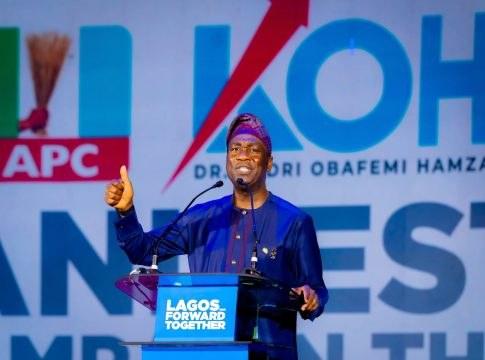
Dr. Kadri Obafemi Hamzat, the All Progressives Congress (APC) governorship candidate in Lagos State, has unveiled an ambitious 100-point development agenda, promising to build on the achievements of successive administrations while addressing the mounting developmental challenges confronting Africa's most populous city.
Hamzat, who currently serves as deputy governor of Lagos State, presented his manifesto on Friday at the Wole Soyinka Centre for Culture and Creative Arts, formerly the National Theatre, Iganmu, Lagos, where he outlined an extensive programme covering transportation, housing, security, infrastructure, environmental sustainability, water resources and youth empowerment.
The APC candidate declared that his proposed administration would be defined not by political promises or campaign rhetoric but by measurable achievements against which residents could assess its performance.
In what appeared to be an invitation to voters to take ownership of the proposed development agenda, Hamzat urged Lagos residents to scrutinise the manifesto, identify commitments relevant to their families and communities, document them and demand explanations from his administration if elected.
"Take the promise, read it, question it. Find the commitment that matters most to you, to your family, your street, your community. Write it down," he told the audience.
He further challenged residents to return to him with their records of the promises, insisting that public accountability must remain central to the relationship between government and citizens.
"Then, bring it back to me. Show me what I delivered. Show me what is left to do. Hold me accountable for both. That is my promise," he declared.
The candidate said his ambition was to build a Lagos that works for all its residents, irrespective of their social and economic circumstances, with development policies designed to improve living conditions, expand opportunities and strengthen the state's position as Nigeria's commercial and economic nerve centre.
His manifesto comes against the background of the enormous pressures associated with Lagos' rapidly expanding population, urban congestion, housing shortages, transportation difficulties, environmental challenges and the increasing demand for public infrastructure.
For a state whose economic importance extends beyond Nigeria's borders, Hamzat's proposed development programme places considerable emphasis on the need to improve the efficiency of urban transportation, expand infrastructure and create a more inclusive environment for residents and businesses.
Transportation: 4,000 Buses And Expanded Rail Network
Transportation occupies a prominent position in Hamzat's 100-point agenda, reflecting the importance of mobility to the economic productivity and everyday experiences of millions of Lagos residents.
The APC candidate promised to expand the state's public bus fleet from its current 1,000 to more than 4,000, with the objective of transporting approximately one million passengers daily.
The proposal represents a significant expansion of the existing public transportation system and is intended to improve access to affordable mass transit while reducing the pressure on private vehicles and informal commercial transport operators.
He also promised to expand the state's railway infrastructure, particularly through the extension of the Blue Line to Ojo and the establishment of an interchange connecting the Blue and Red rail lines at the National Theatre station.
According to him, the Blue Line, upon reaching Trade Fair station early next year, is projected to transport 250,000 passengers daily.
The proposed extension to Ojo is expected to bring rail transportation closer to communities that have historically experienced significant commuting difficulties.
Hamzat also pledged to advance the proposed Green Line, which is designed to connect Marina with the Lekki Free Zone, in collaboration with the Federal Government.
The Green Line is particularly significant to Lagos' long-term economic development because of the concentration of commercial, industrial, residential and investment activities along the Lekki corridor.
With the Lekki Free Zone and surrounding industrial developments expected to attract increasing economic activities, an efficient mass transportation system could become an important component of the state's future economic competitiveness.
However, the success of these proposals will depend on funding arrangements, intergovernmental cooperation, timely project execution and the ability to integrate different transportation systems into a functional network.
Hamzat said his administration would pursue an integrated transportation arrangement involving road, rail and waterways, supported by unified ticketing systems and coordinated timetables.
The intention, he explained, was to eliminate the difficulties associated with moving between different transportation services and provide commuters with a more convenient and predictable travel experience.
Water Transportation: Lagos Seeks To Exploit Its Natural Advantage
In a state surrounded by lagoons, creeks and other navigable waterways, Hamzat believes that water transportation has considerable potential to reduce pressure on the road network.
Describing Lagos as a water state, he argued that the lagoon should become the state's third major transportation corridor, complementing road and rail transportation.
His administration, if elected, would dredge an additional 140 kilometres of waterways, optimise 15 ferry routes, rehabilitate 27 of the existing 47 ferry terminals and procure 75 electric ferry boats.
The proposal suggests an intention to reposition water transportation from a relatively underutilised alternative into a more substantial component of the state's public transportation infrastructure.
The acquisition of electric ferry boats also introduces an environmental dimension to the proposal, particularly as cities worldwide increasingly explore cleaner transportation technologies to reduce emissions and pollution.
Nevertheless, the expansion of water transportation will require sustained attention to passenger safety, terminal accessibility, navigation infrastructure, maintenance and affordable fares.
For communities located around the state's extensive waterways, improved ferry services could provide an alternative to prolonged road journeys and create additional economic opportunities.
Road Infrastructure And The Fourth Mainland Bridge
Beyond rail and water transportation, Hamzat promised an aggressive programme of road rehabilitation, particularly within residential communities where deteriorating inner roads frequently affect mobility and commercial activities.
He said his administration would work with local governments, local council development areas and the Lagos State Public Works Corporation to rehabilitate roads across the state.
The approach is intended to decentralise infrastructure development and ensure that attention is not concentrated exclusively on major highways and prominent urban corridors.
He also promised to reconstruct strategic traffic-bearing roads, activate the Fourth Mainland Bridge through partnerships and accelerate the development of the regional road along the Lake Yembe axis.
Another major infrastructure proposal is the commencement of the second phase of the Ogbebe-Mindene Link Bridge, which is expected to connect with the Third Axial Road.
The Fourth Mainland Bridge remains one of the major infrastructure projects associated with Lagos' long-term transportation planning.
Its proposed development is expected to provide another major crossing across the Lagos Lagoon, potentially improving connectivity between different parts of the state and creating alternative routes for commuters.
However, the project's financing, environmental implications, construction timetable and eventual accessibility will remain important considerations.
For Hamzat, the broader objective is to ensure that infrastructure development keeps pace with the expansion of residential settlements, commercial activities and industrial investments across the state.
Affordable Housing And The Dream Of Home Ownership
On housing, Hamzat promised to introduce a mortgage arrangement designed to make home ownership more accessible to ordinary residents.
Under the proposed arrangement, prospective homeowners would be required to provide an initial deposit of 10 per cent, with lower interest rates and longer repayment periods.
The proposal seeks to address one of Lagos' most persistent socioeconomic challenges: the difficulty faced by middle-income and low-income earners in acquiring decent residential accommodation.
With property prices and rents remaining significant concerns for many households, access to affordable housing finance could become an important instrument for improving living conditions.
A mortgage system with a reduced initial deposit could help households that have regular incomes but lack the substantial upfront capital traditionally required to acquire property.
However, the practical implementation of the proposal will depend on the availability of long-term financing, the participation of mortgage institutions, land administration reforms and the sustainability of the proposed interest-rate arrangements.
The administration would also need to ensure that affordable housing developments are located in areas with adequate transportation, schools, healthcare facilities, water supply and other essential infrastructure.
Security: Neighbourhood Safety And Intelligence Centre
Security is another major component of the manifesto.
Hamzat promised to strengthen the Lagos State Neighbourhood Safety Agency and extend its operations to every ward across the state's 20 local government areas and 37 local council development areas.
The proposal is intended to deepen community-based security arrangements and improve the state's capacity to identify and respond to threats at the grassroots.
He also proposed establishing a state intelligence centre to strengthen the fight against cybercrime, financial crimes and organised criminal activities.
The initiative reflects the changing character of security threats confronting major urban centres, where conventional criminal activities increasingly intersect with technology-enabled offences and sophisticated criminal networks.
For Lagos, a commercial centre attracting people and businesses from different parts of Nigeria and beyond, strengthening intelligence gathering and community-level security could have significant implications for public confidence and economic activities.
Nevertheless, the effectiveness of such an arrangement would depend on proper coordination with federal security agencies, adequate training, respect for citizens' rights and effective intelligence-sharing mechanisms.
Sanwo-Olu Champions Continuity, Says Lagos Must Not Experiment
Earlier, Governor Babajide Sanwo-Olu, who attended the manifesto presentation as Special Guest of Honour, called on Lagos residents to sustain the APC-led administration in the state, arguing that the numerous development projects underway required continuity.
Sanwo-Olu described Hamzat, his deputy for seven years, as an experienced public administrator who had participated in the governance and development of Lagos for more than two decades.
He recalled that Hamzat had served as a commissioner under former governors Bola Ahmed Tinubu and Babatunde Fashola before becoming deputy governor in 2019.
According to the governor, Hamzat's experience across successive administrations had given him considerable exposure to the state's development priorities, institutional structures and policy-making processes.
Sanwo-Olu also recalled that Hamzat had stepped down from the 2018 governorship contest following the intervention of APC leaders and subsequently agreed to serve as his running mate.
He described that decision as evidence of his deputy's loyalty to the party and commitment to the development of Lagos.
The governor credited Hamzat with playing significant roles in major projects and policy decisions, including the development of the Blue and Red rail lines and the Lekki Deep Sea Port.
Using the analogy of a relay race, Sanwo-Olu argued that governance should be understood as a continuous process in which successive administrations build on the foundations established by their predecessors rather than abandon existing programmes and begin afresh.
He identified the Fourth Mainland Bridge, the proposed Lekki-Epe International Airport, the Omu Creek project, food hubs and logistics parks among the initiatives requiring continuity beyond his administration.
"This is not the time to experiment with Lagos. This is the time to consolidate," he said.
The governor, who disclosed that he had seven months left in office, described a peaceful transfer of power to his deputy as one of the most significant legacies of his administration.
He urged Hamzat to maintain public engagement, ensure the completion of ongoing projects and preserve the institutional framework that had supported successive administrations.
GAC Calls For Continuity And Correction Of Development Gaps
Also speaking at the event, former Lagos Deputy Governor and representative of the Governance Advisory Council (GAC), Princess Sarah Adebisi Sosan, emphasised the importance of continuity while acknowledging the need to respond to emerging developmental challenges.
She observed that Lagos' progress under successive administrations had been the product of deliberate planning, sacrifice and purposeful leadership.
According to her, the next administration should preserve policies and programmes that had delivered results while addressing identified shortcomings and introducing improvements where necessary.
Sosan noted that Lagos' expanding population, growing business activities and rising public expectations required strategic planning and experienced leadership.
She identified transportation, road infrastructure, education, affordable healthcare, security, employment, housing and environmental sanitation as areas requiring sustained government attention.
Her remarks reflected the position that continuity should not necessarily mean an absence of policy innovation but rather the preservation of functional institutions and programmes alongside adjustments required by changing circumstances.
Obanikoro Promises Peaceful And Issue-Based Campaign
Meanwhile, Director-General of the PBAT-KOH Campaign Council, Senator Musiliu Obanikoro, pledged that the campaign would be peaceful, disciplined and centred on issues rather than personalities.
He said the campaign organisation would communicate Hamzat's experience, qualifications and policy proposals to residents rather than engage in unnecessary political attacks.
Obanikoro disclosed that the campaign would take its message to every local government, ward and community across Lagos State.
He also emphasised the need for unity among APC leaders, members and supporters, describing cohesion as important to the successful presentation of the party's development agenda.
According to him, the campaign's guiding principles, "Forward and Together", represent a commitment to sustaining development while ensuring that every resident, irrespective of religion, ethnicity, occupation or social status, has a stake in Lagos' progress.
He said the next administration must consolidate existing achievements, address developmental gaps and create additional opportunities for residents.
The Test Ahead: From Manifesto To Measurable Performance
Beyond the elaborate promises and political assurances presented at the manifesto unveiling, the central issue confronting Hamzat's proposed administration will be the translation of its 100-point agenda into tangible improvements in the lives of Lagos residents.
The manifesto covers several sectors that directly influence the economic and social wellbeing of the population. Its transportation proposals, for instance, will be judged not simply by the number of buses purchased or kilometres of railway constructed but by whether commuters spend less time travelling, enjoy safer journeys and have access to affordable transportation.
Similarly, the housing proposal will ultimately be measured by the number of households that can actually access mortgages and acquire homes under the proposed arrangement.
The security agenda will require demonstrable improvements in neighbourhood safety, intelligence coordination and the protection of lives and property.
Road rehabilitation, environmental management, potable water supply, education, healthcare and employment opportunities will also constitute important indicators of the administration's performance.
Hamzat's invitation to residents to document his promises and demand explanations is therefore a significant feature of his manifesto presentation. It places public accountability at the centre of the relationship he hopes to establish with the electorate.
His declaration that a promise is a loan, which he has lifted onto his head before the people, offered a personal dimension to his political commitment.
Recalling his father's advice on public service, he said leadership was fundamentally about serving the people.
"A promise is a loan. I have lifted it onto my head before you. I'm asking you to watch me carry it," he said.
He added: "Lagos has given me a lifetime of work. Today, I give Lagos my promise."
For a state whose development challenges are as complex as its economic opportunities, the unveiling of a 100-point agenda represents the presentation of a proposed governance framework. Its eventual significance, however, will depend on the capacity to convert its numerous commitments into funded programmes, completed projects and measurable improvements in public welfare.
As the political process advances towards the governorship election, the manifesto is likely to provide an important basis for examining the APC candidate's vision, the record of the outgoing administration and the competing development proposals that may emerge from other political parties.
Ultimately, the people of Lagos will have to assess not only the promises made but also the mechanisms proposed for financing, implementing and monitoring them.
For Hamzat, the challenge is to demonstrate that the extensive experience he says he brings to the office can translate into an administration whose achievements are visible in the daily lives of residents.
And for Lagos, the larger question remains whether the next phase of governance can deliver a city that is more accessible, secure, affordable, environmentally sustainable and economically inclusive.