PublicSphere Live
Capital Market
NGX: Equities Market Faces Mixed Sentiment as 31 Stocks Decline, Turnover Falls 4%
Higher trading activity fails to translate into stronger turnover as investors reposition across banking, insurance, industrial and consumer stocks
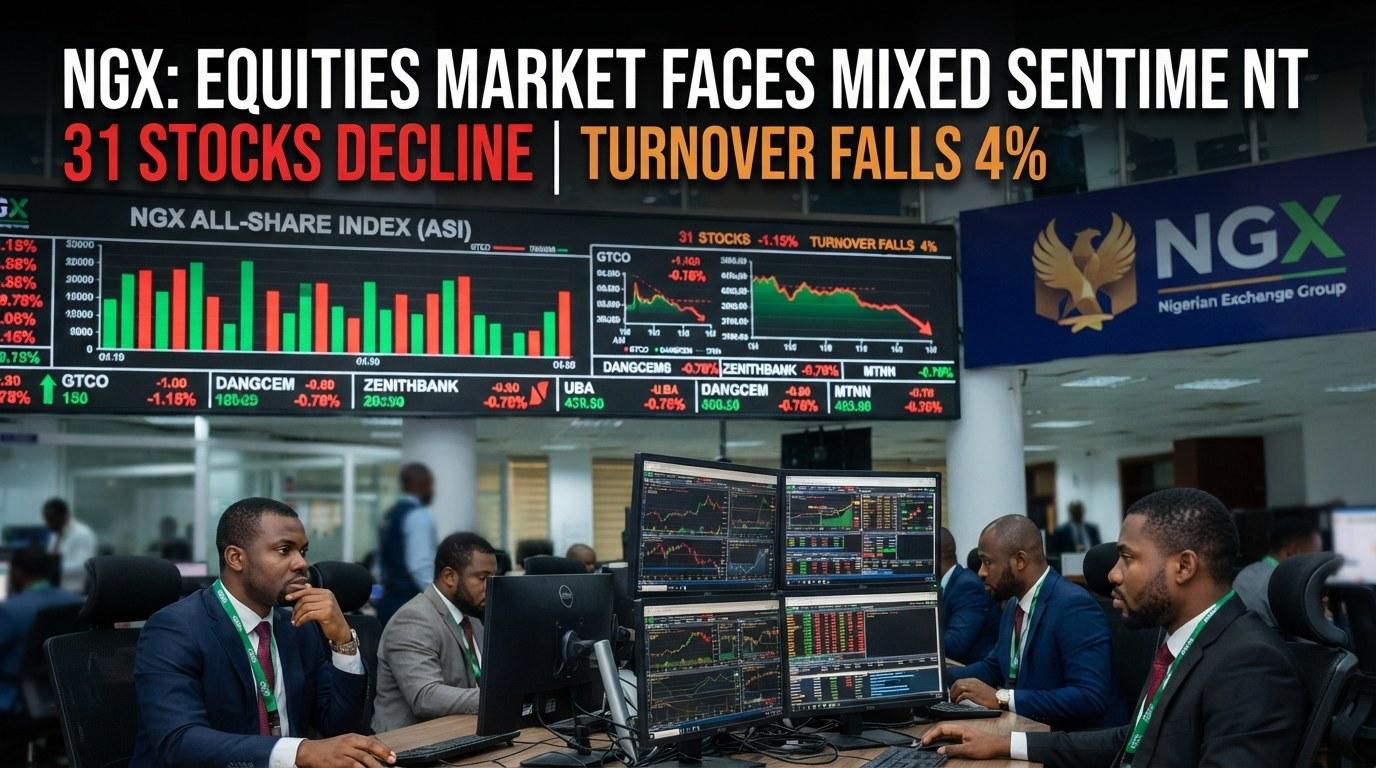
Nigeria’s equities market opened the new trading week on Monday, October 12, 2026, with a mixed performance characterised by increased trading activity, weaker transaction value and a broader balance of losses over gains, reflecting a market in which investors continued to exchange substantial volumes of shares without a corresponding increase in the total value of transactions.
Data from the Nigerian Exchange (NGX) showed that investors traded 402.39 million shares in 52,619 deals, valued at approximately ₦19.57 billion, as 134 listed equities participated in the session. The market recorded 26 gainers against 31 losers, indicating that declining stocks outnumbered advancing equities, although the relatively narrow gap between the two groups suggests that the session was not characterised by an overwhelming sell-off across the entire market.
The day's performance was particularly noteworthy because trading volume rose by 25 per cent from the preceding session on Friday, October 9, while the number of deals increased by 39 per cent. Yet, despite the stronger activity, market turnover declined by four per cent, indicating that the additional transactions did not generate a corresponding increase in the monetary value of shares traded.
The combination of rising volume, more deals and lower turnover provides an important insight into the market's immediate direction: investors were active, but their transactions, in aggregate, involved a lower monetary value than in the previous session. This could reflect changes in the mix of stocks traded, differences in average transaction sizes or more intensive activity in relatively lower-priced equities, rather than a straightforward increase in institutional demand for expensive blue-chip stocks.
With the NGX's reported market capitalisation standing at approximately ₦160.8 trillion, equivalent to $121 billion, Monday's session offered a useful indication of the balance between investor participation and price direction at the beginning of the trading week. However, the market capitalisation figure represents the overall value of listed equities, not the amount of money exchanged during the session, and should therefore be distinguished from the ₦19.57 billion daily turnover.
ASI and the direction of the broader market
The All-Share Index (ASI) remains the most important benchmark for assessing the overall direction of Nigerian equities because it reflects changes in the prices of listed ordinary shares. However, the trading summary supplied for Monday does not include the closing ASI, its point movement or percentage change, nor does it provide the closing values of the individual sectoral indices. It would therefore be misleading to assign an exact gain or loss to the benchmark or any sector for October 12 without the corresponding official closing data.
The latest confirmed benchmark available before Monday's session was the ASI's close at 248,363.55 points on Friday, October 9, following a 0.13 per cent recovery that ended a seven-session losing streak. The index had nevertheless declined by 0.97 per cent over the preceding week, leaving its year-to-date return at 59.60 per cent.
This recent performance provides an important backdrop to Monday's activity. Although Nigerian equities had delivered substantial gains earlier in 2026, the losses recorded over the previous two weeks suggested that investors were becoming more selective, with profit-taking and portfolio adjustments weighing on some of the market's leading stocks.
The distinction between short-term weakness and the market's cumulative annual performance is particularly important. A benchmark that has advanced considerably since January can experience periods of correction as investors realise profits, reassess valuations or redirect capital towards stocks with stronger earnings prospects. Such movements do not necessarily signal the end of an upward trend, but sustained declines accompanied by deteriorating market breadth would indicate that the correction is becoming more widespread.
Monday's balance of 31 declining stocks against 26 advancing stocks continued to show a modest negative bias. Nevertheless, the difference of only five stocks suggests that the market's weakness was not uniform, with selected equities attracting buying interest even as others faced selling pressure.
Sectoral Performance: Selective Buying Across Different Industries
Banking and financial services
The financial services sector remained central to Monday's trading activity, with Access Holdings, Zenith Bank and Jaiz Bank ranking among the four most actively traded equities by volume. Access Holdings led with 33.3 million shares, followed by Zenith Bank with 27.7 million and Jaiz Bank with 27.6 million, while Regency Alliance Insurance recorded 27.1 million shares.
Together, the four stocks accounted for approximately 115.7 million shares, representing about 28.8 per cent of total market volume. This concentration demonstrates the importance of financial services counters in the exchange's daily liquidity, although high trading volume alone does not establish whether investors were accumulating or disposing of shares.
The activity in Access Holdings and Zenith Bank is particularly significant because large banking stocks can influence overall market sentiment through their market capitalisation, liquidity and position in institutional portfolios. However, their trading volumes must not be confused with price performance: the supplied report does not state their closing price movements for Monday.
The latest available weekly sector figures showed that the NGX Banking Index fell by 2.64 per cent in the week ended October 9, declining from 2,685.71 to 2,614.79 points.
Against this background, Monday's high activity in banking stocks could represent renewed interest, portfolio rebalancing or continued trading amid uncertainty. The direction of the banking index and the closing prices of individual banks will be needed to determine whether the sector staged a recovery or extended its recent weakness.
Insurance stocks also featured prominently in trading volume through Regency Alliance Insurance. However, the contrasting performances of individual insurance equities suggest that the sector should not be treated as a single, uniform market. The available summary does not provide enough information to calculate the insurance index's daily return.
Consumer goods: Guinness attracts buyers
The consumer goods segment received support from Guinness Nigeria, which appreciated by 9.93 per cent, placing it among the day's strongest performers. Its closing price was not stated in the supplied report, but the percentage gain indicates substantial demand relative to the stock's previous closing price.
The performance is noteworthy against a background of pressure on household purchasing power, elevated operating costs and intense competition within Nigeria's consumer market. Investors in the sector generally weigh a company's capacity to sustain sales, manage input costs, protect margins and translate revenue growth into earnings.
A strong daily gain in Guinness Nigeria may reflect stock-specific demand or expectations concerning its business prospects. It does not, however, establish that the entire consumer goods sector advanced, since the report does not provide the performances of other constituents or the NGX Consumer Goods Index.
For the sector as a whole, investors will continue to look towards corporate earnings, pricing power, consumer demand and the cost of financing as key determinants of share-price direction.
Healthcare and pharmaceuticals
Neimeth International Pharmaceuticals gained 10 per cent, placing it among the session's leading advancers and providing evidence of buying interest in the healthcare segment.
Pharmaceutical companies operate within a market where exchange-rate movements, imported raw materials, energy costs, access to finance and consumers' ability to afford medicines can influence profitability. Investors must also consider production capacity, distribution networks and the extent to which companies can substitute local inputs for imported materials.
Neimeth's advance is a positive development for the stock itself, but it should not be interpreted as confirmation that the broader healthcare index rose. A sector-level conclusion would require the closing performances of other listed healthcare companies and the official index movement.
Real estate and investment trusts
UPDC Real Estate Investment Trust advanced by 10 per cent, making it another notable gainer in Monday's session. The performance suggests renewed demand for the listed investment vehicle, although the report does not establish the specific factors behind the price increase.
Real estate-related investments remain sensitive to interest rates, rental income, property valuations, occupancy levels and the cost of financing. The attractiveness of a real estate investment trust also depends on the sustainability of distributions to investors and the quality of its underlying assets.
UPDC REIT's performance therefore provides an encouraging stock-specific signal, but the absence of broader real estate index data prevents a definitive assessment of the sector's overall direction.
Oil and gas: Oando under pressure
Oando declined by 7.55 per cent, making it one of Monday's worst-performing equities. Its decline is significant given the oil and gas sector's substantial gains earlier in the year, but a single trading session cannot establish whether the sector's longer-term upward trend has reversed.
The latest weekly data showed that the NGX Oil and Gas Index lost 3.85 per cent in the week ended October 9, falling to 6,005.98 points. Despite that setback, the index remained up 124.92 per cent year-to-date at the time.
This divergence between strong cumulative gains and recent losses illustrates the potential for profit-taking in stocks that have appreciated considerably. Investors may be reassessing valuations, earnings expectations and company-specific risks, even where the broader industry retains favourable long-term prospects.
Oando's decline should therefore be assessed alongside its corporate disclosures, financial performance and subsequent price movements rather than treated as proof of a sector-wide downturn.
Industrial goods and other sectors
The supplied trading summary does not identify the day's leading industrial goods stocks or provide the sector's closing index. A definitive assessment of cement, construction materials and other industrial counters is consequently not possible.
For context, the NGX Industrial Goods Index was the only sectoral benchmark among those covered in the latest weekly review to finish the week ended October 9 in positive territory, edging up 0.02 per cent. The oil and gas, banking and commodity indices, by contrast, recorded weekly declines.
That previous performance suggests that industrial goods had displayed relative resilience, although Monday's actual sectoral movement would be required to establish whether that resilience continued.
Market Leaders and Laggards
Sterling Bank was reported as the session's leading gainer, with a stated appreciation of 887.01 per cent to ₦76 per share. That figure is exceptionally large and should be verified against the NGX's official daily price list and any relevant corporate-action or price-adjustment information before publication, since it could reflect a special price adjustment or a reporting anomaly.
Other leading gainers were UPDC REIT and Neimeth International Pharmaceuticals, both up 10 per cent, followed by Guinness Nigeria, which gained 9.93 per cent.
On the losing side, Sunu Assurances Nigeria fell 9.85 per cent to ₦2.93, followed by Critical Minerals Financing Corporation, down 9.78 per cent; Oando, which shed 7.55 per cent; and LivingTrust Mortgage Bank, down 6.25 per cent.
The coexistence of substantial advances and sharp declines reinforces the importance of stock selection in the current market environment. While selected equities continued to attract buyers, other stocks faced significant selling pressure, indicating that investors were not moving uniformly across the exchange.
Trading Activity and The Outlook
Monday's 402.39 million shares traded in 52,619 deals, with a value of ₦19.57 billion, point to an active opening to the trading week. The 25 per cent increase in volume and 39 per cent rise in deals suggest stronger participation, but the four per cent decline in turnover indicates that this activity did not translate into a higher aggregate transaction value.
This combination makes the direction of prices, rather than trading volume alone, especially important in evaluating market strength. An increase in volume can accompany accumulation or distribution, and only the relationship between price movements, trading flows and market breadth can help distinguish the two.
Investors will also be watching third-quarter corporate earnings, company announcements, interest-rate expectations and broader economic conditions as they assess valuations and decide whether to increase exposure to equities or lock in gains.
The market's year-to-date performance remains an important source of context, but recent weakness in the benchmark and several major sectoral indices underlines the need for greater selectivity.
The immediate outlook is therefore cautious, with room for stock-specific opportunities but insufficient evidence to declare a broad-based market recovery. Confirmation of the Monday closing ASI, the banking, insurance, consumer goods, industrial goods and oil and gas indices, as well as the performances of heavyweight stocks, would be necessary to establish whether the session marked a meaningful change in the market's recent direction.