PublicSphere Live
Capital Market
NGX ASI Falls 0.82% As Selling Pressure Hits Equities, Despite 66% Rise in Turnover
Banking stocks dominate trading activity as market capitalisation remains at ₦160.6 trillion, while investors weigh profit-taking against the market’s strong year-to-date gains
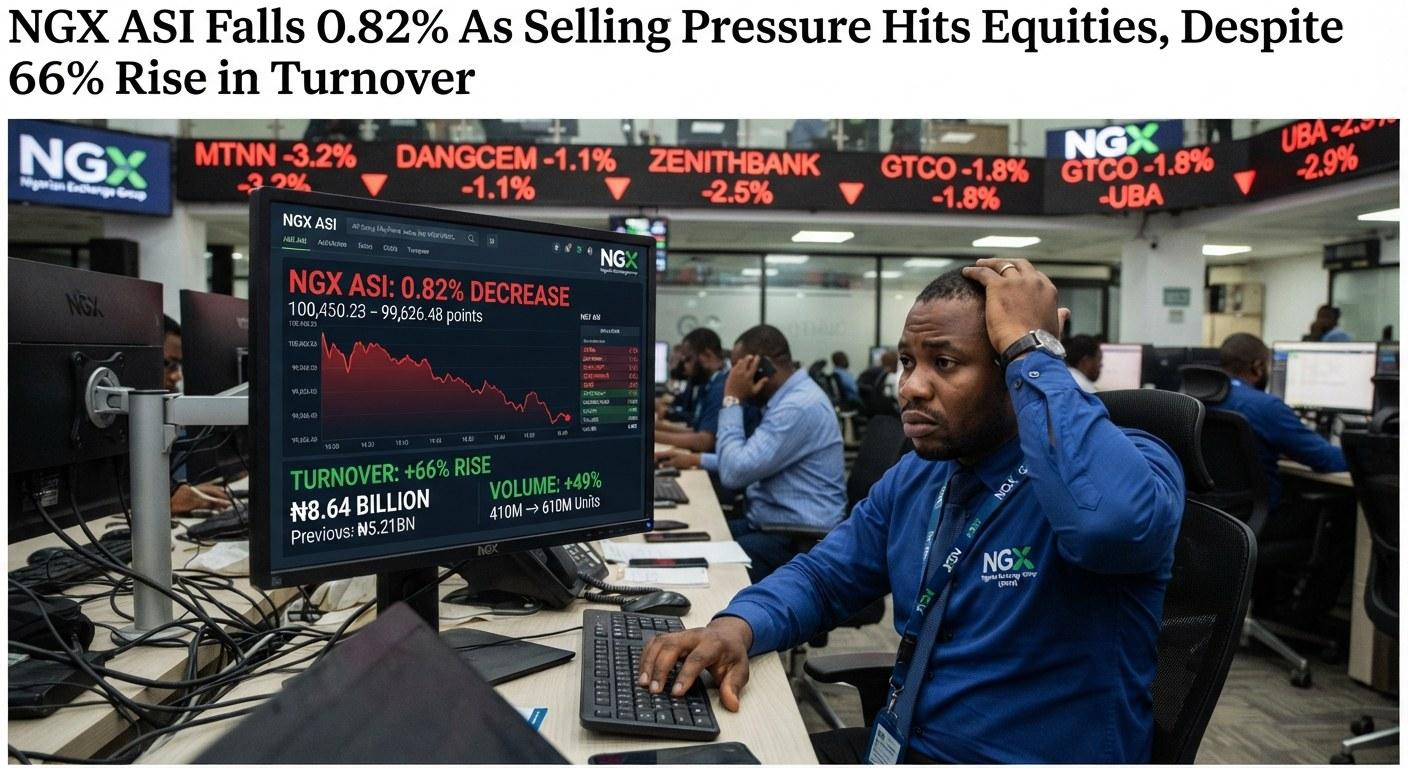
The Nigerian equities market extended its downward movement on Thursday, October 8, 2026, as the Nigerian Exchange Limited (NGX) All-Share Index (ASI) declined by 0.82 per cent, reflecting persistent selling pressure across several important segments of the market despite a substantial improvement in trading turnover and share volume.
The benchmark index shed 2,054.25 points to close at 248,042.50, bringing its year-to-date appreciation to 59.4 per cent, according to the trading figures supplied for the session. The decline also left the market with a one-week loss of 1.26 per cent, although its performance over four weeks remained positive at 2.4 per cent.
The session presented a mixed picture of market activity: investors exchanged more shares and committed considerably more money to transactions than they did on Wednesday, yet the number of equities that declined exceeded those that advanced, while the benchmark index and several major market indicators closed lower.
This divergence between higher turnover and a declining index is important in understanding the market's immediate direction. It suggests that the increased value of transactions did not translate into broad-based buying strength sufficient to overcome the influence of declining share prices, although turnover alone cannot establish whether investors were accumulating shares or distributing their holdings.
Thursday's performance therefore raises important questions about the sustainability of the market's rally, the behaviour of institutional and retail investors, the resilience of banking stocks, and the extent to which the market can preserve its substantial gains accumulated since the beginning of the year.
Higher Turnover Fails To Prevent Market Decline
Trading statistics showed that 492,137,063 shares changed hands in 38,644 deals, with a total transaction value of approximately ₦37.94 billion.
Compared with Wednesday's session, trading volume increased by 10 per cent, while turnover advanced by 66 per cent. The figures indicate that significantly more money passed through the market, even though the improvement in the number of shares traded was comparatively modest.
The disparity between volume growth and turnover growth suggests that the average value represented by the shares traded increased during the session. This may reflect greater activity in relatively expensive equities, larger institutional transactions, or changes in the composition of the securities traded. The available figures, however, do not identify which of these factors accounted for the increase.
The 66 per cent rise in turnover is particularly noteworthy because it indicates that Thursday's decline occurred amid an expansion in the monetary value of market transactions rather than a simple collapse in trading activity.
Nevertheless, higher turnover should not automatically be interpreted as evidence of renewed investor confidence. Every completed transaction has a buyer and a seller, and the direction of the market depends on the prices at which investors are willing to transact, the relative urgency of their orders, and the weight of the securities involved in the index.
The market's closing performance suggests that selling pressure remained strong enough to pull the ASI lower, despite the greater volume of funds changing hands.
Market capitalisation stood at ₦160.6 trillion, equivalent to approximately $121 billion in the supplied report. This valuation underscores the scale of the Nigerian equities market, but its daily movement must be considered alongside the index, individual stock performances and broader investor sentiment to establish whether the market is experiencing a temporary correction or a more sustained reversal.
ASI Retreats As Profit-Taking Gathers Momentum
The 0.82 per cent decline in the ASI was the most significant indicator of Thursday's trading session, as it demonstrated that the selling pressure extended beyond isolated losses in individual equities to affect the broader market benchmark.
The index closed at 248,042.50 points, compared with 250,096.75 points recorded on Wednesday, October 7, representing a loss of 2,054.25 points. The movement also placed the benchmark at its lowest level of the week, according to market reporting on the session.
One possible explanation is profit-taking after the substantial appreciation recorded by Nigerian equities over the preceding months. With the ASI still up 59.4 per cent year to date, investors sitting on considerable paper gains may have decided to sell some holdings and secure profits rather than remain fully exposed to the possibility of a correction.
Such behaviour is not unusual in a market that has experienced a strong rally. As valuations rise, some investors become more selective, reassessing whether current share prices adequately reflect companies' earnings prospects, dividend-paying capacity and future growth.
The four-week gain of 2.4 per cent indicates that Thursday's decline has not entirely erased the market's more recent advances. Nevertheless, the one-week loss of 1.26 per cent points to weakening short-term momentum and suggests that investors should be cautious about interpreting the year's cumulative appreciation as a guarantee of further immediate gains.
The distinction between short-term weakness and the longer-term trend is important. A market can experience a correction without entering a prolonged bearish phase, just as a strong year-to-date performance can coexist with substantial losses in individual stocks.
For investors, the immediate question is whether buyers will return at lower prices to support the index or whether continued selling will push the market towards another leg of correction.
Oil And Gas Leads Sectoral Losses
The oil and gas sector was the most conspicuous source of weakness in Thursday's trading, with the NGX Oil and Gas Index falling 3.87 per cent to 5,996.24 points from 6,237.88 points. The decline was associated with sharp losses in Aradel Holdings and Eterna, both of which recorded price depreciations of 10 per cent.
Aradel closed at ₦1,377 per share, making it the worst-performing stock in the supplied report, while Eterna also finished at its daily loss limit. The simultaneous decline of the two energy-related equities was significant because it illustrated how pressure on individual large or actively traded stocks can influence sectoral sentiment.
For Aradel, investors must distinguish between a fall in market price and a deterioration in the company's underlying business. A one-day decline does not, by itself, establish that the company's earnings prospects have weakened. Rather, it may reflect profit-taking, changing valuation expectations or a reassessment of the risks associated with the energy business.
The same caution applies to Eterna. Its price decline indicates pronounced selling pressure during the session, but a reliable assessment of its long-term investment prospects would require examining financial results, cash flows, debt exposure and operating conditions.
The wider significance of the oil and gas sector's performance lies in its sensitivity to developments affecting petroleum prices, domestic refining, foreign exchange, production costs and investor expectations about future earnings.
Although oil prices and energy-sector equities can sometimes move in different directions, investors may respond to company-specific developments and changes in expected profitability rather than the international crude price alone.
Thursday's figures therefore suggest that energy stocks were a major source of market weakness, even as some other sectors demonstrated greater resilience.
Banking Index Declines 0.18% Despite Heavy Trading
The NGX Banking Index declined by 0.18 per cent to 2,639.74 points, extending its one-week loss to 2.67 per cent. Despite the daily decline, the index retained a substantial year-to-date gain of 74.14 per cent.
The combination of a weekly decline and strong annual appreciation provides a useful indication of the pressure facing investors who have benefited from the sector's earlier rally. Banking stocks have attracted significant market attention, but the latest performance suggests that their upward movement has become less uniform.
Zenith Bank led the volume chart with 47.8 million shares traded, followed by Wema Bank with 43.6 million, Access Holdings with 42.9 million and FCMB Group with 32.7 million shares.
Together, these four institutions accounted for 167 million shares, representing approximately 34 per cent of the day's total reported volume. Their prominence demonstrates the importance of financial stocks in providing liquidity to the Nigerian equities market.
However, high trading volume should not be confused with positive share-price performance. A stock can record millions of transactions while declining in price, particularly when investors seeking to sell are more aggressive than buyers seeking to accumulate shares.
The banking sector's year-to-date appreciation of 74.14 per cent remains impressive, but the 2.67 per cent weekly loss suggests that investors are reassessing their positions in the short term.
Future performance will depend partly on banks' earnings growth, asset quality, capital strength, dividend prospects and their capacity to translate changes in the operating environment into sustainable shareholder returns.
Consumer Goods Provides A Rare Bright Spot
The NGX Consumer Goods Index advanced by 0.08 per cent, making it the only major sectoral index in the supplied report to record a positive daily return.
Although the increase was modest, it demonstrated that buying interest remained present in selected areas of the market despite the broader decline.
The index nevertheless recorded a one-week loss of 0.78 per cent, while its year-to-date gain stood at just 1.29 per cent. This contrasts sharply with the banking index's 74.14 per cent appreciation and the overall ASI's 59.4 per cent gain.
The difference raises questions about how investors have distributed their funds across industries during the year's rally. Consumer goods companies operate in a market shaped by household purchasing power, input costs, exchange-rate movements, distribution expenses and the ability to pass higher costs on to customers.
A small daily advance does not establish that these challenges have disappeared. Instead, it suggests that the sector experienced comparatively greater resilience during Thursday's session.
Investors assessing consumer goods equities should consider whether companies are increasing sales volumes, improving margins, managing working capital efficiently and maintaining competitive positions in a difficult consumer environment.
The sector's low year-to-date return relative to the broader market may also prompt investors to look for opportunities in stocks that have not participated as strongly in the rally. Nevertheless, subdued performance can reflect genuine business challenges, so price weakness alone is not sufficient grounds for assuming that a stock is undervalued.
Industrials Remain Virtually Flat As Insurance Slips
The NGX Industrial Index was essentially unchanged on Thursday, according to the supplied figures, although its year-to-date gain remained substantial at 83.92 per cent.
Its resilience contrasted with the weakness in oil and gas and the modest decline in banking stocks. However, the near-zero daily movement should not be interpreted as evidence that every industrial stock was stable; an index reflects the combined performance of its constituents, and gains in some equities can offset losses in others.
The industrial sector's year-to-date performance remains one of the strongest among the reported indices, potentially reflecting investor expectations surrounding manufacturing, infrastructure, cement, industrial materials and other productive activities represented on the exchange.
Whether that performance can be sustained will depend on company earnings, production costs, energy supply, demand conditions and the ability of businesses to convert revenue growth into improved profitability.
The NGX Insurance Index, meanwhile, declined by 0.44 per cent. Its one-week return was positive at 0.16 per cent, but its year-to-date performance remained negative at minus 8.45 per cent.
This divergence between the daily, weekly and annual returns underscores the uneven nature of the market. Insurance equities have not shared equally in the broad appreciation of Nigerian stocks, and Thursday's decline further illustrated their vulnerability to short-term selling.
Investors evaluating the sector should look beyond share-price movements to consider underwriting performance, investment income, claims management, capital adequacy and the impact of regulatory developments on business operations.
Top 30 And Main Board Index Reflect Broader Weakness
The NGX Top 30 Index declined by 0.86 per cent, slightly underperforming the ASI's 0.82 per cent fall. Its one-week loss stood at 1.26 per cent, while its year-to-date gain remained strong at 60.85 per cent.
The performance suggests that selling pressure was not confined to smaller or less frequently traded equities. The decline in the Top 30 indicates that important constituents among the exchange's leading companies also experienced weakness.
The NGX Main Board Index fell by 0.81 per cent, recording a one-week loss of 0.98 per cent and a year-to-date appreciation of 42.95 per cent.
Although both indices declined, their strong annual gains demonstrate that the broader market remains significantly above its beginning-of-year levels. The immediate challenge is whether investors will interpret lower prices as an opportunity to accumulate fundamentally sound stocks or remain on the sidelines until market direction becomes clearer.
Gainers, Losers and Investor Selectivity
The supplied report recorded 26 gainers and 32 losers among the 133 equities that participated in trading. The figures indicate a negative market breadth, with declining stocks outnumbering advancing stocks by six.
E-Tranzact International led the gainers, appreciating by 10 per cent to ₦12.10 per share. Livestock Feeds followed with a 9.09 per cent gain, while Guinea Insurance rose by 8.97 per cent and Learn Africa advanced by 8.93 per cent.
On the losing side, Aradel Holdings and Eterna each declined by 10 per cent, while Cutix fell by 9.02 per cent and Critical Minerals Financing Corporation dropped by 8.98 per cent.
The contrast between the gainers and losers suggests that the market was characterised by selective buying rather than a uniform withdrawal of investor interest. Some stocks attracted strong demand even as others suffered substantial losses.
However, the percentage changes must be considered alongside trading volumes, corporate fundamentals and liquidity. A large percentage gain in a relatively thinly traded stock may not have the same market-wide significance as a smaller decline in a heavily capitalised company.
Outlook: A Correction Within a Strong Year-To-Date Rally?
Thursday's session left the NGX with three important signals: the ASI declined significantly, turnover rose sharply, and the market's annual appreciation remained substantial.
Taken together, these indicators suggest a market experiencing a period of adjustment rather than one whose long-term direction can be determined from a single trading day.
The immediate outlook will depend on whether selling pressure moderates, whether leading stocks regain support and whether improved turnover begins to accompany rising prices rather than further declines.
Investors should also monitor the next set of corporate earnings, dividend announcements, monetary-policy developments, inflation, foreign-exchange conditions and yields on competing fixed-income instruments, all of which can influence the relative attractiveness of equities.
For the moment, caution is warranted, particularly in stocks that have recorded sharp advances or declines without corresponding changes in their underlying fundamentals. Investors with a longer horizon may find opportunities in attractively valued companies, but decisions should be based on earnings quality, balance-sheet strength, cash generation and realistic valuation expectations rather than the assumption that every market decline will quickly reverse.
The essential conclusion from Thursday's trading is that the NGX remains well ahead of its beginning-of-year position, but its impressive year-to-date performance has not insulated it from profit-taking and sector-specific weakness. The coming sessions will help determine whether the decline is a temporary pause in the rally or the beginning of a more sustained period of consolidation.