PublicSphere Live
Business
Dangote Foundation Targets 7m Students, Vulnerable Women for Refinery IPO Share Grants
Under the programme, the Foundation will match qualifying share subscriptions by eligible beneficiaries, enabling them to double their initial holdings without paying for the additional shares, subject to the approved application process and allocation.
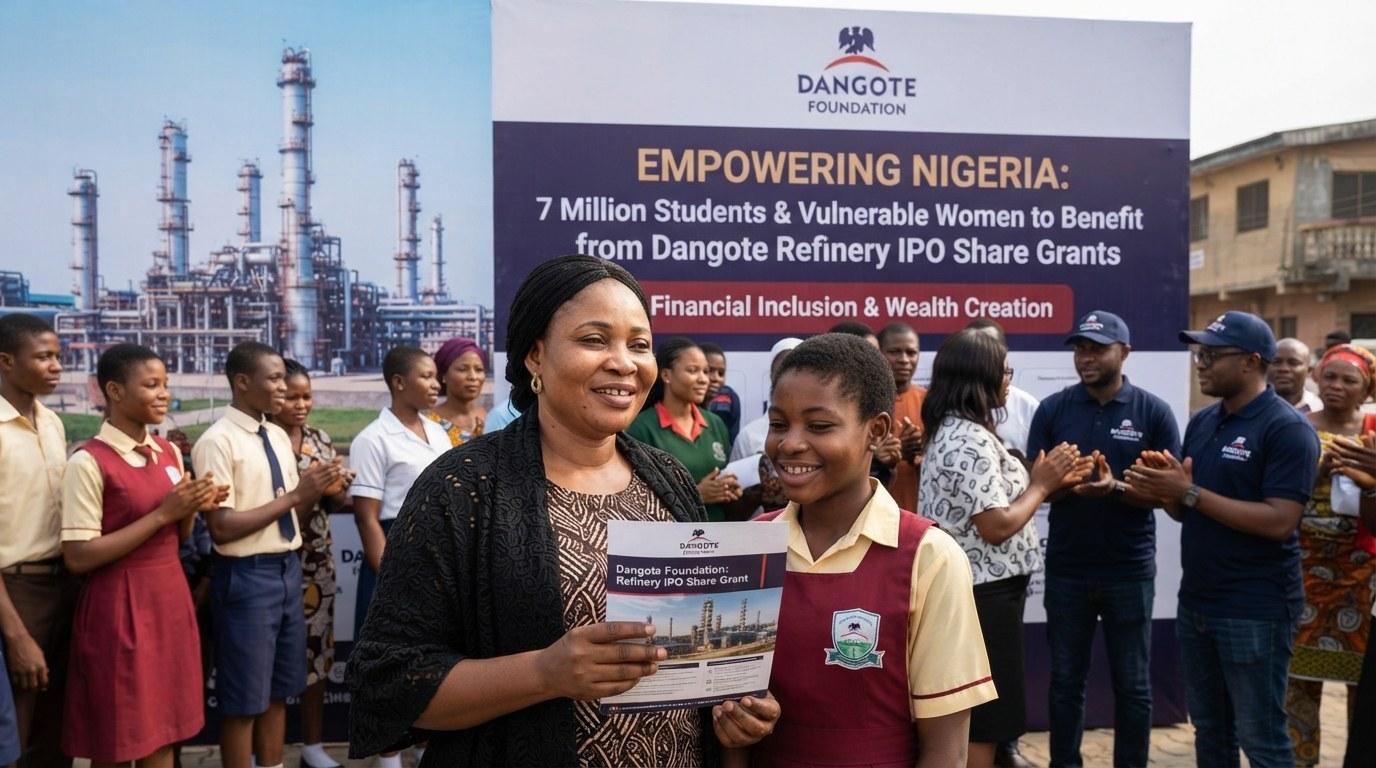
The Aliko Dangote Foundation (ADF) has unveiled a share grant initiative targeting five million tertiary students and two million vulnerable women, as part of efforts to broaden public participation in the capital market through the Initial Public Offering (IPO) of Dangote Petroleum Refinery and Petrochemicals.
Under the programme, the Foundation will match qualifying share subscriptions by eligible beneficiaries, enabling them to double their initial holdings without paying for the additional shares, subject to the approved application process and allocation.
The Managing Director and Chief Executive Officer of ADF, Zouera Youssoufou, disclosed this during a television interview, explaining that the initiative was designed to translate the refinery's vision of a “People's IPO” into practical opportunities for Nigerians who have traditionally had limited access to share ownership.
According to her, students who subscribe for the minimum 10 shares valued at N5,250 will receive an additional 10 shares funded by the Foundation, bringing their total holdings to 20 shares, subject to the programme's terms and successful allocation.
“When Aliko announced the IPO, he described it as the IPO of the people and wanted as many Nigerians as possible to participate,” Youssoufou said.
She explained that students and vulnerable women were deliberately selected because they remained underrepresented in Nigeria's capital market, despite the potential benefits of long-term investment and asset ownership.
The Foundation said it was prepared to extend the student component of the programme to as many as five million beneficiaries enrolled in Nigerian tertiary institutions, including universities, polytechnics and colleges of education.
Applicants must be at least 18 years old and enrolled in a recognised institution, while the Foundation is working with relevant educational authorities to establish a verification process to ensure that the benefits reach eligible students.
Youssoufou disclosed that approximately N25 billion had been earmarked for the student component, while the broader programme covering students and vulnerable women was valued at about N40 billion.
She stressed that the initiative was a grant rather than an investment by the Foundation on behalf of the beneficiaries, adding that ownership of the additional shares would ultimately rest with the individuals receiving them.
“The shares end up with the beneficiary. Our goal is to help people who may never have had the opportunity to own shares begin building long-term wealth,” she said.
Beyond tertiary students, the initiative is expected to benefit up to two million vulnerable women, including widows, women living in extreme poverty, persons with disabilities and widows of members of the Armed Forces.
To identify eligible beneficiaries, the Foundation is partnering with state governments, the Federal Ministry of Women Affairs, the Armed Forces and other relevant institutions.
The collaboration is expected to facilitate the identification and verification of vulnerable women who could otherwise find it difficult to participate in the share offering because of financial constraints or limited access to investment opportunities.
Youssoufou said the programme was not merely intended to expand ownership of the refinery but also to encourage financial literacy, promote a savings culture and introduce more Nigerians to the benefits of investing in the capital market.
By providing additional shares to qualifying participants, the Foundation hopes to create an entry point for individuals who may not previously have considered themselves capable of becoming shareholders in a major industrial enterprise.
The initiative also comes against the backdrop of efforts to deepen retail participation in Nigeria's capital market, where limited disposable income and inadequate financial knowledge have often constrained the ability of ordinary citizens to invest in listed companies.
For students, the programme could provide an opportunity to acquire an initial financial asset while still in school, potentially exposing them to the fundamentals of share ownership, investment returns and the risks associated with capital market participation.
For vulnerable women, the intervention is intended to create an avenue for asset ownership and longer-term financial inclusion, although the eventual value of their holdings will depend on the performance of the shares and prevailing market conditions.
The Foundation's intervention places social inclusion at the centre of the refinery's proposed public offering, linking the commercial ambition of raising capital with a philanthropic effort to distribute share ownership more widely among Nigerians.
However, the success of the scheme will depend partly on the effectiveness of its beneficiary verification arrangements, the clarity of its application procedures and the timely communication of eligibility requirements to prospective participants.
The programme's scale, with a combined target of seven million students and vulnerable women, also makes coordination among the Foundation, educational authorities, state governments and other participating institutions crucial to ensuring that the intended beneficiaries can access the opportunity.
The share grant initiative is expected to bring new participants into the investment community while supporting the Foundation's broader objective of helping Nigerians build sustainable wealth through ownership of financial assets.
As the refinery's IPO seeks to attract investors, the Foundation's plan offers a distinctive approach to widening participation by reducing the initial financial burden on selected groups and giving them an opportunity to own a stake in one of Africa's largest industrial projects.
The initiative's ultimate impact will be measured not only by the number of beneficiaries who receive shares but also by whether it encourages sustained interest in saving, investing and participating in Nigeria's capital market beyond the immediate share offering.