PublicSphere Live
Politics
Ibrahim Explains Tinubu’s Absence From UNGA, Says 15-Minute Speech Not Enough Reason To Attend
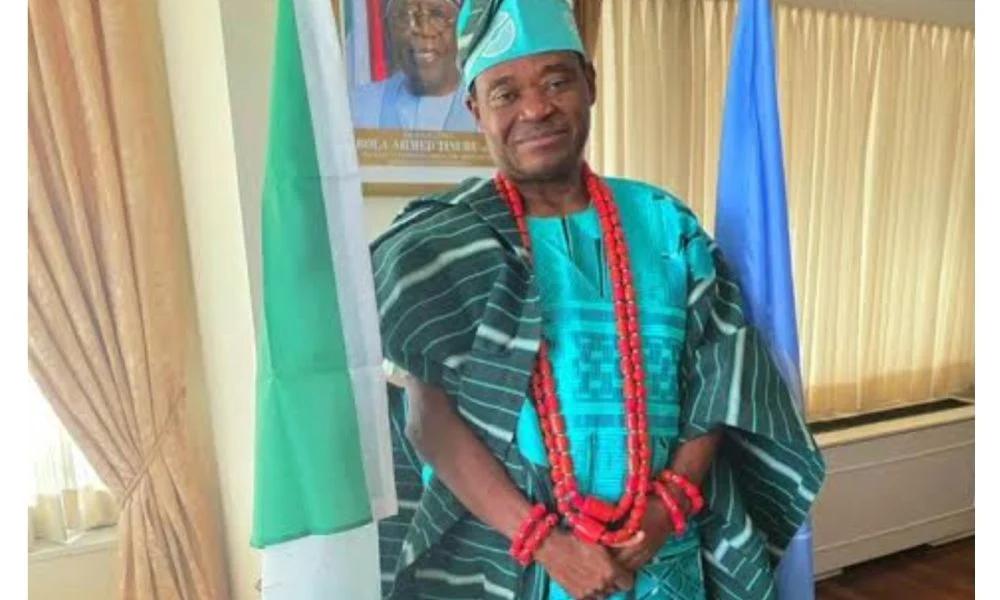
Nigeria’s Permanent Representative to the United Nations, Ambassador Jimoh Ibrahim, has offered a fresh explanation for President Bola Ahmed Tinubu’s absence from the ongoing 81st United Nations General Assembly (UNGA), in New York, saying it would not have been worthwhile for the President to travel to the United States merely to deliver a speech lasting about 15 minutes.
Tinubu is currently in Paris, France, where he has extended his stay, while Vice President Kashim Shettima is representing Nigeria at the high-level UNGA meetings in New York.
Ibrahim, speaking on TVC’s Beyond Headlines, said the composition of the UNGA speaking list was one of the factors that informed the decision not to have Tinubu attend the gathering personally.
According to him, about 60 per cent of the countries scheduled to address the General Assembly at the current session are being represented by foreign affairs ministers and vice presidents rather than heads of government.
He argued that sending Tinubu to New York in circumstances where the President would have only a brief speaking slot would not necessarily translate into greater diplomatic impact for Nigeria.
“I had a meeting with the Ambassador of the US to the United Nations and I also had another Ambassador that came to my office here. The British Ambassador has been with me here, that of Singapore has been here. What do you think that Tinubu is coming to do?” Ibrahim asked.
He noted that presidents speaking at the General Assembly are generally allocated limited time and questioned whether such a brief appearance, by itself, justified a presidential trip to New York.
“Presidents are allowed in the UN under 15 minutes. Is that the reason why he (Tinubu) should board a flight and be here for 15 minutes?” he said.
Ibrahim maintained that Vice President Shettima had been actively participating in high-level engagements on Nigeria’s behalf, including meetings involving representatives of other countries.
He described such engagements as important because they provide opportunities for Nigeria to pursue diplomatic and bilateral interests outside the formal speeches delivered from the General Assembly podium.
“Vice President Shettima has been attending high-level meetings which is country-to-country provided that it’s on neutral ground,” he said.
The Nigerian envoy also spoke about the importance of holding diplomatic engagements in appropriate settings, arguing that some meetings could not simply be transferred to foreign embassies.
“I have also said by way of advice that we can’t go to some embassies to go and have meetings, we can’t take our President to another embassy to have meetings if that embassy is not having meeting in Nigeria House,” he said.
According to him, the Vice President's presence at Nigeria House in New York also provided an opportunity for members of the Nigerian diaspora to engage directly with the government.
“Yes, Vice President Shettima was in Nigeria House and the diaspora spoke with him. This is the kind of thing that we want and not that the President will jump into a plane and be coming to UNGA for a 15-minute speech,” Ibrahim said.
He questioned whether the physical presence of the President at the General Assembly should be regarded as the only measure of Nigeria's participation or diplomatic influence at the annual gathering of world leaders.
“What is the meaning of that?” he asked.
Ibrahim further sought to draw attention to Nigeria's seating position in the General Assembly chamber, saying the country had been placed prominently among member states.
“I promised that Nigeria will be on the front row seat at UNGA. Are we not on the front row seat?” he asked.
He said Nigeria was occupying seat number eight, while the United States was seated farther back at number 26, arguing that the seating arrangement demonstrated that Nigeria continued to occupy an important position within the proceedings.
“Did you report that too that Nigeria is sitting on number 8 while America is on number 26 at the back of Nigeria’s seat?” he asked.
The ambassador also referred to the participation of US President Donald Trump, who, according to him, did not remain throughout the proceedings but appeared to deliver a lecture before leaving.
“And you know that Donald Trump didn’t go to sit on his seat, he came in to give a lecture at the UNGA and went back from there,” Ibrahim said.
Against that background, Ibrahim rejected the suggestion that Tinubu's absence automatically meant Nigeria was failing to make an impact at the international gathering.
“Are you saying that Nigeria is not making the impact it’s supposed to make globally? Must we have Tinubu here before we can make the impact?” he asked.
Speaking List Influenced Recommendation
Ibrahim, who said he serves as chairman of the UN administrative and budget committee, explained that his assessment of the composition of the speaking list would have influenced any advice he might give the Nigerian President.
He said that, if he were required to prepare a memo recommending whether Tinubu should travel to New York specifically for the General Assembly, the composition of the list would be a major consideration.
“I’m chair of admin and budget. On the speaking list this year, 60 percent are foreign affairs ministers and vice presidents,” he said.
“If I’m to do a memo to the President on boarding the plane to go to UNGA, do you think that I would recommend that he should be on his way when 60 percent of the speaking list of countries are ministers representing their countries and vice presidents?”
Ibrahim suggested that the circumstances could have been different if the overwhelming majority of speakers were presidents and prime ministers.
“So there are exigencies. If the speaking list is 90 percent President, of course, maybe the President can come,” he said.
“But if the list is 60 percent ministers, I don’t think that the President can come and be where his equivalent is a minister of Foreign Affairs of another country.”
The explanation adds another dimension to the debate surrounding Tinubu's decision not to attend the 81st UNGA personally.
The President's absence has attracted public attention because the UN General Assembly provides one of the largest annual platforms for heads of state and government to present their countries' positions on international affairs, economic cooperation, security, development and other global issues.
Nigeria, however, has not been absent from the proceedings. Shettima has been representing the country at the high-level meetings, while Ibrahim and other Nigerian officials have continued diplomatic engagements at the United Nations.
The debate therefore centres less on whether Nigeria is represented and more on the level of representation considered appropriate for the country's participation at the annual gathering.
Ibrahim's latest explanation places emphasis on the practical value of presidential attendance, arguing that diplomatic influence cannot be measured solely by whether a country's president delivers a speech at the General Assembly.
His comments also suggest that the Nigerian delegation is seeking to use the UNGA platform for a combination of multilateral, bilateral and diaspora engagements rather than concentrating exclusively on the President's address.
For the Nigerian government, the presence of the Vice President, the Permanent Representative and other officials provides avenues for Nigeria to participate in formal sessions and diplomatic discussions while maintaining representation at the United Nations.
The issue is nevertheless likely to remain a subject of public discussion, particularly because Tinubu's absence comes at a time when Nigeria faces a range of domestic and international issues requiring diplomatic engagement.
Ibrahim's position is that the effectiveness of Nigeria's participation should ultimately be assessed by the country's diplomatic engagements and outcomes rather than simply by the physical presence of the President at the General Assembly podium.
As the 81st UNGA continues, Shettima's engagements and the activities of Nigeria's diplomatic team will therefore remain central to the country's representation at the global forum.