PublicSphere Live
Capital Market
Nigerian Banking Stocks Drive NGX Trading as GTCO, UBA and Zenith Bank Record High Activity
Despite a decline in overall market turnover and a 0.33 per cent loss in the All-Share Index, banking stocks remained among the most actively traded equities, reflecting continued investor interest in the sector amid market volatility.
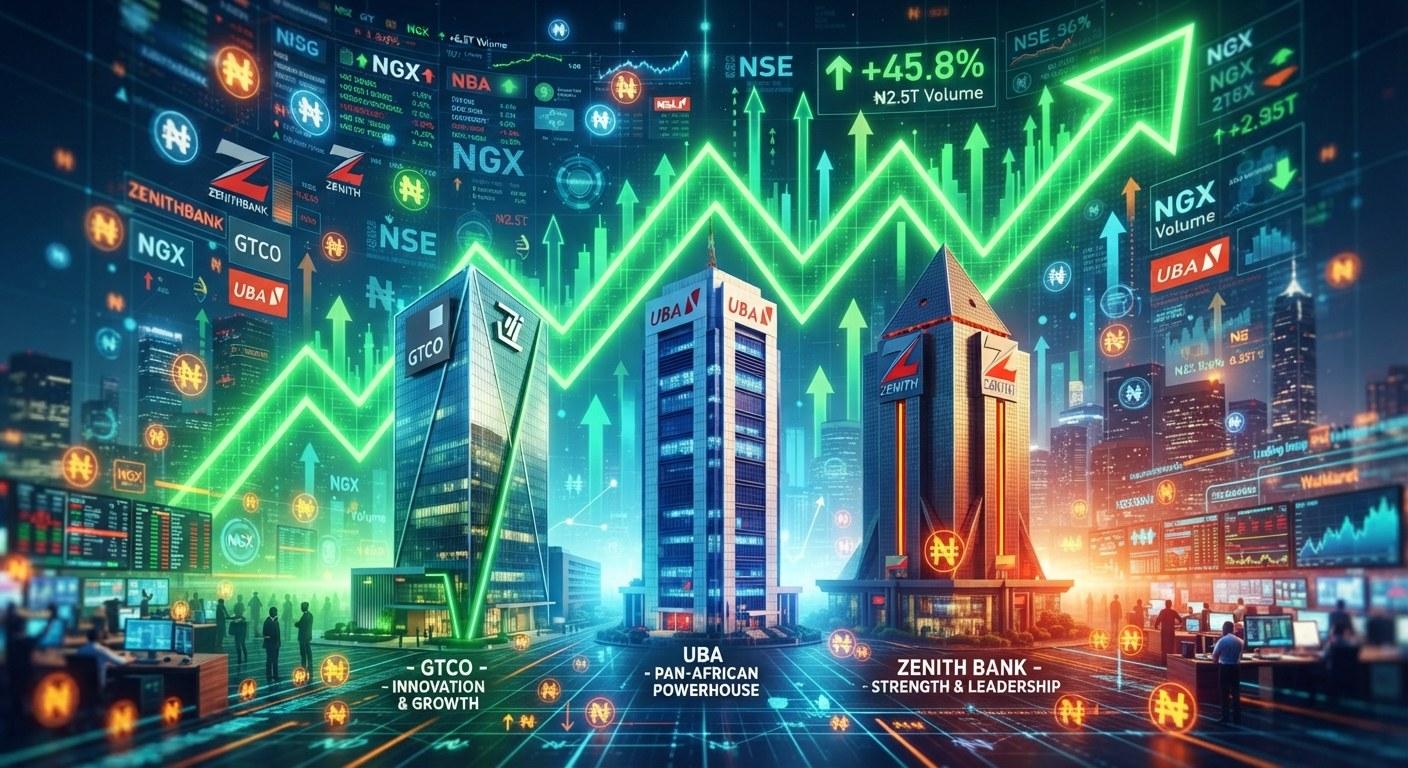
The Nigerian equities market ended trading on Friday, November 6, 2026, on a cautious note, with banking stocks continuing to play prominent roles in market activity even as the benchmark Nigerian Exchange All-Share Index (ASI) recorded another decline.
The performance of banking equities was particularly significant against the backdrop of a market that witnessed lower trading volume, reduced turnover and fewer transactions compared with the preceding session. Although the banking sector did not prevent the broader market from closing in negative territory, the participation of major financial institutions, particularly Guaranty Trust Holding Company Plc (GTCO), United Bank for Africa Plc (UBA) and Zenith Bank Plc, underscored the continued importance of banking stocks in determining the direction and liquidity of the Nigerian equities market.
The trading session ended with 369,924,948 shares exchanged in 32,351 deals, with a total market value of approximately ₦26.04 billion. This represented a three per cent decline in volume, a 12 per cent decrease in turnover and a three per cent reduction in the number of deals compared with Thursday's trading session.
The market capitalisation stood at ₦161.6 trillion, while the ASI declined by 833.37 points, or 0.33 per cent, to close at 248,877.22 points.
The market's negative performance notwithstanding, banking stocks remained conspicuous in the day's trading statistics, particularly in terms of volume.
GTCO Leads Banking Stocks In Trading Volume
GTCO emerged as the most actively traded equity on the NGX on Friday, recording approximately 41 million shares.
The performance placed the financial services holding company ahead of other major equities across the exchange, demonstrating the depth of investor interest in its shares.
GTCO's trading activity was particularly noteworthy because it occurred within a broader market environment characterised by declining turnover and subdued investor participation.
The company's position at the top of the volume table suggests that it continued to attract substantial attention from investors, including those seeking exposure to the financial services sector.
While trading volume alone does not establish whether investors were accumulating or disposing of shares, the level of activity highlights GTCO's importance in market liquidity and its influence on the overall banking-sector trading landscape.
The stock's prominent position also reinforces the role of GTCO as one of the major financial institutions through which investors express their views about the Nigerian banking industry.
With the banking sector undergoing significant regulatory and operational adjustments, the company's continued presence among the most actively traded equities makes its market performance particularly important to investors monitoring financial-sector developments.
UBA And Zenith Bank Reinforce Banking Sector Presence
United Bank for Africa recorded approximately 26 million shares traded, while Zenith Bank accounted for 23.4 million shares.
The two institutions ranked among the four most actively traded equities on the exchange, demonstrating that investor interest in banking stocks was not concentrated exclusively on GTCO.
UBA's trading volume placed it behind Honeywell Flour Mill, which recorded 32 million shares, but ahead of Zenith Bank.
The participation of UBA and Zenith Bank in the leading volume rankings underscores the continuing significance of Nigeria's major commercial banks in the equities market.
Together with GTCO, the institutions accounted for approximately 90.4 million shares traded during the session.
This represents about 24.4 per cent of the entire market volume of 369.9 million shares.
The proportion is significant because it demonstrates that three major banking stocks alone represented nearly one-quarter of the day's total trading activity.
However, the figures should not be interpreted as the entire banking sector's contribution to market turnover, as other listed financial institutions also participated in trading.
The banking sector's overall contribution would require the trading volumes and values of all listed banking stocks to be aggregated.
Nevertheless, the activity recorded by GTCO, UBA and Zenith Bank provides a strong indication of the sector's continued influence on market liquidity.
Banking Stocks And The Market's Mixed Performance
The broader market performance on Friday was mixed, with 29 equities appreciating, 23 declining and 132 participating in trading.
The ASI's 0.33 per cent decline reflected the prevailing weakness among several market constituents, although the performance of individual sectors varied.
The NGX Insurance Index gained 3.34 per cent, while the Oil and Gas Index advanced by 0.12 per cent.
Conversely, the Top 30 Index declined by 0.4 per cent, the Consumer Goods Index lost 0.09 per cent, and the Industrial Index shed 0.33 per cent.
The Main Board Index also recorded a marginal decline of 0.04 per cent.
The banking sector's high trading volume therefore occurred within a market that was experiencing some degree of selling pressure.
This distinction is important because high volume does not automatically translate into positive price performance.
A stock can record substantial trading activity while its price declines, remains unchanged or advances, depending on the balance between buying and selling interests.
Consequently, the banking sector's performance on Friday should be assessed through both trading activity and price movement.
The available data establishes that banking stocks were actively traded, but it does not provide the individual closing prices or percentage changes of GTCO, UBA and Zenith Bank.
It would therefore be premature to conclude that the three institutions led banking-sector price appreciation or that investors were uniformly bullish on the stocks.
What the figures establish is that the major banking equities remained highly liquid and attracted substantial investor attention.
The Significance Of Banking Stocks In Market Liquidity
Banking stocks occupy a central position in the Nigerian equities market because of their size, institutional importance and extensive investor participation.
The sector includes some of the NGX's most capitalised companies and provides investors with exposure to financial intermediation, corporate lending, retail banking, payments, international operations and other financial services.
Consequently, changes in investor sentiment towards banking stocks can have significant implications for overall market performance.
When major banks experience substantial trading activity, the resulting transactions can influence market liquidity, trading turnover and the performance of indices in which they are represented.
GTCO's emergence as the most actively traded stock on Friday was particularly relevant in this regard.
UBA and Zenith Bank's presence among the leading equities further demonstrated the importance of financial services stocks to the exchange's trading structure.
However, the banking sector's influence on the ASI depends not merely on trading volume but also on the market capitalisation and price movements of individual banking stocks.
A heavily traded stock with a declining price may exert downward pressure on an index, while a heavily traded stock experiencing appreciation may contribute positively.
This makes the combination of volume, turnover, price movement and market capitalisation essential for understanding banking-sector performance.
Bank Recapitalisation And Investor Expectations
The banking sector's performance also comes against the backdrop of Nigeria's ongoing banking recapitalisation exercise, which has reshaped the industry's strategic priorities.
The recapitalisation programme has encouraged banks to strengthen their capital bases, improve their capacity to absorb financial shocks and position themselves for greater participation in domestic and international markets.
For investors, the exercise presents opportunities as well as challenges.
Banks with stronger capital positions may be better equipped to finance large-scale businesses, support industrial expansion, undertake infrastructure-related transactions and deepen their participation in the Nigerian economy.
The exercise could also strengthen the capacity of Nigerian banks to compete in regional and international markets.
However, investors must also consider the implications of capital raising for existing shareholders, particularly where new shares are issued.
Depending on the terms of capital raising and the subsequent performance of the institution, shareholders may experience dilution or benefit from improved earnings capacity and long-term growth prospects.
The critical consideration is whether additional capital translates into stronger profitability, improved asset quality and sustainable returns.
Investors are therefore likely to scrutinise the financial statements of banks, their capital adequacy ratios, earnings performance, dividend policies and exposure to non-performing loans.
The recapitalisation exercise is not, by itself, a guarantee of higher share prices.
Rather, it creates a framework within which banks can potentially strengthen their operations and improve their long-term competitiveness.
Banking Stocks In A Market With Strong Year-To-Date Gains
Despite Friday's decline, the Nigerian equities market remained substantially higher than its position at the beginning of the year.
The ASI's year-to-date gain stood at 59.93 per cent, indicating that the market had generated considerable appreciation over the period.
This strong cumulative performance provides important context for the recent weakness.
After a significant market rally, some investors may decide to take profits, particularly when share prices have appreciated considerably.
Profit-taking can temporarily reduce market momentum even where the underlying fundamentals of listed companies remain intact.
The ASI's one-week loss of 2.13 per cent suggests that the market experienced some pressure during the week, although its four-week performance remained positive at 0.21 per cent.
For banking stocks, this environment presents a delicate balance between investors seeking to lock in gains and those positioning themselves for future appreciation.
The sector's strong trading activity could therefore reflect different investment strategies rather than a uniform market direction.
Long-term investors may be attracted by the prospects of stronger banking capitalisation and earnings growth, while short-term traders may focus on price movements and liquidity.
Outlook: Banking Stocks Remain Central To Market Direction
The performance of the banking sector on Friday, November 6, reinforces its position as one of the most influential segments of the Nigerian equities market.
GTCO, UBA and Zenith Bank's combined trading volume of approximately 90.4 million shares demonstrated the extent to which major financial institutions continued to attract investor attention.
The fact that GTCO emerged as the most actively traded stock on the exchange was particularly significant.
However, the decline in the ASI and the broader reduction in market turnover suggest that investors remain cautious.
The banking sector's future performance will depend on several factors, including the successful completion of recapitalisation programmes, earnings growth, asset quality, dividend prospects, monetary policy developments and the ability of banks to translate stronger capital positions into sustainable profitability.
The performance of the wider Nigerian economy will also remain important.
Economic growth, inflation, interest rates, exchange-rate stability and business confidence can influence the ability of banks to generate income and manage risks.
For investors, the distinction between trading activity and investment performance remains critical.
High trading volume may indicate liquidity and interest, but sustainable share-price appreciation ultimately depends on financial performance, valuation and investor expectations.
The November 6 session therefore offered a clear message: banking stocks remain central to the NGX's liquidity and market dynamics, but their ability to drive the next phase of market appreciation will depend on fundamentals rather than trading volume alone.
As the market enters the new trading week, investors will be watching whether the activity recorded in GTCO, UBA and Zenith Bank translates into renewed price momentum or whether the sector continues to experience the cautious trading pattern reflected in the broader market.
The banking sector remains one of the most important indicators of investor confidence in Nigeria's financial system, and its performance will continue to be closely watched as the equities market navigates the remainder of 2026.