PublicSphere Live
Capital Market
NGX ASI Rises 0.09% As First HoldCo Dominates Trading, But Market Breadth Remains Weak
However, reported heavy trading in First HoldCo, more declining than advancing stocks and divergent sector performances raise questions about the strength and sustainability of the market rally.
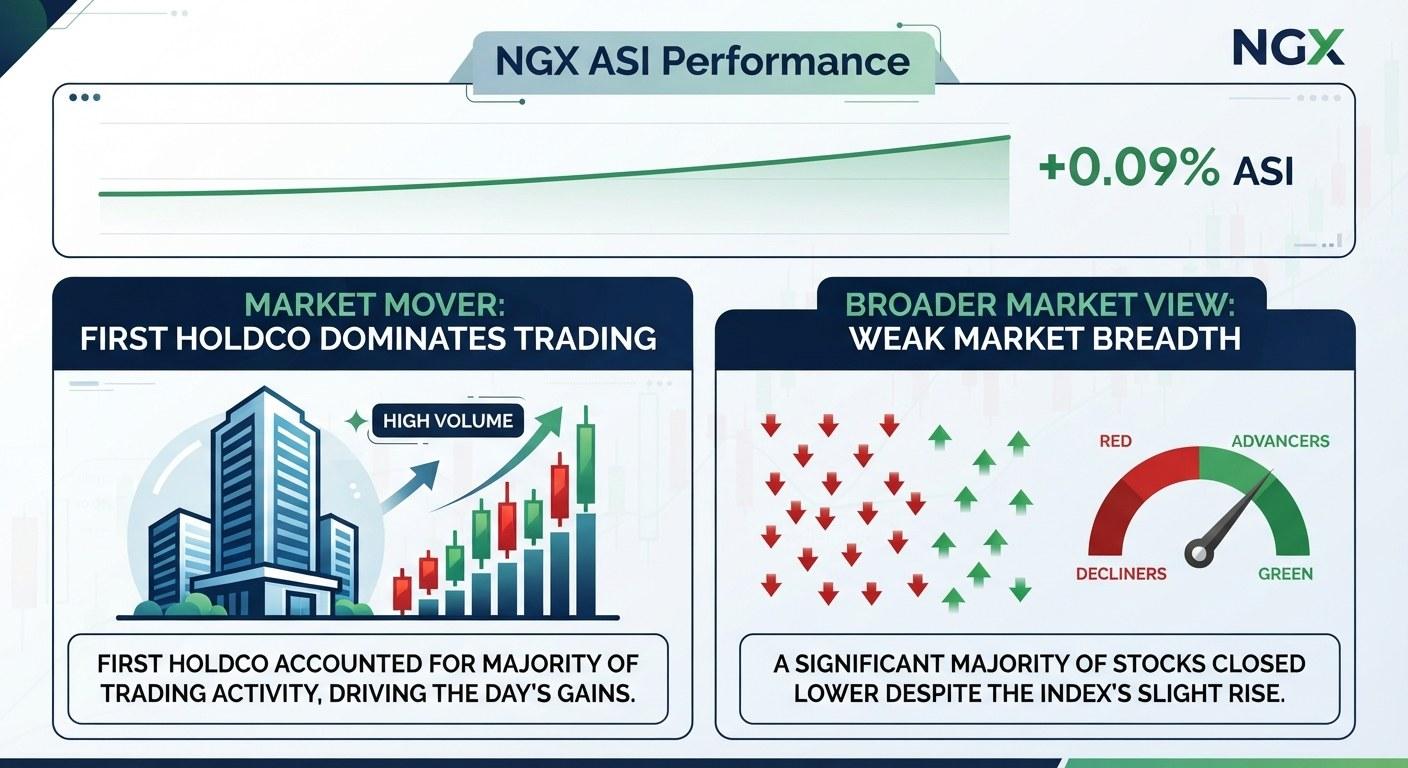
Nigeria's equities market closed the final trading session of October on a positive note, with the NGX All-Share Index appreciating by 0.09 per cent. However, reported heavy trading in First HoldCo, more declining than advancing stocks and divergent sector performances raise questions about the strength and sustainability of the market rally.
The Nigerian equities market ended October trading on a cautiously positive note on Friday, October 30, as the benchmark NGX All-Share Index (ASI) advanced marginally, even as investors continued to reposition their portfolios across selected stocks.
The session presented an interesting picture of a market experiencing substantial reported trading activity but struggling to translate that momentum into widespread price appreciation. While the benchmark index gained 216.47 points, or 0.09 per cent, to close at 254,299.49, declining equities outnumbered advancing stocks, suggesting that the market's positive performance was not evenly distributed.
According to the supplied trading summary, investors exchanged 831.55 million shares in 37,744 deals, valued at approximately N68.83 billion. The report indicated that trading volume increased by 145 per cent, turnover by 168 per cent and the number of deals by six per cent compared with Thursday's session.
If independently confirmed, the substantial increase in volume and turnover would represent a significant expansion in market activity. However, the reported figures require reconciliation with other available market-data records, which displayed approximately 339.16 million shares and N25.65 billion in turnover for the same date. The official NGX closing bulletin remains necessary to establish the definitive figures.
Nevertheless, the reported concentration of activity in First HoldCo provides an important starting point for understanding the dynamics of the session.
First HoldCo's Dominance Raises Questions About Market Liquidity
First HoldCo emerged as the most actively traded equity, recording 414 million shares, according to the supplied report. This represented approximately 49.8 per cent of the reported total market volume.
Fidelity Bank followed with 51.5 million shares, while Guaranty Trust Holding Company recorded 36.5 million shares. Sovereign Trust Insurance completed the leading four with 22.7 million shares.
The concentration of nearly half the reported market volume in one equity is particularly significant because it raises questions about the nature and distribution of investor participation.
Although high trading volume generally indicates liquidity and increased market engagement, it does not automatically translate into stronger investor confidence or positive price performance.
Large transactions may reflect institutional portfolio restructuring, profit-taking, changes in ownership, negotiated deals or investors taking advantage of price movements.
Consequently, First HoldCo's dominant position deserves closer examination, particularly against the background of heightened activity in banking stocks following the sector's recapitalisation exercise and the continuing repositioning of institutional investors.
The important question is whether the transactions represent renewed accumulation of banking equities or the redistribution of existing holdings.
The distinction matters because sustained buying interest would suggest confidence in the earnings prospects of financial institutions, while heavy distribution could indicate that some investors are taking profits after the considerable appreciation recorded by banking stocks.
For the broader equities market, the quality of liquidity matters as much as its volume. A market driven by a handful of heavily traded stocks may record impressive aggregate statistics without delivering comparable opportunities across the wider investment universe.
Positive Index Performance Contrasts With Weak Market Breadth
The day's market breadth provided another important indication of investor sentiment.
Of the 134 equities reported to have participated in trading, 25 appreciated, while 32 declined. This meant that declining stocks represented approximately 56 per cent of the advancing and declining equities.
The negative breadth contrasted with the marginal appreciation of the All-Share Index.
This divergence suggests that the market's positive closing performance was supported by selected equities rather than a broad improvement in share prices.
May & Baker Nigeria led the gainers, appreciating by 10 per cent to close at N41.80 per share. Honeywell Flour Mills also advanced by 10 per cent, while Livestock Feeds gained 9.92 per cent and Eterna appreciated by 9.9 per cent.
These performances indicate that buying interest remained strong in selected pharmaceutical, consumer-related, agricultural and energy-linked equities.
However, the losses recorded elsewhere demonstrated that investors were not indiscriminately purchasing stocks.
Caverton Offshore Support Group led the decliners with a 10 per cent depreciation to N3.60 per share. LivingTrust Mortgage Bank lost 9.94 per cent, Veritas Kapital Assurance declined by 9.91 per cent, while Zichis Agro Allied Industries shed 9.46 per cent.
The difference between the gainers and losers suggests a market characterised by selective investment decisions, with investors increasingly distinguishing between companies based on their perceived prospects, valuations and earnings expectations.
For investors, this reinforces the importance of examining individual corporate fundamentals rather than relying exclusively on the direction of the benchmark index.
Premium And Industrial Stocks Lead The Longer-Term Rally
The sectoral performance of the NGX revealed some of the most significant developments in the market.
The NGX Premium Index appreciated by 0.15 per cent during Friday's session, taking its reported year-to-date gain to 115.73 per cent. Its weekly appreciation stood at 7.21 per cent.
This performance suggests that premium-listed equities have remained important contributors to the market's broader revaluation.
The NGX Top 30 Index also advanced by 0.09 per cent, recording a weekly gain of 3.03 per cent and a year-to-date appreciation of 65.29 per cent.
These figures point to sustained investor interest in some of the exchange's more prominent and liquid companies.
More striking, however, was the performance of the NGX Industrial Index, which recorded a weekly appreciation of 14.58 per cent and a year-to-date gain of 114.91 per cent, despite being virtually unchanged during Friday's trading.
The industrial sector's performance is particularly important for an economy seeking to strengthen domestic manufacturing, expand productive capacity and reduce dependence on imported goods.
The substantial appreciation suggests that investors have assigned considerable value to selected industrial companies, potentially reflecting expectations of improved corporate earnings, infrastructure investment and stronger domestic production.
However, stock market appreciation should not be confused with actual industrial expansion. The sustainability of the rally will ultimately depend on whether improved valuations are supported by stronger revenues, operating margins, cash flows and profitability.
Oil And Gas Remains The Market's Strongest Sectoral Performer
The NGX Oil & Gas Index maintained its position as the strongest-performing sectoral index on a year-to-date basis among those listed in the report.
Although it declined marginally by 0.06 per cent on Friday, its reported year-to-date appreciation stood at 127.9 per cent, while its weekly gain was 0.82 per cent.
The performance reflects the continued importance of energy-related equities in investors' portfolios, particularly amid developments in the domestic petroleum industry and changing expectations about Nigeria's energy production and refining capacity.
The expansion of domestic refining, particularly the operations of the Dangote Petroleum Refinery, has created new expectations concerning the country's energy supply chain, industrial development and the future profitability of companies operating in the sector.
Nevertheless, the impressive performance of oil and gas equities should be assessed against individual company earnings, production costs, operational efficiency and exposure to international crude oil price movements.
A strong sectoral index does not mean every company within the sector is equally positioned to benefit.
Consumer Goods Sector Remains Under Pressure
One of the more disappointing performances came from the NGX Consumer Goods Index, which declined by 0.07 per cent during Friday's session.
Its reported year-to-date appreciation stood at just 0.97 per cent, while its four-week and weekly performance figures indicated limited momentum.
This relatively weak showing is significant because consumer goods companies operate close to the realities of household purchasing power.
Despite the gradual moderation in Nigeria's headline inflation, consumers continue to face affordability challenges, while manufacturers contend with input costs, energy expenses, distribution challenges and the difficulty of passing higher production costs to customers.
Companies in the food, beverage and household products segments must therefore balance pricing decisions against the risk of losing market share.
The contrasting performance of the industrial and consumer goods indices also raises an important question about the distribution of investment capital across the productive economy.
Investors appear to have rewarded selected industrial equities more generously than consumer-facing companies, although individual earnings and valuations remain decisive factors.
Market Valuation And The Question Of Sustainability
The supplied report puts NGX market capitalisation at N165.1 trillion, equivalent to approximately $123 billion.
The All-Share Index's reported year-to-date appreciation of 63.42 per cent represents a remarkable performance, reflecting the substantial revaluation of Nigerian equities over the course of 2026.
However, the market's impressive gains also make valuation discipline increasingly important.
Investors must distinguish between companies whose share prices are supported by earnings expansion and those whose appreciation may have moved ahead of their underlying financial performance.
The NGX Main Board Index, for instance, recorded a year-to-date gain of 42.23 per cent but declined by 0.11 per cent over the reported week. This suggests that market performance is becoming increasingly differentiated across listing segments.
The next phase of the market rally will depend on the ability of listed companies to convert improved investor expectations into sustainable earnings and stronger shareholder returns.
Dividend declarations, corporate expansion programmes, debt management and operating efficiency will become increasingly important in determining which equities can sustain their valuations.
Outlook: Selective Investing Will Define The Next Market Phase
Friday's trading session demonstrated that Nigeria's equities market remains active, but its direction is becoming increasingly dependent on selected stocks and sectors.
The positive ASI performance, impressive year-to-date returns in premium, industrial and oil and gas equities, and the reported increase in trading activity provide reasons for cautious optimism.
Nevertheless, the greater number of declining stocks and the concentration of reported trading volume in First HoldCo suggest that the market's strength should not be exaggerated.
Investors will need to pay closer attention to corporate fundamentals, valuation levels and the sustainability of earnings growth.
The banking sector deserves particular monitoring because of its significant contribution to market liquidity and the continuing adjustment following recapitalisation. Industrial companies also merit attention because their performance could provide an important indication of investors' expectations about Nigeria's productive economy.
Meanwhile, consumer goods companies must demonstrate that they can protect margins and grow sales despite continuing affordability constraints.
Ultimately, the Nigerian equities market's next challenge is not simply to achieve higher index levels but to establish a broader, more sustainable rally supported by corporate profitability and wider investor participation.
Friday's performance offered a positive closing signal for October, but the real test will be whether the market can translate its impressive headline returns into stronger fundamentals and more inclusive gains across listed equities.