PublicSphere Live
Capital Market
NGX ASI Rises 0.47% to 254,083 as Industrial Stocks Drive Nigeria’s Equities Market Rally
Industrial Goods Index surges 3.41% in a session of broad market gains, while declining turnover and sharp losses in First HoldCo temper investor enthusiasm
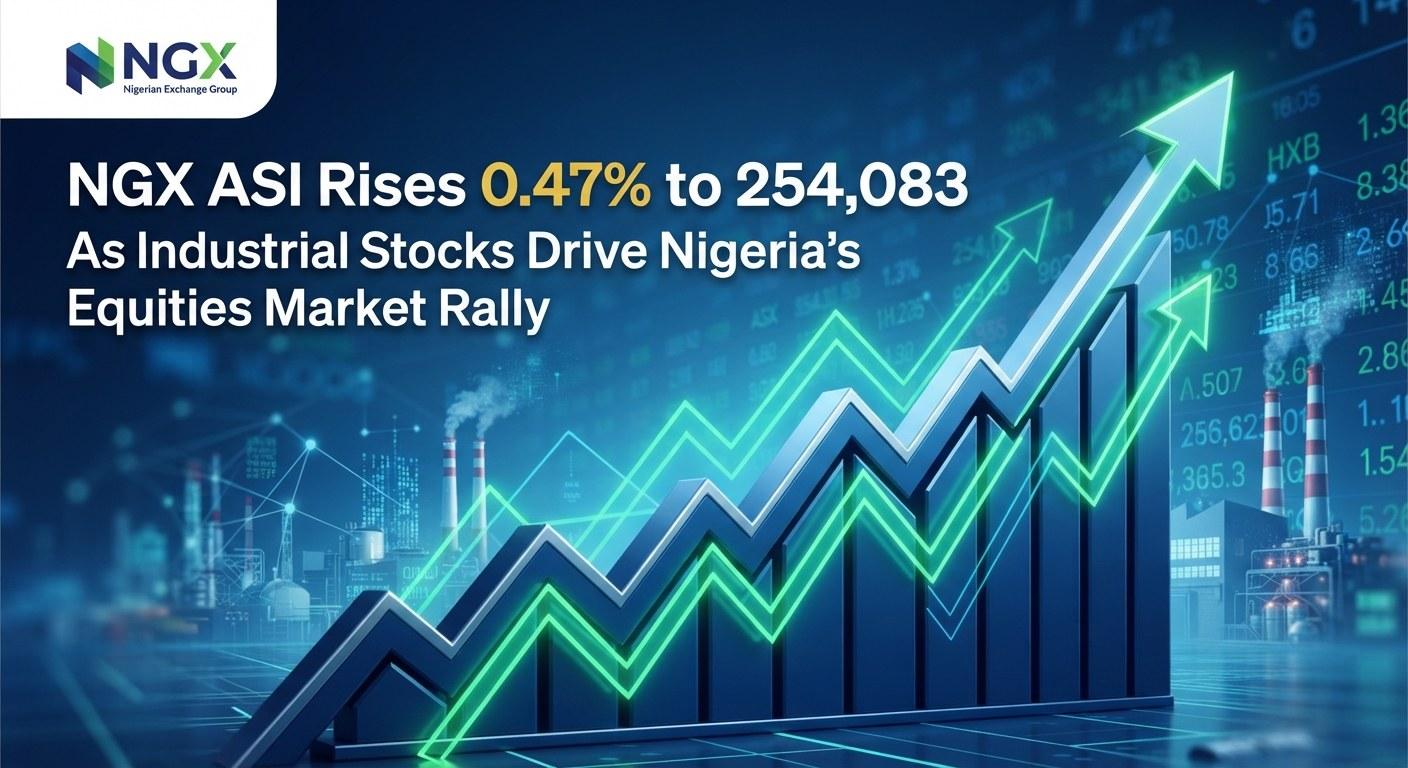
The Nigerian Exchange (NGX) sustained its upward momentum on Thursday, October 29, 2026, as the benchmark All-Share Index (ASI) advanced by 1,200.24 points, or 0.47 per cent, to close at 254,083.02. The performance reinforced the market’s impressive year-to-date rally, even as a moderation in trading volume, transaction value and deal count suggested that investors were becoming more selective in their participation.
The session’s most consequential development was the exceptional performance of the industrial goods sector, whose index surged by 3.41 per cent, substantially outperforming the broader market. Its one-day advance, combined with an 18.8 per cent gain over the preceding week and a remarkable 114.91 per cent year-to-date appreciation, positioned the sector as a particularly important contributor to the exchange’s growth story.
The industrial goods sector’s performance is significant because it offers a window into the relationship between equity-market expansion, investor expectations and Nigeria’s broader industrial ambitions. A sustained rally in industrial stocks can reflect optimism about manufacturing capacity, construction activity, infrastructure development and the long-term prospects of companies supplying essential inputs to the economy. Nevertheless, share-price appreciation alone does not establish that industrial production or corporate earnings have expanded at the same pace.
The overall market closed with a capitalisation of approximately ₦165 trillion, equivalent to $123 billion, while 131 listed equities participated in trading. Of these, 27 recorded gains and 26 declined, suggesting a relatively balanced contest between bullish and bearish forces among the actively traded stocks.
A total of 339.16 million shares changed hands in 35,773 deals, valued at ₦25.65 billion. Compared with Wednesday’s session, volume declined by 15 per cent, turnover by seven per cent and the number of deals by eight per cent.
These figures present a market that is still advancing but requires closer examination. The ASI’s positive close indicates that buying pressure remained sufficient to lift the benchmark, while lower trading activity raises questions about the breadth and intensity of investor commitment behind the rally.
Industrial Goods: The Market’s Most Powerful Growth Engine
The industrial goods index emerged as the standout performer, rising 3.41 per cent on Thursday. Its performance was nearly seven times the ASI’s daily percentage gain, underscoring the influence that industrial heavyweights can exert on the direction of the Nigerian equities market.
According to market reporting on the session, Dangote Cement was a principal driver of the industrial rally, advancing 5.82 per cent to close at ₦1,420 per share. The company’s substantial market capitalisation means that a significant price movement in its shares can materially influence the sector index and the broader market.
NGX market performance at a glance
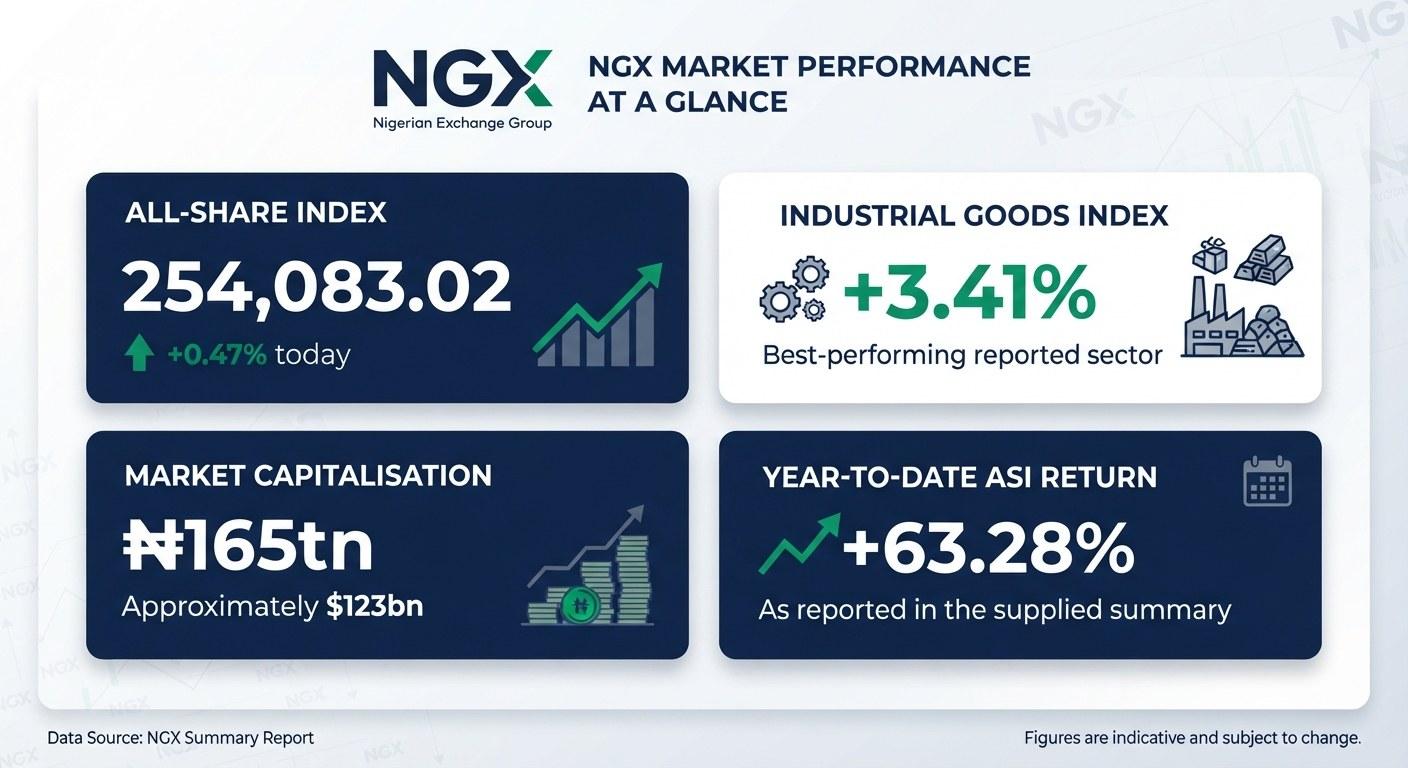
As reported in the supplied summary
The sector’s 18.8 per cent weekly advance is particularly noteworthy. It indicates that the latest rally forms part of a broader upward movement rather than an isolated one-day surge. Its year-to-date gain of 114.91 per cent is even more striking, although investors must distinguish between nominal share-price appreciation and the underlying growth in earnings, dividends and productive capacity.
For the equities market to maintain a durable upward trajectory, industrial companies must demonstrate that rising valuations are supported by stronger revenues, improved operating margins, sustainable cash flows and credible expansion plans. Where these fundamentals are present, industrial equities can attract long-term institutional investors and strengthen confidence in the exchange.
The wider economic implications are equally important. Nigeria needs stronger domestic manufacturing, competitive building-material producers, improved infrastructure and reduced dependence on imported industrial inputs. Listed industrial companies that successfully expand local production can benefit from construction demand, infrastructure spending and the development of domestic supply chains.
Consequently, the industrial goods sector deserves particular attention from investors and policymakers. Its performance offers a potential connection between capital-market expansion and the productive transformation of the economy.
Premium And Top 30 Indices Reinforce The Bullish Momentum
Beyond industrial goods, the NGX Premium Index advanced by 1.01 per cent, while the NGX Top 30 Index gained 0.49 per cent. Their respective year-to-date gains stood at 115.41 per cent and 65.14 per cent.
The Premium Index’s performance suggests continued strength among some of the exchange’s prominent listed companies. Its substantial annual appreciation also highlights the extent to which the market has rewarded selected large and established equities during 2026.
The Top 30 Index, meanwhile, gained 3.97 per cent over one week, indicating that the recent upward movement has extended across a group of leading market constituents. However, the weekly advance should not be interpreted as evidence that every constituent participated equally.
The NGX Main Board Index rose by a modest 0.07 per cent, bringing its year-to-date gain to 42.17 per cent. The relatively subdued daily movement suggests that the advance was not equally pronounced across all segments of the market.
The insurance index gained 0.75 per cent during the session but remained down 1.01 per cent over one week and 12.8 per cent year to date. This divergence illustrates why investors must examine sector-specific performance rather than rely exclusively on the headline ASI.
Similarly, the oil and gas index edged up just 0.05 per cent. Despite its impressive 128.04 per cent year-to-date appreciation, its weekly decline of 1.65 per cent indicates that recent momentum has weakened.
These contrasting performances demonstrate that the market’s impressive annual returns conceal significant differences in sectoral fortunes. Investors who concentrate solely on the headline index risk overlooking both opportunities and vulnerabilities beneath the surface.
Banking Stocks: High Trading Volumes, Mixed Price Performance
Financial stocks continued to occupy a prominent position in trading activity. Guaranty Trust Holding Company led the volume table with 40.6 million shares, followed by First HoldCo with 29.6 million, United Bank for Africa with 26.4 million and Regency Alliance Insurance with 20.5 million shares.
These figures reinforce the importance of financial services equities to market liquidity. However, high trading volumes do not automatically translate into positive price performance.
First HoldCo was the session’s biggest loser, shedding 10 per cent to close at ₦125.55 per share. Livestock Feeds declined 9.7 per cent, Tantalizers lost 8.4 per cent, while C&I Leasing fell 7.41 per cent.
First HoldCo’s simultaneous presence among the most actively traded equities and the biggest decliners suggests substantial selling pressure. Such activity warrants attention because sharp losses in a heavily traded stock can influence sentiment across the financial sector.
Nevertheless, a single session’s decline does not establish a lasting deterioration in a company’s fundamentals. Investors should examine financial results, capital adequacy where applicable, asset quality, corporate disclosures and the reasons behind unusual trading activity before drawing conclusions.
The banking sector’s wider outlook will also depend on the capacity of lenders to translate stronger capital positions into productive lending, sustainable earnings and improved support for businesses. Recapitalisation will deliver its greatest economic benefit when the resulting financial strength supports productive investment rather than remaining concentrated in financial transactions.
Gainers, Losers And The Question Of Market Breadth
E-Tranzact International led the gainers, appreciating 10 per cent to ₦17.60 per share. Sovereign Trust Insurance followed with a 9.6 per cent increase, while Fortis Global Insurance rose 9.37 per cent and McNichols gained 9.18 per cent.
The presence of financial technology, insurance and consumer-related stocks among the leading gainers points to opportunities beyond the industrial heavyweights. Nevertheless, individual price surges should be evaluated alongside trading liquidity, company announcements and financial performance.
Market breadth was modestly positive, with 27 gainers against 26 losers. This narrow margin suggests that advances and declines were almost evenly matched among the 131 equities traded.
The ASI’s gain, therefore, should not be mistaken for a universal improvement across listed companies. While selected large-cap stocks can lift the benchmark, individual investors may experience substantially different portfolio outcomes depending on their holdings.
Lower Turnover Raises A Cautionary Note
The reported 15 per cent decline in volume, seven per cent reduction in turnover and eight per cent fall in deals compared with Wednesday introduce an important qualification to the bullish close.
Lower activity during an advancing session is not inherently negative. It can reflect reduced selling pressure, temporary consolidation or a shift towards a smaller number of influential stocks. However, it may also indicate that fewer investors are willing to commit additional funds at prevailing valuations.
The distinction will become clearer through subsequent sessions. If the ASI continues advancing alongside stronger turnover and broad participation, the rally would receive more convincing confirmation. If prices rise while trading activity continues to contract, investors may need to exercise greater caution.
There is also a need to reconcile the supplied turnover and volume figures with other published market summaries, which report different transaction totals for October 29.
Nairametrics+1
The figures used in this analysis are those provided in the trading summary, but the discrepancy should be resolved before the statistics are used in formal market reporting.
Outlook: Industrial Stocks Hold The Key
Thursday’s session reinforces the industrial goods sector’s importance to the NGX’s current growth trajectory. Its 3.41 per cent advance, supported by strong buying in Dangote Cement, substantially outperformed the broader market and helped offset weakness in selected financial stocks.
The immediate challenge is to determine whether this strength can be sustained. Investors will need to monitor industrial companies’ earnings, input costs, energy expenses, borrowing conditions, infrastructure demand and the extent to which higher valuations are justified by business fundamentals.
The market also needs broader participation. A durable bull run should ideally combine industrial leadership with improving performance in banking, consumer goods, insurance and oil and gas, supported by rising liquidity and consistent corporate disclosures.
For policymakers, the message is that a rising stock market is most valuable when it supports productive investment, facilitates capital formation and enables Nigerian businesses to expand. For investors, the lesson is to look beyond impressive index returns and distinguish fundamentally strong companies from stocks benefiting mainly from short-term momentum.
Ultimately, the industrial goods sector was the standout engine of Thursday’s market advance. Its continued strength could provide an important foundation for further gains on the NGX, but the durability of the rally will depend on earnings growth, investor participation and the ability of listed companies to convert favourable market valuations into sustainable economic value.