PublicSphere Live
Editorial
EDITORIAL: Nigeria’s Political Class And The Tyranny Of Self-Interest: A Nation Held Hostage By The Ambition Of Its Elite
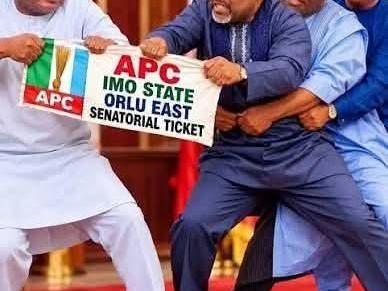
A Federal High Court in Abuja reportedly restrained the governor from parading himself as the party’s senatorial candidate after ruling that former governor Rochas Okorocha had won the party’s primary
There is something profoundly disquieting about a political establishment that appears perpetually animated by the acquisition, retention and redistribution of power, yet insufficiently stirred by the anguish of the people over whose lives that power is exercised. Nigeria’s political class has, for far too long, conducted its affairs as though the state were an inheritance to be appropriated, public office a private estate to be defended, and political authority an instrument for the gratification of personal ambition. Meanwhile, the ordinary Nigerian, battered by economic adversity, diminished purchasing power, insecurity, unemployment and the steadily mounting costs of survival, is left to contend with the consequences of a political culture in which the pursuit of power too frequently eclipses the obligations of governance.
The spectacle surrounding the reported judicial setback suffered by Imo State Governor, Hope Uzodimma, in his bid to secure the All Progressives Congress (APC) ticket for the Imo West Senatorial District election in 2027 is yet another manifestation of this disturbing pathology. A Federal High Court in Abuja reportedly restrained the governor from parading himself as the party’s senatorial candidate after ruling that former governor Rochas Okorocha had won the party’s primary. The development has occasioned intense political reactions, including the circulation of an unverified video purportedly showing Okorocha and the Minister of the Federal Capital Territory, Nyesom Wike, celebrating the outcome.
The authenticity and context of the footage require independent verification. Nevertheless, the controversy it has generated provides a compelling occasion to interrogate the moral bankruptcy that increasingly threatens to define Nigeria’s political culture: the disconcerting propensity of influential political actors to subordinate the collective interest to the vicissitudes of personal ambition, factional allegiance and the gratification derived from the political misfortune of rivals.
What, one may reasonably ask, is there to celebrate when the political fortunes of one individual are diminished, while the existential anxieties of millions remain unaddressed? What conceivable national dividend accrues from the triumph of one political faction over another when the citizenry continues to grapple with the debilitating consequences of economic distress and inadequate public services? These are questions that the Nigerian political establishment must confront with candour, humility and a renewed sense of moral responsibility.
The Abdication Of Public Responsibility
The circumstances surrounding Uzodimma’s reported senatorial ambition are particularly instructive. In January 2020, the Supreme Court overturned the earlier declaration of Emeka Ihedioha as the winner of the 2019 Imo State governorship election and declared Uzodimma the duly elected governor. That judgment altered the state’s electoral timetable, producing an off-cycle election schedule. Following his re-election in 2023, Uzodimma is expected to complete his current tenure in January 2028.
Against this background, his reported determination to contest the Imo West senatorial seat in 2027, amid speculation that he may harbour ambitions for the Senate presidency, raises legitimate questions about the hierarchy of his political priorities. Political ambition, in itself, is neither a transgression nor an aberration in a constitutional democracy. The right to aspire to public office is an indispensable feature of democratic participation. However, the legitimacy of ambition must always be measured against the obligations that accompany an existing mandate.
A governorship is not a political transit lounge from which an officeholder may casually depart in pursuit of a more alluring destination. It is a solemn covenant between the elected leader and the people whose mandate confers upon him the authority to govern. It entails responsibilities that cannot be suspended whenever the prospect of personal advancement beckons.
The citizens of Imo State did not entrust Uzodimma with the administration of their collective affairs merely to provide him with a platform for further political elevation. They expect the completion of developmental programmes, the strengthening of public institutions, the improvement of infrastructure, the expansion of economic opportunities and the establishment of conditions conducive to a dignified standard of living.
If the calculations surrounding a prospective Senate presidency have begun to overshadow these obligations, the governor must pause and reflect on the ethical implications of such a disposition. The argument that postponing his senatorial aspiration until 2031 could diminish his chances of attaining a coveted leadership position may be intelligible within the narrow arithmetic of political survival. It is, however, an inadequate justification for allowing personal calculations to take precedence over the unfinished business of governance.
Public office is a commission of service, not an instrument of self-perpetuation. Its highest justification lies not in the elevation of the officeholder but in the advancement of the people.
When Political Rivalry Becomes A National Distraction
The reported celebration by Okorocha and Wike, if the footage accurately represents the circumstances described, is equally deserving of sober reflection. Political adversaries are entitled to contest, criticise and challenge one another within the bounds of democratic propriety. They are not, however, absolved of their responsibility to exercise restraint, particularly when the public perception of their conduct reinforces the impression that political life has degenerated into an endless succession of personal vendettas.
A judicial pronouncement should principally be regarded as an affirmation of the rule of law, subject to the remedies available within the judicial system. It should not become an occasion for the humiliation of political opponents or a carnival of factional triumphalism. Those who prevail in court ought to demonstrate magnanimity; those who suffer adverse decisions should submit to the law while pursuing any legitimate avenue of appeal.
The gravest indictment of Nigeria’s political class is not that its members disagree. Disagreement is intrinsic to democratic life. It is that their disagreements too frequently revolve around the distribution of offices, the preservation of influence and the exclusion of rivals, while the substantive questions of development remain inadequately addressed.
The political class must understand that the suffering of the people is not an inexhaustible resource to be exploited for electoral mobilisation, bargaining leverage or factional advantage. The frustrations of citizens should provoke introspection and corrective action, not provide convenient ammunition in the contest for political ascendancy.
Nigeria requires a political culture in which victory is measured by the advancement of the common good, not by the humiliation of an adversary.
The Senate Presidency And The Politics Of Exclusion
The reported manoeuvres surrounding the Senate presidency further illuminate the extent to which the struggle for political office can consume the energies of those entrusted with legislative responsibility.
The Senate presidency is a consequential constitutional position, conferring substantial influence over legislative priorities, parliamentary procedure, institutional oversight and the relationship between the legislature and the executive. It is therefore understandable that political actors should seek to influence the process through which its occupant emerges. What is unacceptable, however, is any attempt to subordinate the institutional interests of the Senate to the private calculations of a narrow circle of political beneficiaries.
Earlier reports of a Senate initiative, reportedly championed by its leadership, to prevent incoming senators from contesting for leadership positions in the chamber raise important questions about institutional fairness and democratic opportunity. The precise terms, legal status and applicability of any such restriction must be established before definitive conclusions are reached. Nevertheless, any rule that appears designed to foreclose legitimate competition or predetermine leadership outcomes deserves rigorous scrutiny.
Experience and institutional knowledge are valuable attributes in legislative leadership. They should not, however, be converted into instruments of exclusion that diminish the opportunities of otherwise qualified legislators. The Senate must be guided by its constitutional responsibilities, established rules, competence, integrity and the legitimate aspirations of its members.
More importantly, the preoccupation with who occupies the Senate presidency must not eclipse the fundamental purpose for which the institution exists. Nigerians expect their senators to scrutinise public expenditure, strengthen accountability, enact progressive legislation, protect constitutional rights and create a legislative environment conducive to economic expansion.
They expect laws that facilitate investment, encourage industrialisation, improve employment prospects and strengthen public institutions. They expect legislative scrutiny that exposes waste, restrains abuses of power and ensures that public resources are deployed in the service of national development.
They do not expect the Red Chamber to become a theatre in which the energies of its members are disproportionately consumed by the politics of succession, exclusion and personal advancement.
The Human Cost Of Elite Self-Interest
The consequences of this distorted political orientation extend far beyond the corridors of power. They are reflected in the everyday realities of Nigerians whose hopes of economic security are repeatedly undermined by structural deficiencies, policy inconsistencies and failures of governance.
For millions of households, the question of survival has become an increasingly demanding exercise in economic calculation. Parents struggle to reconcile school fees with food expenditure. Workers discover that their earnings no longer command the necessities they once afforded. Small businesses confront prohibitive operating costs, expensive credit and unreliable infrastructure. Young graduates contend with a labour market that offers too few opportunities for their aspirations and qualifications.
These difficulties cannot be attributed exclusively to the selfishness of politicians. Nigeria’s developmental challenges are complex, encompassing infrastructure deficits, insecurity, weak productivity, institutional deficiencies and longstanding structural imbalances. Yet the quality of political leadership remains decisive in determining whether these challenges are confronted with seriousness or perpetuated through neglect.
When political officeholders become more preoccupied with their next electoral destination than with their present constitutional obligations, governance suffers. When party leaders devote their energies to the manipulation of succession arrangements rather than the development of coherent economic programmes, public confidence erodes. When political competition becomes an instrument of personal vengeance, the institutions necessary for national progress are weakened.
Economic development requires more than the announcement of policies or the presentation of ambitious projections. It demands continuity, institutional stability, predictable regulation, security, investment in human capital and a political environment in which productive enterprise is encouraged rather than encumbered.
Investors require confidence that public policy will not be subordinated to factional interests. Manufacturers need reliable electricity, efficient transport networks and a predictable business environment. Farmers need security, storage facilities, market access and supportive infrastructure. Young people need education that equips them with relevant skills and an economy capable of absorbing their talents.
These are the imperatives that should command the attention of Nigeria’s political leadership. They are infinitely more consequential than the transient satisfaction derived from defeating a rival for a party ticket or securing a coveted legislative position.
A Repudiation Of Politics Without Conscience
The Nigerian political class must recognise that democracy cannot flourish indefinitely on the foundations of elite self-interest. Electoral legitimacy, however formally acquired, is ultimately strengthened or diminished by the quality of governance it produces. A government that neglects the material conditions of its citizens while its principal actors engage in relentless contests for power risks alienating the very people whose consent sustains democratic authority.
We therefore call upon Uzodimma to accord the responsibilities of his present office the attention and seriousness they deserve. His political future is a matter for lawful democratic competition, but the unfinished obligations of his governorship cannot be treated as incidental to his personal ambitions.
We equally urge Okorocha, Wike and other influential political figures to recognise that political stature carries obligations beyond the advancement of personal or factional interests. Their influence should be deployed towards reconciliation, institutional development, responsible governance and the promotion of peaceful democratic engagement.
The APC, as the governing party at the federal level, must demonstrate that internal competition can be managed through transparent procedures, respect for judicial decisions and fidelity to democratic principles. Party structures should provide equitable opportunities for qualified aspirants rather than become instruments for the consolidation of political fiefdoms.
These expectations apply with equal force to opposition parties. No political organisation should be permitted to claim moral superiority while reproducing the same practices of exclusion, patronage and personalised power that have contributed to public disillusionment.
Nigeria needs a decisive departure from the politics of bitterness. It needs political leaders capable of distinguishing between legitimate competition and destructive antagonism, between ambition and entitlement, and between the temporary acquisition of office and the enduring responsibility of public service.
The 2027 elections must therefore become an opportunity for a more elevated national conversation. Political parties should place credible programmes, measurable development commitments, institutional reform and economic opportunity at the centre of their campaigns. Candidates should be judged by their competence, integrity, policy proposals and records of service—not by the ferocity with which they attack their opponents or the sophistication of their political manoeuvres.
The People Must Reclaim The Centre Of Politics
Ultimately, the responsibility for transforming Nigeria’s political culture rests not only upon those who occupy public office but also upon the institutions and citizens who hold them accountable. The electorate must insist that political parties explain how their candidates intend to improve living standards, create productive employment, expand access to quality education and healthcare, strengthen security and establish the conditions for sustainable economic growth.
Civil society, the media, professional associations and other democratic institutions must continue to scrutinise political conduct without succumbing to partisan manipulation. The judiciary must retain its independence, while electoral and regulatory institutions must discharge their responsibilities with impartiality and integrity.
Above all, political leaders must understand that the ultimate purpose of government is not the satisfaction of the ambitions of the governing elite. It is the creation of a just, peaceful and prosperous society in which citizens can pursue their aspirations without being perpetually overwhelmed by avoidable hardship.
Nigeria possesses enormous human and material resources. Its developmental prospects are not irretrievably compromised by a lack of potential, but they are endangered whenever political leadership fails to translate that potential into broadly shared prosperity. The country cannot realise its promise if the energies that ought to be devoted to industrialisation, agricultural productivity, technological advancement and human development are continually dissipated in the struggle for political dominance.
History will not be impressed by the number of political offices occupied by Nigeria’s leaders, the succession of rivals they have vanquished or the alliances they have assembled to secure their ambitions. It will judge them by the institutions they strengthened, the opportunities they created, the hardships they alleviated and the quality of life they bequeathed to succeeding generations.
The message to the political class must therefore be unequivocal: Nigeria is greater than any individual, any political party, any faction or any ambition for public office.
The nation cannot remain perpetually hostage to the private calculations of its political elite. Public office is a solemn trust, power is a burden of responsibility, and leadership derives its nobility from service to the people.
It is time for Nigeria’s politicians to abandon the sterile pursuit of personal ascendancy and embrace the demanding but ennobling work of nation-building. Let them cultivate a political environment in which disagreement does not degenerate into hostility, competition does not become persecution, and ambition does not extinguish compassion.
Let them build a society in which businesses can thrive, investments can flourish, employment opportunities can multiply and the fruits of economic growth can improve the living standards of ordinary Nigerians.
The people have endured enough of politics without conscience. They deserve leadership with vision, public service with integrity and a democracy that delivers more than the perpetual redistribution of power among the privileged.
Nigeria’s future must no longer be sacrificed on the altar of elite self-interest. The time has come for the political class to put the people first—or answer to history for the consequences of its failure to do so.