PublicSphere Live
Capital Market
NGX ASI Rallies 1.26% To 250,343 Points As Market Capitalisation Gains ₦2.03 Trillion
According to the supplied trading figures, investors exchanged 329.51 million shares in 43,647 deals, valued at approximately ₦25.43 billion. Compared with Friday, October 23, trading volume declined by about seven per cent, ...
Nigerian Equities Market Analysis | Monday, October 26, 2026
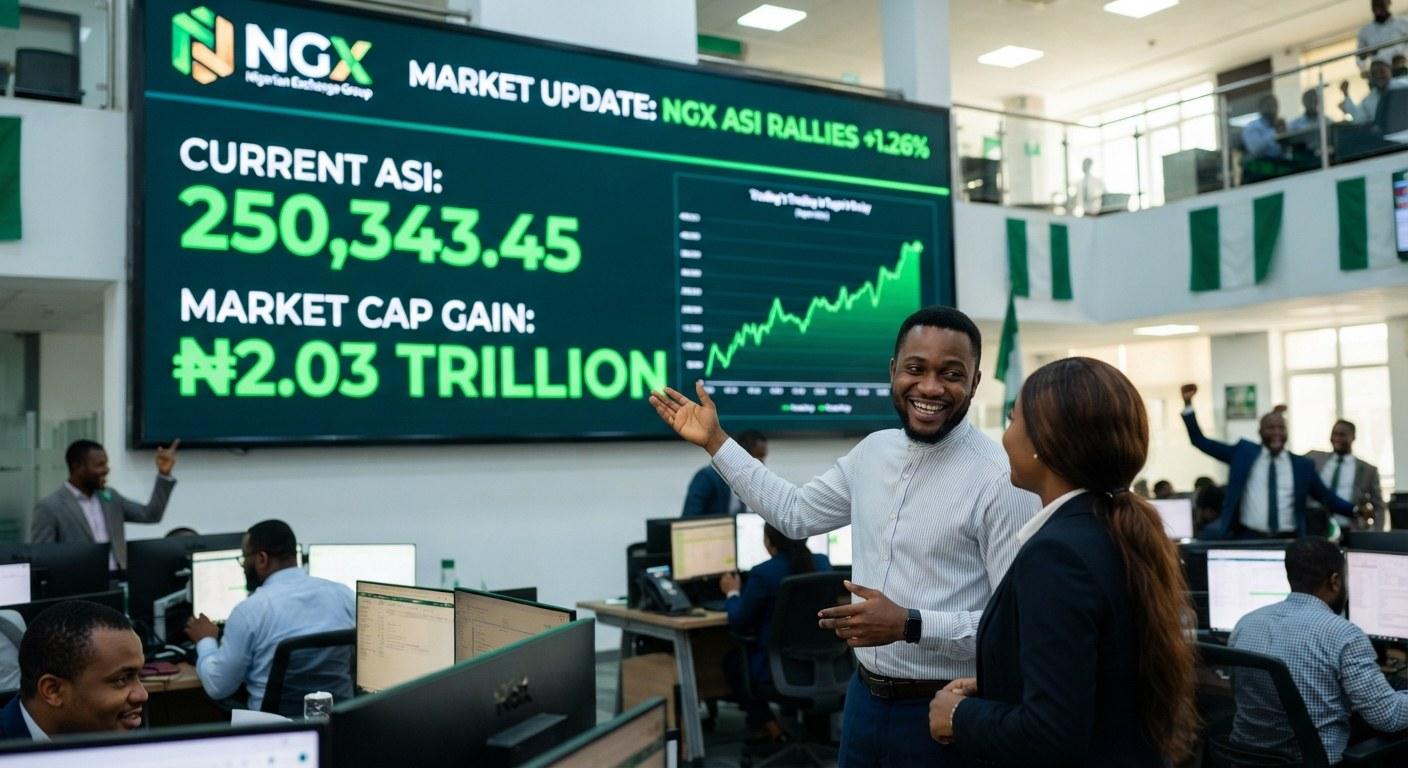
Nigeria’s equities market opened the final trading week of October on a strong note on Monday, with the benchmark All-Share Index (ASI) advancing by 1.26 per cent to close at 250,343.41 points, while market capitalisation reportedly increased by approximately ₦2.03 trillion to ₦162.55 trillion. The performance marked a significant improvement in aggregate market valuation, although the predominance of declining stocks over advancing equities suggested that the rally did not translate into a broadly shared recovery across the market.
The day’s trading presented investors with a market characterised by stronger transaction values, increased trading frequency, substantial gains in selected heavyweight stocks and continued selling pressure in several other counters. The contrast between the impressive rise in the headline index and the negative market breadth raises important questions about the sustainability of the advance, the distribution of investment demand and the direction of equities trading as the market approaches the end of October.
According to the supplied trading figures, investors exchanged 329.51 million shares in 43,647 deals, valued at approximately ₦25.43 billion. Compared with Friday, October 23, trading volume declined by about seven per cent, while turnover increased by 14 per cent and the number of deals rose by 30 per cent.
These figures indicate that although fewer shares changed hands, the value of transactions and the frequency of trades increased. This combination suggests that trading activity was concentrated in transactions involving relatively higher-value securities, increased activity in particular counters, or a shift in the composition of shares traded. It does not, by itself, establish that institutional investors were responsible for the rally, but it points to a market in which substantial capital continued to circulate despite the decline in aggregate volume.
The All-Share Index And Market Capitalisation: A Strong Headline Performance
The ASI’s reported 1.26 per cent appreciation represents a gain of 3,121.14 points, indicating a substantial upward movement in the aggregate prices of equities captured by the benchmark. The index is particularly important because it provides investors with a broad measure of price performance across the exchange, rather than the performance of an individual company or sector.
However, the index must be interpreted alongside market capitalisation and the performance of individual stocks. The reported increase in market capitalisation to ₦162.55 trillion, representing a gain of ₦2.03 trillion, suggests a considerable expansion in the market value of listed equities during the session.
Such an increase can strengthen investor confidence, improve the perceived value of equity holdings and reinforce expectations that the market may sustain its recovery. Yet, market capitalisation is a valuation measure, not an indication that the same amount of fresh money entered the exchange. It can rise as share prices appreciate even when aggregate trading volume declines.
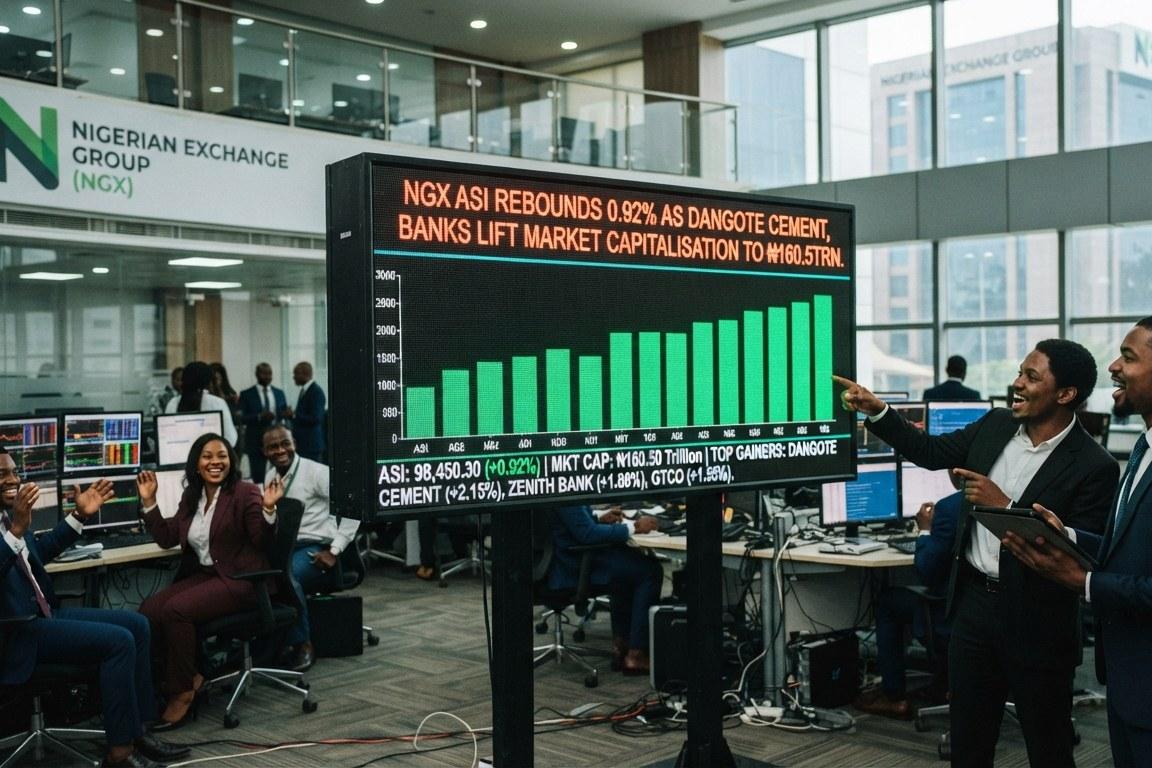
The market's performance also comes against the background of a substantial advance recorded on Friday, October 23. The ASI closed that session at 247,222.27 points, up 0.92 per cent, while market capitalisation rose to ₦160.52 trillion.
Monday’s reported advance would therefore represent a continuation of the positive momentum established at the end of the previous week.
Nevertheless, investors should distinguish between the market’s headline performance and the durability of the rally. A sustained advance would require continued demand across several sectors, improved corporate earnings expectations and sufficient liquidity to absorb profit-taking without significant deterioration in prices.
Trading Turnover Rises As Share Volume Declines
One of the more revealing aspects of Monday’s trading was the divergence between volume and value. The exchange reportedly recorded 329.51 million shares worth ₦25.43 billion in 43,647 deals, compared with Friday’s trading session.
The seven per cent decline in volume, combined with a 14 per cent increase in turnover, suggests that the average value represented by the shares traded increased. The 30 per cent rise in deals also indicates that transactions were more frequent, even though fewer shares changed hands.
This distinction matters because trading volume alone can give an incomplete picture of market activity. A large number of low-priced shares can generate considerable volume without producing a proportionate increase in turnover. Conversely, activity in expensive shares can lift transaction values even when fewer units are traded.
The figures suggest that investors were willing to transact at higher aggregate values, although the available information does not establish whether this resulted from institutional accumulation, retail participation, portfolio rebalancing or changes in the mix of securities traded.
The increase in turnover is therefore encouraging, but its significance should not be exaggerated. A healthy market advance is better established when stronger turnover accompanies broad-based price appreciation and when the upward movement persists beyond a single session.
There is, however, an important data-quality issue. The supplied summary also gives an alternative total of 268.46 million shares, 40,389 deals and ₦16.99 billion, which differs materially from the headline figures. Full-session market trackers also publish differing closing readings.
The headline figures supplied for this analysis are used provisionally, but the final exchange bulletin should be checked before publication.
Negative Market Breadth Tempers The Rally
Despite the impressive advance in the benchmark index, market breadth remained negative, with the supplied detailed report recording 23 gainers against 30 losers among the 132 equities that participated in trading. Three stocks reportedly closed unchanged in the alternative summary, although those counts do not reconcile with the total number of participating equities.
Negative breadth is an important warning signal because it shows that the index’s appreciation was not matched by a majority of rising shares. In practical terms, an investor holding a diversified collection of stocks could experience losses even as the headline market index advances.
This apparent contradiction is possible because the contribution of each stock to a market-capitalisation-weighted index depends on its weighting and price movement. A substantial gain in a large company can exert more influence on the benchmark than the decline of several smaller companies.
Consequently, Monday’s performance may reflect concentrated buying in influential stocks rather than a general improvement in investor sentiment across the exchange.
The 30 declining stocks, compared with 23 advancing equities in the detailed report, also suggest that selling pressure remained significant in parts of the market. Investors may have been taking profits on stocks that had appreciated in previous sessions, reassessing valuations or moving funds from weaker counters into companies perceived to offer stronger prospects.
Negative breadth does not invalidate the ASI’s advance, but it makes the quality of that advance less convincing. For the rally to demonstrate greater strength, the number of advancing equities would ideally expand, particularly across banking, industrial goods, consumer goods, insurance and oil and gas.
Dangote Cement, Honeywell Flour And NGX Group Lead Gainers
Dangote Cement emerged as the leading gainer in the supplied detailed report, appreciating by 10 per cent to close at ₦1,222.10 per share. Honeywell Flour Mills followed with a 9.78 per cent increase to ₦19.65, while Royal Exchange gained 9.18 per cent and Nigerian Exchange Group appreciated by 8.20 per cent.
These movements illustrate the diversity of interests driving the session, with gains recorded in industrial goods, consumer-related activity, insurance and the exchange’s own listed company.
Dangote Cement’s advance is particularly significant because of its position as a major industrial company and a heavyweight in the Nigerian equities market. Its share-price appreciation can materially influence the aggregate valuation of the exchange, although the precise contribution to Monday’s ASI movement would require the company’s weighting and the official index calculation.
The gain also places industrial equities in focus. Cement manufacturers are exposed to construction activity, infrastructure investment, production costs, energy prices, foreign-exchange conditions and demand from the property and building sectors. Investors evaluating the company must therefore consider whether the share-price advance is supported by earnings prospects and operating fundamentals rather than price momentum alone.
Honeywell Flour Mills’ near-10 per cent increase similarly draws attention to the consumer-goods segment. Flour milling companies are affected by grain prices, foreign-exchange movements, energy costs, financing expenses and the purchasing power of Nigerian households. A rising share price may reflect improved expectations, but sustained gains ultimately depend on the company’s ability to protect margins and generate earnings in a difficult operating environment.
NGX Group’s 8.20 per cent appreciation adds another dimension to the session. As a listed exchange operator, the company is linked to capital-market activity and investor participation, although its share-price performance should not automatically be treated as a direct measure of the exchange’s overall profitability.
The reported gains in these stocks were substantial, but investors should examine the underlying announcements, financial results and trading liquidity before interpreting them as evidence of a durable upward trend.
ABC Transport And Other Losers Signal Continued Selling Pressure
On the losing side, Associated Bus Company, also known as ABC Transport, declined by 9.59 per cent to ₦6.60 per share, making it the weakest performer in the supplied report. Caverton Offshore Support Group fell by approximately 9.38 per cent, Livestock Feeds lost 9.09 per cent, while Champion Breweries declined by 8.16 per cent.
The losses demonstrate that the market’s upward movement did not eliminate company-specific and sectoral pressures. The declines in transport, offshore support, agriculture-related and brewing stocks also underline the importance of examining individual counters rather than assuming that a rising benchmark guarantees positive returns across the market.
For ABC Transport, the price decline warrants closer examination of liquidity, earnings expectations and any relevant corporate disclosures before investors draw conclusions about the cause. The same principle applies to Caverton, Livestock Feeds and Champion Breweries: a single session’s decline does not establish a long-term deterioration in business prospects.
Nevertheless, simultaneous losses across several counters can influence investor psychology, especially when the headline index is rising. Investors who see their holdings decline while the benchmark advances may become more cautious, reassess their portfolios or seek opportunities in stocks demonstrating stronger relative performance.
The immediate question is whether these declines represent temporary profit-taking or a more persistent withdrawal of demand. Subsequent sessions should provide a clearer indication.
Zenith Bank, UBA And Access Holdings Drive Trading Activity
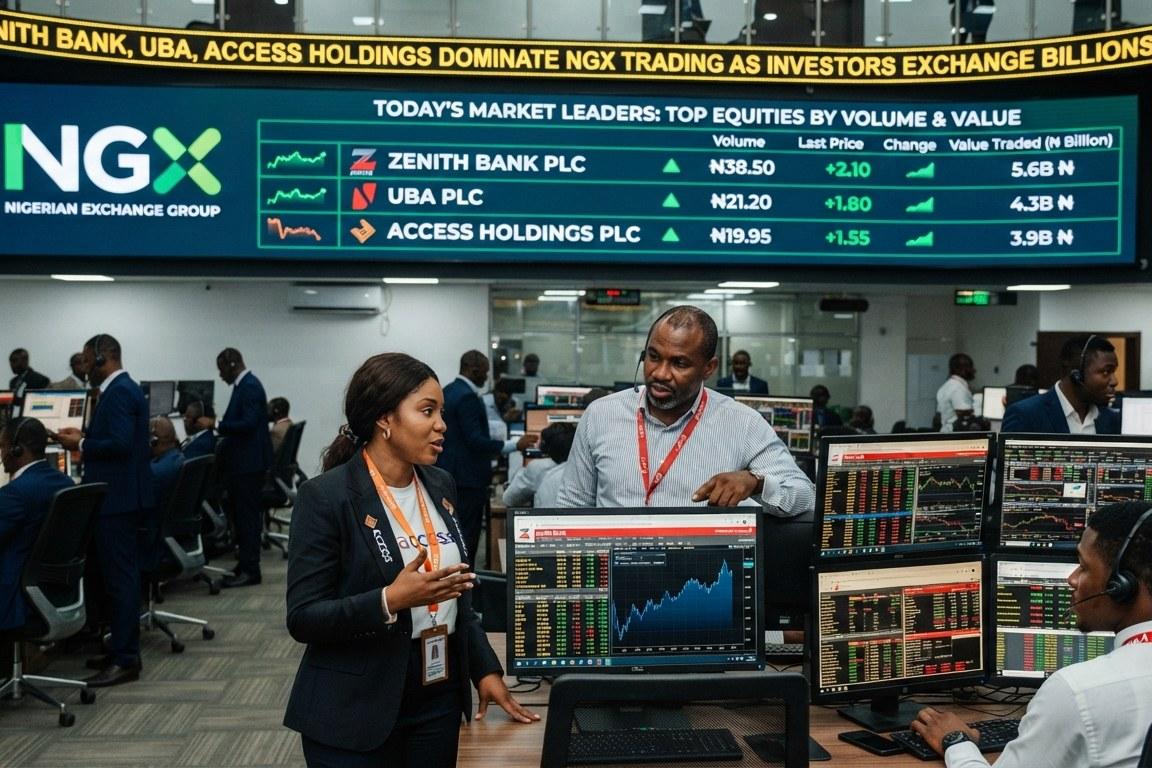
Banking stocks featured prominently among the most actively traded equities. Zenith Bank reportedly recorded approximately 25.9 million shares, followed by United Bank for Africa with 24 million shares, Access Holdings with 18 million and Fidelity Bank with 17.5 million.
The concentration of trading in major banking counters reinforces the importance of financial stocks to market liquidity and investor activity. These institutions are exposed to interest-rate conditions, credit quality, capital requirements, foreign-exchange transactions and the broader performance of the Nigerian economy.
However, high trading volume should not be confused with a positive price performance. Volume measures the number of shares exchanged, whereas price direction depends on the balance between buying and selling orders. Without the closing price movements and the official NGX Banking Index reading for Monday, it would be premature to conclude that the banking sector participated fully in the broader rally.
The same caution applies to other sectoral indices. The available report does not provide verified closing levels and daily percentage changes for the NGX 30, Banking, Industrial Goods, Consumer Goods, Insurance, Oil and Gas, Premium and other indices. These figures should not be invented or inferred from individual stock movements. The NGX publishes its index data separately.
Outlook: Can The Market Sustain Its October Recovery?
Monday’s reported performance offers an encouraging start to the trading week, supported by a stronger benchmark index, increased turnover and substantial gains in selected large-cap equities. Nevertheless, negative market breadth and losses in several stocks suggest that investors remain selective.
The direction of the market over the remaining sessions will depend on whether buying interest extends beyond the leading gainers, whether banking and other heavyweight equities sustain their contribution, and whether investors continue to accept prevailing valuations.
Macroeconomic conditions will also remain relevant. Inflation, borrowing costs, foreign-exchange stability, corporate earnings and household purchasing power all influence the attractiveness of equities relative to fixed-income securities and other investments. Companies that demonstrate earnings growth, stronger cash flows and credible dividend prospects may attract more durable demand than stocks rising primarily on short-term momentum.
Investors should also watch trading turnover and market breadth together. Rising turnover accompanied by a growing number of advancing stocks would provide stronger evidence of a broad-based recovery. If the ASI continues rising while decliners dominate, the market could remain vulnerable to profit-taking and reversals in heavyweight counters.
The reported increase in market capitalisation is therefore welcome, but it should be assessed alongside the sustainability of earnings, the distribution of gains and the quality of market participation.
In conclusion, Monday’s reported 1.26 per cent ASI advance to 250,343.41 points signals a positive headline performance, with market capitalisation rising to ₦162.55 trillion. Dangote Cement, Honeywell Flour Mills, Royal Exchange and NGX Group led the reported gainers, while ABC Transport, Caverton, Livestock Feeds and Champion Breweries suffered notable declines.
The central message for investors is that a rising index is encouraging, but a broadly advancing market is more convincing. The next sessions will show whether Monday’s gains mark the beginning of a wider recovery or another rally driven by a relatively narrow group of influential stocks.