PublicSphere Live
Politics
Kwankwaso, Atiku And The 2031 Calculation: The Politics Behind The Opposition's Growing Divisions
Nevertheless, the controversy exposes a deeper problem within Nigeria’s opposition: the difficulty of reconciling individual presidential ambitions with the collective necessity of building a coalition capable of challenging an incumbent president.
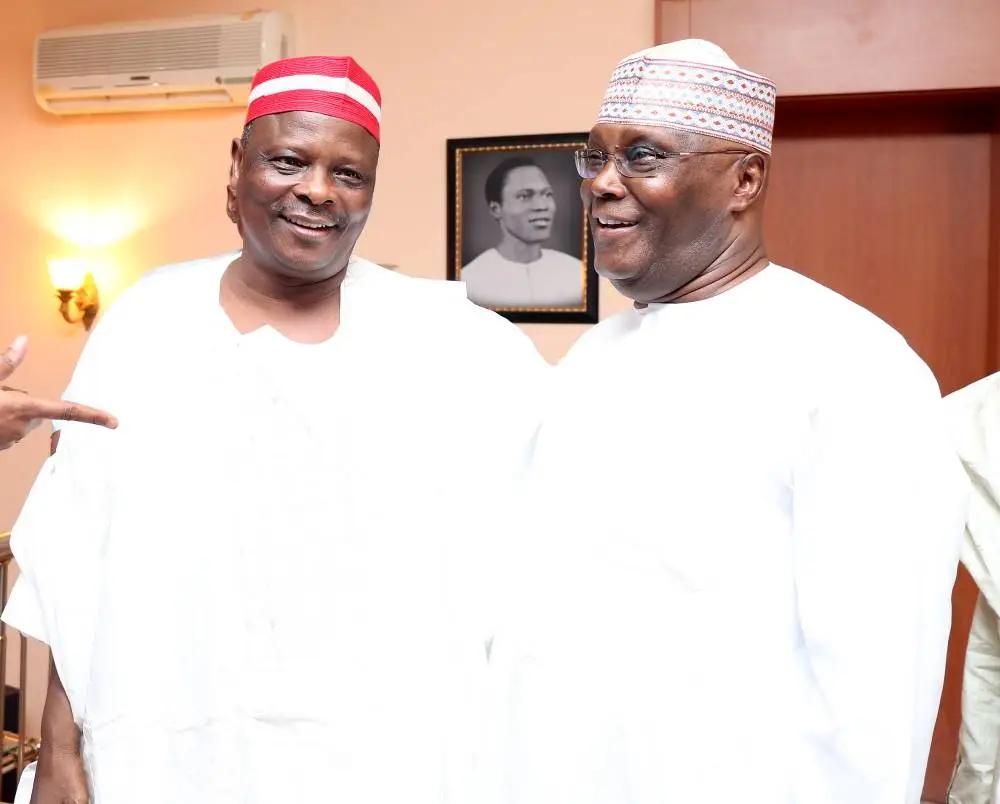
Nigeria’s opposition politics appears to be entering a season in which personal ambitions, strategic calculations and the struggle for political relevance are becoming as consequential as the declared objective of defeating the ruling All Progressives Congress (APC) in the 2027 general elections. At the centre of this emerging contest is Rabiu Musa Kwankwaso, the former Kano State governor whose political influence in northern Nigeria has made him an important figure in the opposition’s search for a credible presidential alternative to President Bola Tinubu.
A recent criticism by Kola Ologbondiyan, spokesman for the Presidential Campaign Council of the African Democratic Congress (ADC-PCC), has raised a fundamental question about Kwankwaso’s political calculations: Is his apparent fixation on former Vice President Atiku Abubakar driven by genuine ideological differences, a disagreement over the opposition’s leadership structure, or a longer-term ambition to become Nigeria’s president in 2031?
Ologbondiyan’s argument is that Kwankwaso may be more interested in securing his future presidential prospects than in contributing to a collective opposition strategy for 2027. According to him, Kwankwaso’s reported description of the office of vice president as a “spare tyre” suggests that he may not consider the position sufficiently attractive to justify sacrificing his presidential ambition.
This interpretation deserves serious examination. However, it is important to distinguish between political accusations and established facts. The claim that Kwankwaso is working to advance Tinubu’s interests, for instance, remains Ologbondiyan’s political assessment rather than proof of a coordinated arrangement between the former Kano governor and the ruling party.
Nevertheless, the controversy exposes a deeper problem within Nigeria’s opposition: the difficulty of reconciling individual presidential ambitions with the collective necessity of building a coalition capable of challenging an incumbent president.
The 2031 Question Behind The 2027 Struggle
The suggestion that Kwankwaso may be calculating towards 2031 is plausible as a political hypothesis, even though his actual intentions cannot be established from the reported remarks alone.
In presidential politics, the immediate election is rarely the only consideration. Politicians assess not merely what they can win today but also what a particular alliance might mean for their bargaining power, political identity and prospects in subsequent electoral cycles.
Kwankwaso is not a political newcomer who can easily be persuaded to abandon his ambitions in exchange for a subordinate position. Having served as governor of Kano State and occupied other important political offices, he has built a recognisable political identity around the Kwankwasiyya movement, with a substantial following in Kano and influence beyond the state.
For such a politician, accepting the vice-presidential position in a coalition could represent a strategic compromise. It might offer an immediate opportunity to participate in a new administration, but it could also require him to support a presidential candidate whose political stature, national network and ambitions might overshadow his own.
The vice presidency is constitutionally significant, but its practical influence depends considerably on the president, the political circumstances and the responsibilities assigned to the occupant. A vice president can become an influential participant in government, yet the office does not automatically provide an independent political platform equivalent to the presidency.
If Kwankwaso believes that he has a realistic opportunity to contest for the presidency in his own right in 2031, he may consider it more advantageous to preserve his political independence than to enter an alliance that could complicate that ambition.
Such a calculation would not necessarily make him an opponent of the opposition. It would, however, place his personal political future in potential conflict with the immediate objective of defeating the APC in 2027.
The central question, therefore, is not simply whether Kwankwaso wants to become president. Presidential ambition is a legitimate feature of democratic politics. The more important question is whether the pursuit of that ambition is compatible with the compromises required to establish a viable opposition coalition.
Why Atiku Has Become A Point Of Contention
Atiku Abubakar remains one of the most experienced figures in Nigeria’s opposition politics. His long political career, national connections and repeated presidential campaigns have given him considerable visibility, but they have also made him a controversial figure among politicians seeking a generational or strategic change in the country's leadership.
For Kwankwaso, the issue may extend beyond personal relations with Atiku to the question of who should lead the opposition and how the leadership should be determined.
If Atiku emerges as the dominant presidential figure in an opposition arrangement, other ambitious politicians may fear that their own prospects will be diminished. A coalition in which one leader enjoys a clear advantage in political experience, financial resources, national organisation or elite connections can create tensions among partners who believe they possess equally valuable electoral assets.
Kwankwaso may also believe that his political base gives him sufficient bargaining power to demand a more favourable arrangement than the one available under Atiku's leadership. His support in Kano, the influence of the Kwankwasiyya movement and his appeal among sections of northern voters could make him an attractive partner to a presidential candidate seeking to strengthen his electoral prospects.
But political leverage does not automatically translate into presidential viability. A candidate must demonstrate an ability to build alliances across geographical, religious, ethnic and economic divisions, as well as persuade voters outside his strongest constituency that he can govern the country.
Consequently, Kwankwaso's challenge is to determine whether his political influence is best deployed in a joint opposition project or preserved for a future independent presidential campaign.
Ologbondiyan's criticism suggests that Kwankwaso's conduct is weakening the opposition's immediate prospects. Yet it is equally possible that Kwankwaso and his supporters view the disagreements as a necessary struggle over the terms of political cooperation rather than an attempt to undermine the opposition.
The distinction matters. Political disagreement should not automatically be interpreted as sabotage, just as the language of coalition-building should not be used to suppress legitimate questions about leadership, representation and the distribution of power.
Is Kwankwaso Indispensable To Victory In Kano?
One of Ologbondiyan's strongest arguments concerns the assumption that Kwankwaso's support is indispensable to any presidential candidate seeking victory in Kano State.
He cited the presidential elections of 2003 and 2007, arguing that Muhammadu Buhari secured victories in Kano without Kwankwaso's support and that Atiku could similarly win the state in 2027.
The argument challenges the tendency to treat political leaders as the unquestionable owners of their supporters' votes.
In Nigeria, political movements often acquire an identity so closely associated with their founders that party strategists assume followers will automatically vote according to their leaders' instructions. Yet electoral behaviour is more complicated. Voters can remain loyal to a political movement while making independent decisions about particular candidates, parties and elections.
Kano's electoral history demonstrates the importance of examining local political structures, candidate appeal and wider political circumstances rather than attributing every outcome to one individual.
However, historical comparisons must be handled carefully. The political environment of 2003 or 2007 cannot simply be reproduced in 2027. Party structures, voter demographics, political alliances, campaign strategies and public attitudes have changed over time.
Buhari's electoral appeal in Kano was shaped by factors that extended beyond Kwankwaso's political choices. Similarly, Atiku's prospects in the state will depend on his own popularity, the strength of his party's organisation, the effectiveness of his campaign and the broader political mood.
Kwankwaso's influence should therefore neither be exaggerated nor dismissed. His movement could provide a presidential candidate with an important organisational advantage, but it cannot guarantee victory. Conversely, the absence of his endorsement would not automatically make victory impossible.
The decisive issue is whether a candidate can establish a credible relationship with voters, particularly those who feel neglected by existing political arrangements.
The Allegation Of Helping Tinubu
Ologbondiyan's most politically consequential allegation is that Kwankwaso's actions amount to advancing President Tinubu's interests by creating confusion within the opposition.
This accusation reflects a longstanding problem in Nigeria's multiparty politics: whenever opposition parties disagree over candidates, alliances or leadership, supporters of rival camps often accuse one another of helping the ruling party.
There is an understandable strategic argument behind the concern. An incumbent president generally benefits when opposition forces enter an election divided, particularly where they compete for similar voter groups. Fragmentation can disperse votes, complicate campaign coordination and make it harder for challengers to present a convincing alternative to the electorate.
If several opposition candidates divide their support among themselves, the ruling party may benefit even without expanding its own popularity.
Yet this does not establish that every politician who refuses to join a coalition is acting on behalf of the government. Democratic competition permits independent candidates, competing platforms and disagreements over the best route to political change.
To substantiate the allegation against Kwankwaso, critics would need to demonstrate more than the fact that his position differs from theirs. They would need to establish how his actions objectively benefit the APC and, if alleging deliberate collaboration, provide credible evidence of coordination or intent.
Without such evidence, the accusation remains a political interpretation.
Nevertheless, Kwankwaso cannot entirely escape responsibility for the consequences of his strategic choices. If he rejects an opposition arrangement, he must explain what alternative he proposes, how that alternative would improve the country's political prospects and whether it is intended primarily to strengthen the opposition or preserve his personal bargaining position.
The same standard should apply to Atiku and other opposition leaders. They cannot demand unity while treating every disagreement as disloyalty or expecting other politicians to surrender their ambitions without transparent negotiations.
The Opposition's Problem Is Bigger Than Kwankwaso
The controversy exposes a fundamental weakness in Nigeria's opposition: the absence of a sufficiently trusted and transparent mechanism for deciding who should lead a coalition.
Opposition politicians frequently invoke unity when they need electoral cooperation, but unity becomes more difficult when they must agree on presidential tickets, campaign financing, party structures, political appointments and the distribution of influence in a prospective government.
These disagreements are often presented as ideological disputes, although personal ambition and calculations about political survival may be equally important.
If opposition leaders genuinely believe that Nigeria needs a different political direction, they must demonstrate that belief through negotiations capable of accommodating competing interests without sacrificing democratic principles.
A credible coalition should establish clear criteria for selecting its presidential candidate, whether through a transparent primary, an agreed consensus procedure or another legitimate mechanism accepted by its participating parties.
It should also articulate a common programme addressing economic hardship, unemployment, insecurity, education, healthcare, public accountability and the cost of living. Voters need to know what an opposition administration would do differently, not merely which politicians would occupy the highest offices.
This is particularly important in a country where many citizens face serious economic pressures. For such voters, the question of whether Kwankwaso, Atiku or another politician becomes president is secondary to whether the next government can create jobs, improve public services, strengthen security and restore confidence in public institutions.
An opposition that spends more time debating the ambitions of its leaders than presenting credible solutions risks appearing indistinguishable from the political establishment it seeks to replace.
What Kwankwaso Must Decide
Kwankwaso faces a strategic choice. He can participate in building a broad opposition arrangement for 2027, negotiate for a role that preserves his influence, or maintain a political position that leaves him better placed to pursue his own ambitions in the future.
Each option carries risks. Joining a coalition could strengthen the opposition's electoral prospects but require compromises that may constrain his future plans. Remaining outside an agreed arrangement could preserve his independence but reduce his influence over the immediate contest. Supporting an alternative political route could strengthen his bargaining position, but it would also require convincing voters that the strategy serves a wider public interest rather than an individual ambition.
There is nothing inherently wrong with a politician preparing for 2031 while participating in the 2027 contest. Political leaders routinely think beyond a single election. The difficulty arises when future ambitions undermine present commitments or when political manoeuvres weaken the very democratic alternatives that politicians claim to be building.
Kwankwaso should therefore be judged by the clarity of his proposals, the consistency of his political conduct and the evidence available about the consequences of his decisions, rather than by assumptions about his intentions.
Atiku, for his part, must recognise that experience and national recognition do not automatically entitle any politician to lead the opposition. He must demonstrate that his candidacy can attract new supporters, accommodate coalition partners and offer a credible route to electoral victory.
Tinubu's political opponents also need to understand that defeating an incumbent requires more than assembling prominent names. It requires organisation, public trust, a compelling programme and the discipline to manage internal disagreements.
Conclusion: Ambition Is Legitimate, But Voters Must Come First
Is Kwankwaso obsessed with Atiku because he is already calculating towards 2031? The possibility cannot be dismissed, but the available statements do not establish it as fact. His apparent disagreement with Atiku may reflect a mixture of personal ambition, concerns about political leadership, competing electoral strategies and the desire to preserve the strength of his own movement.
Ologbondiyan's criticism is significant because it highlights the danger that competing ambitions could weaken the opposition before the 2027 elections. His historical argument about Kano also serves as a reminder that no politician should assume permanent ownership of a state's electorate.
But the opposition will not become stronger simply by accusing Kwankwaso of helping Tinubu or by insisting that Atiku must lead. It will become stronger when its leaders establish transparent rules for cooperation, present a credible alternative to the electorate and demonstrate that their collective purpose extends beyond the distribution of political offices.
Ultimately, the question is not whether Kwankwaso has presidential ambitions for 2031. He is entitled to aspire to the highest office in the land. The question is whether he, Atiku and other opposition figures can reconcile their ambitions with the immediate responsibility of offering Nigerians a credible democratic choice in 2027.
For voters struggling with economic hardship, insecurity and uncertainty about the future, the opposition's internal calculations will matter only insofar as they produce a better government. If political leaders cannot place that public interest above their rivalry, they may discover that the greatest beneficiary of their disagreements is neither Kwankwaso nor Atiku, but the political establishment they claim to be challenging.