PublicSphere Live
Metro News
FG Reopens First Niger Bridge After 38-Day Closure
The Minister of Works, Dave Umahi, performed the reopening ceremony on Thursday at the Onitsha end of the bridge, in the presence of representatives of the federal and state governments, as well as traditional rulers from Anambra and Delta states.
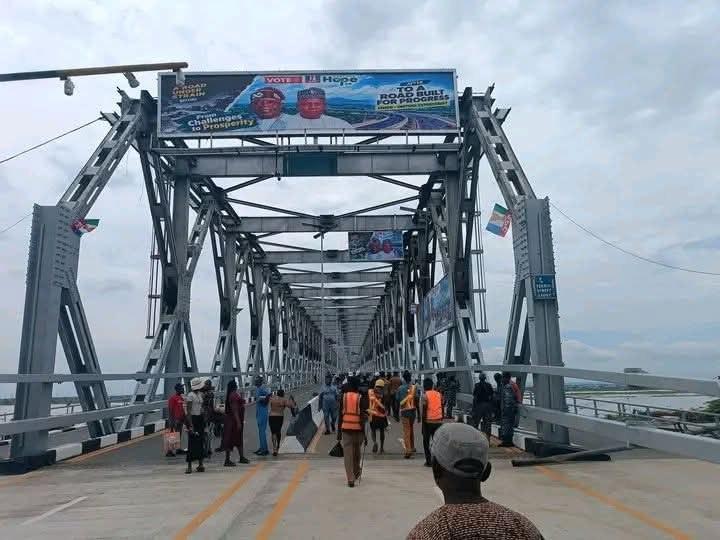
Umahi Says Rehabilitation Will Improve Safety, Ease Congestion; Commends Contractor, Seeks Support For Tinubu’s Re-Election
The Federal Government has reopened the First Niger Bridge linking Onitsha in Anambra State with Asaba in Delta State after approximately 38 days of closure for emergency rehabilitation and maintenance, restoring a critical transportation corridor connecting the South-East and South-South regions.
The Minister of Works, Dave Umahi, performed the reopening ceremony on Thursday at the Onitsha end of the bridge, in the presence of representatives of the federal and state governments, as well as traditional rulers from Anambra and Delta states.
The reopening is expected to provide relief to motorists, commercial drivers, traders, transport operators and other road users whose movements were disrupted by the prolonged closure of the bridge, a vital crossing over the River Niger that facilitates the movement of people and goods between the two regions and other parts of the country.
The bridge, commissioned in 1965, is one of Nigeria’s most important road infrastructure assets. Its strategic position makes it essential to commercial activities in Onitsha, one of the country’s major trading centres, and Asaba, the Delta State capital, as well as communities and businesses that depend on the route for the movement of agricultural produce, manufactured goods and other commodities.
The closure, which began on September 7, was initially scheduled to last until September 21 to allow emergency repairs following the discovery of vandalised structural components, including steelwork associated with the bridge’s expansion joints.
However, the Federal Government subsequently extended the closure indefinitely after persistent rainfall and other unforeseen circumstances delayed the rehabilitation programme.
The reopening on Thursday marks the end of the extended disruption, although Umahi indicated that some aspects of the rehabilitation work remained outstanding.
Emergency Repairs to Protect Bridge Users
Explaining the importance of the intervention, the minister said the necessary infrastructure had been repaired to facilitate the free flow of traffic and improve safety for motorists using the bridge.
He stressed that the rehabilitation was undertaken to address identified structural concerns, ease congestion and ensure that the bridge could continue to serve the travelling public.
The discovery of vandalised structural components had raised concerns about the condition of the ageing bridge and the need for prompt intervention to protect road users.
Expansion joints are important components of bridge infrastructure because they accommodate movements arising from temperature changes, traffic loads and other structural forces. Their proper functioning helps protect the bridge structure from stresses that could accelerate deterioration.
The emergency intervention therefore represents an important maintenance measure on a facility that has served the country for more than six decades.
Although the minister announced the reopening, he acknowledged that the rehabilitation programme was not entirely completed, indicating that further work would be undertaken.
“We are not 100 per cent done because we are going to do more work,” Umahi said.
His remarks suggest that the reopening should be understood as the restoration of traffic following the completion of the essential works required at this stage, rather than a declaration that every aspect of the maintenance programme has been concluded.
The remaining work will be important in ensuring that the repairs deliver lasting benefits and that the bridge continues to provide a safe and reliable connection between the two states.
Umahi Commends Contractor, State Governments
Umahi expressed appreciation to the governors of Anambra and Delta states for their cooperation during the rehabilitation exercise.
He also commended the contractor, SKCC, for what he described as a commendable performance in carrying out the work.
“We have every reason to thank the governors of Anambra and Delta states,” the minister said.
“We must commend the contractors, SKCC, very, very highly; they have worked very well.”
The minister’s acknowledgement of the two state governments highlights the importance of cooperation between the federal and state authorities in maintaining infrastructure that serves communities across state boundaries.
Although the bridge is a federal infrastructure asset, its condition and availability have immediate consequences for economic and social activities in both Anambra and Delta states.
The closure also demonstrated how disruptions to a single strategic transportation link can affect businesses, commuters and transport services on either side of the River Niger.
For traders operating in Onitsha, a major commercial destination, and businesses in Asaba and neighbouring communities, the restoration of the crossing is particularly significant because reliable road connections are essential to the movement of goods, the delivery of supplies and the coordination of commercial activities.
The reopening is also expected to help normalise journeys for passengers travelling between the South-East and South-South, although the actual improvement in traffic conditions will depend on the volume of vehicles returning to the route and the arrangements put in place for traffic management.
Tinubu’s Infrastructure Agenda in Focus
The reopening ceremony also became an occasion for Umahi to defend the infrastructure record of President Bola Tinubu’s administration and appeal for continued political support for the President.
The minister described the rehabilitation as evidence that the administration was committed to infrastructure development across the country's regions, arguing that the South-East and South-South were benefiting from federal interventions alongside other parts of Nigeria.
“What other regions are getting, the people of the South-South and South-East are getting it,” he said.
He added that the intervention demonstrated the President’s commitment to serving Nigerians without discrimination on the basis of ethnicity or regional affiliation.
In a direct appeal to the people of the South-East, Umahi urged them to recognise the administration’s infrastructure efforts by supporting Tinubu’s re-election bid in the presidential election scheduled for January 16, 2027, as stated by the minister.
“What other regions are getting, the people of the South-South and South-East are getting it. And so, why should we not appreciate the President?” he asked.
The minister maintained that the bridge rehabilitation was part of a broader pattern of infrastructure interventions that, in his view, justified his support for the President.
He declared that he had no regret backing Tinubu and expressed confidence in the President’s leadership qualifications.
“We have no regret supporting President Bola Tinubu. Let me declare, in opening this bridge, that I have no regret supporting Mr President,” Umahi said.
“I am very, very proud for him to be my boss. He is the most qualified and eminently qualified to lead this country.”
His comments reflect the administration’s effort to connect infrastructure delivery with its broader political message ahead of the next general election.
However, the ultimate political impact of such interventions will depend not only on the completion of projects but also on how citizens experience their benefits in their everyday lives, including the condition of connecting roads, transport costs, journey times and the reliability of public infrastructure.
Minister Recalls Enugu-Onitsha Road Challenges
In defending the administration’s record, Umahi also drew attention to the longstanding difficulties associated with the Enugu-Onitsha Road, which he said had remained impassable in previous years.
He questioned why earlier administrations and political officeholders had not intervened sufficiently to address the road’s problems.
“For how many years, we had Enugu-Onitsha Road, nobody could pass it. Why was there no governor that intervened?” he asked.
The minister’s reference to the road underscored his argument that the present administration should be judged partly by its efforts to address longstanding infrastructure challenges.
The Enugu-Onitsha corridor is an important route for transportation and commerce across the South-East. Its condition has implications for regional mobility, business costs and access to markets.
For road users, however, the central consideration remains whether ongoing and completed interventions translate into durable improvements in the quality of travel.
The First Niger Bridge and the Enugu-Onitsha Road are examples of infrastructure whose importance extends beyond the immediate communities they serve. Their condition affects interstate commerce, the distribution of goods and the movement of people across a substantial part of southern Nigeria.
Consequently, the reopening of the bridge provides an opportunity for the Federal Government to demonstrate that emergency maintenance can be followed by consistent monitoring, preventive repairs and sustained investment in the transportation network.
A Vital Link for Commerce and Regional Mobility
The First Niger Bridge occupies a special position in Nigeria’s transportation network because it links two states separated by the River Niger while connecting major commercial and administrative centres.
Onitsha's markets attract traders and customers from across Nigeria and beyond, while Asaba serves as a gateway to communities in Delta State and other parts of the South-South.
The bridge therefore supports far more than routine commuting. It facilitates commercial exchanges, distribution networks, passenger transport and other economic activities that depend on predictable movement between the regions.
A prolonged closure of such a strategic crossing can place additional pressure on alternative routes, potentially increasing travel distances, journey times and operating costs for transport businesses.
For commercial drivers, delays can affect the number of trips completed in a day, while traders may face difficulties coordinating the movement of goods and meeting delivery schedules.
The reopening should help ease those pressures and restore greater predictability to journeys between Onitsha and Asaba.
Nevertheless, the experience of the past 38 days reinforces the importance of planning major maintenance operations carefully and communicating changes to closure schedules promptly, particularly when unforeseen weather conditions affect construction work.
It also highlights the need to protect public infrastructure against vandalism. Damage to critical structural components can necessitate emergency repairs, disrupt economic activity and impose additional costs on government and road users.
Protecting the bridge must therefore be a shared responsibility involving the relevant authorities, maintenance contractors and the public.
Focus Shifts to Completion and Long-Term Maintenance
While Thursday's reopening represents an important milestone, the minister's admission that some work remains unfinished points to the need for continued attention to the bridge.
The immediate priority is to ensure that traffic resumes safely and that outstanding rehabilitation tasks are completed to the required standards.
Regular inspections, prompt repairs and effective protection of structural components will be necessary to preserve the facility and minimise the likelihood of further disruptions.
The age of the bridge makes maintenance especially important. Having served Nigeria since 1965, it remains a crucial national asset whose continued reliability depends on consistent engineering oversight and timely intervention.
The government will also need to ensure that motorists receive clear information about any further work that could affect traffic, so that commuters and businesses can plan their journeys accordingly.
For the residents, traders and transport operators who depend on the crossing, the reopening is welcome news after more than a month of disruption.
For the Federal Government, it offers an opportunity to demonstrate that infrastructure rehabilitation can deliver practical benefits when projects are executed, monitored and maintained effectively.
Umahi formally declared the bridge open, expressing gratitude to God and describing the intervention as evidence of the President's commitment to the South-East and South-South.
“By the power of Mr President and in our deep appreciation of what he has done for the people of the South-South and South-East on this bridge, it is my humble pleasure, with gratitude to God Almighty, to open this bridge for the benefit of our people, in Jesus' name,” he said.
With traffic now restored, attention will turn to the completion of the outstanding works and the bridge's continued performance as a major link between the two regions.
Ultimately, the success of the intervention will be measured not simply by the reopening ceremony, but by the safety of road users, the durability of the repairs and the bridge's ability to sustain the movement of people and goods without avoidable interruptions.