PublicSphere Live
Editorial
EDITORIAL: First Niger Bridge: FG Deserves Credit for Restoring A Lifeline, But Must Sustain The Gains
It is the restoration of a critical economic lifeline, the easing of an enormous transportation burden and the return of a measure of normalcy to communities whose daily lives and livelihoods have been disrupted by the closure.
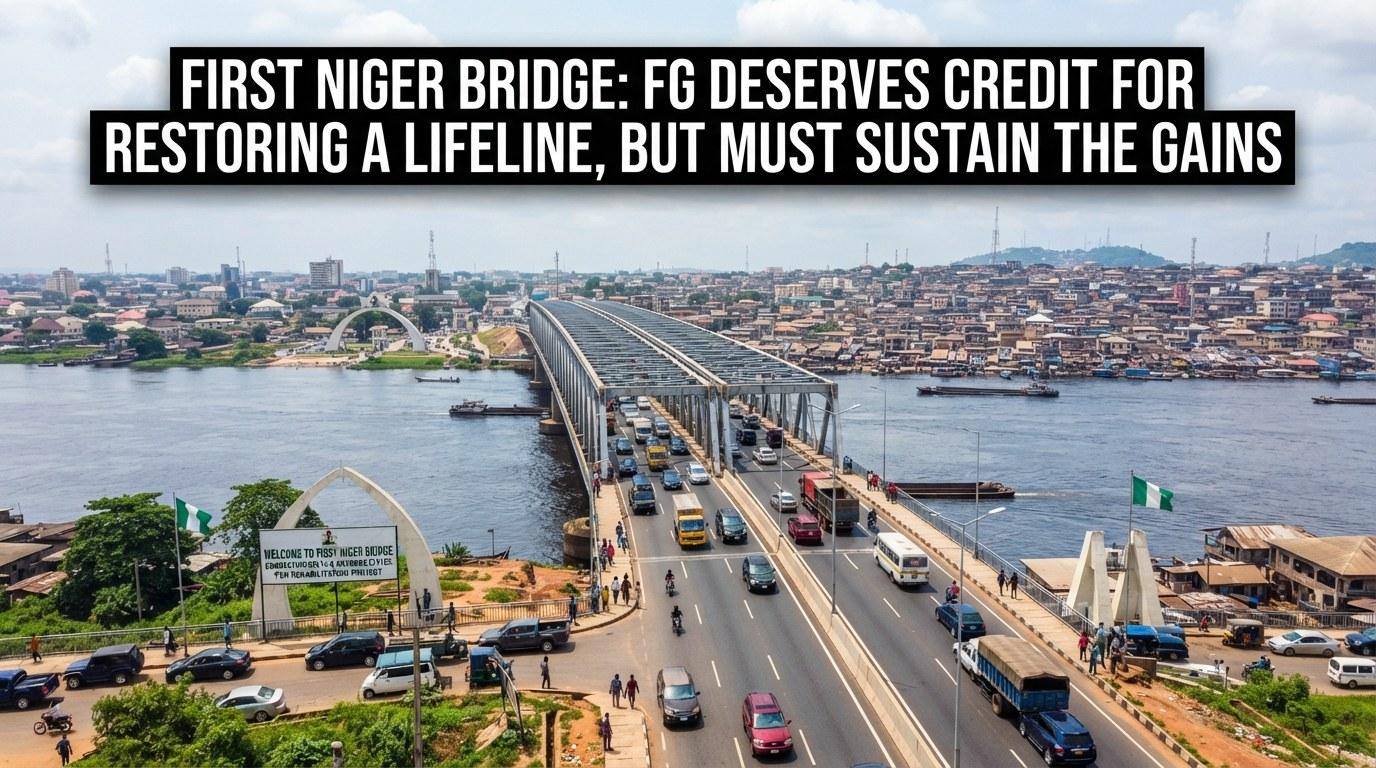
The reopening of the First Niger Bridge to traffic after approximately 38 days of closure is a welcome development that deserves commendation. For the thousands of motorists, traders, transport operators, commuters, manufacturers and other road users who depend on this vital connection between Onitsha in Anambra State and Asaba in Delta State, the Federal Government’s action represents more than the reopening of a bridge. It is the restoration of a critical economic lifeline, the easing of an enormous transportation burden and the return of a measure of normalcy to communities whose daily lives and livelihoods have been disrupted by the closure.
The decision by the Federal Government, through the Ministry of Works under the supervision of the Minister, Dave Umahi, to reopen the bridge is therefore a development worth welcoming. It demonstrates the importance of completing essential road maintenance and rehabilitation work while recognising that prolonged restrictions on strategic transport infrastructure impose substantial costs on citizens and businesses.
However, while the reopening deserves praise, the larger lesson is that Nigeria must move beyond celebrating the restoration of access after disruptions. The country must build a more dependable system of infrastructure maintenance, traffic management and alternative-route planning that minimises the hardship experienced by citizens whenever major transport corridors require repairs.
The First Niger Bridge is too important to the national economy for its condition and availability to be treated as matters of routine administrative concern.
A Bridge That Connects More Than Two Cities
The significance of the First Niger Bridge extends far beyond its physical location between Onitsha and Asaba. It is one of the principal transport links connecting communities in the South-East and South-South with other parts of Nigeria. It facilitates the movement of people, agricultural produce, manufactured goods, raw materials and commercial supplies across regional boundaries.
Onitsha, one of Nigeria’s most important commercial centres, hosts a vast network of wholesalers, retailers, distributors and manufacturers whose activities depend on the efficient movement of goods. Asaba, the Delta State capital, is equally important as an administrative, residential and commercial centre, while the wider region supports oil and gas operations, agriculture, logistics, construction and numerous small and medium-sized enterprises.
The bridge is consequently not merely a piece of concrete and steel. It is an essential component of the country's economic infrastructure, linking markets, supporting employment and helping businesses meet their obligations to customers and suppliers.
When such a strategic connection becomes unavailable, the consequences extend far beyond the immediate vicinity. Transport costs rise, delivery schedules are disrupted, journeys become longer and commercial transactions may be delayed. The effects can be particularly severe for small businesses operating on narrow profit margins and transport operators whose earnings depend on completing several trips within a reasonable period.
The reopening therefore restores an important channel of economic activity and offers relief to the many people whose daily responsibilities depend on the free movement of traffic across the Niger.
Relief For Motorists, Traders and Commuters
The greatest immediate beneficiaries of the reopening are ordinary Nigerians who have had to contend with the consequences of the closure.
For commercial drivers, the additional time and distance associated with alternative routes can translate into higher fuel consumption, increased vehicle maintenance costs and fewer trips completed each day. For passengers, detours and congestion can mean longer journeys, missed appointments and additional transport expenses. For traders, delays can affect the delivery of perishable goods, the availability of merchandise and the timely movement of supplies to customers.
These are not insignificant inconveniences in an economy where many households and businesses are already under pressure from the high cost of living and the rising cost of doing business.
Every unnecessary hour spent on the road represents a potential loss of productive time. Every avoidable increase in transport expenses places another burden on consumers and business owners. Every delayed consignment can affect a chain of commercial transactions involving suppliers, distributors, retailers and final buyers.
The reopening should therefore be seen as a practical intervention with direct implications for livelihoods, productivity and economic confidence.
It offers motorists the prospect of more predictable journeys, gives traders a better opportunity to reconnect with their markets and allows transport operators to resume using their normal routes. It also helps restore the movement of people visiting relatives, attending to official duties, pursuing educational opportunities and accessing essential services on either side of the Niger.
For these reasons, the Federal Government deserves credit for restoring access to this important corridor. Government action is most meaningful when citizens can experience its benefits in their daily lives, and the reopening of a strategic bridge is an example of the kind of public intervention whose value can be readily understood by ordinary Nigerians.
Maintenance Must Not Be Confused with Neglect
It is important, however, to recognise that the need to close a bridge for essential maintenance does not necessarily indicate administrative failure. Major infrastructure requires periodic inspection, rehabilitation and other interventions to preserve its structural integrity and extend its service life.
A bridge that carries heavy traffic over many years cannot be expected to remain dependable without proper engineering attention. Allowing deterioration to continue unchecked in the name of avoiding temporary inconvenience would be an irresponsible approach that could expose road users to much greater risks and ultimately result in more expensive repairs.
The responsible course is to identify problems early, undertake the necessary work and communicate clearly with the public about the expected disruption.
In this respect, the reopening of the First Niger Bridge provides an opportunity to emphasise the importance of preventive maintenance as a central pillar of national infrastructure management. Governments should not wait until roads, bridges and other public assets become severely damaged before committing resources to their rehabilitation.
A systematic maintenance programme can help reduce emergency closures, limit the scale of repairs required and protect public investment. It can also improve safety and make infrastructure expenditure more predictable.
The Federal Government should therefore treat the reopening not as the end of its responsibility but as an important stage in the continuing obligation to preserve the bridge and ensure that it remains safe, serviceable and dependable.