PublicSphere Live
Politics
Soludo Backs Tinubu’s Re-Election, Calls for Unity of Progressive Parties
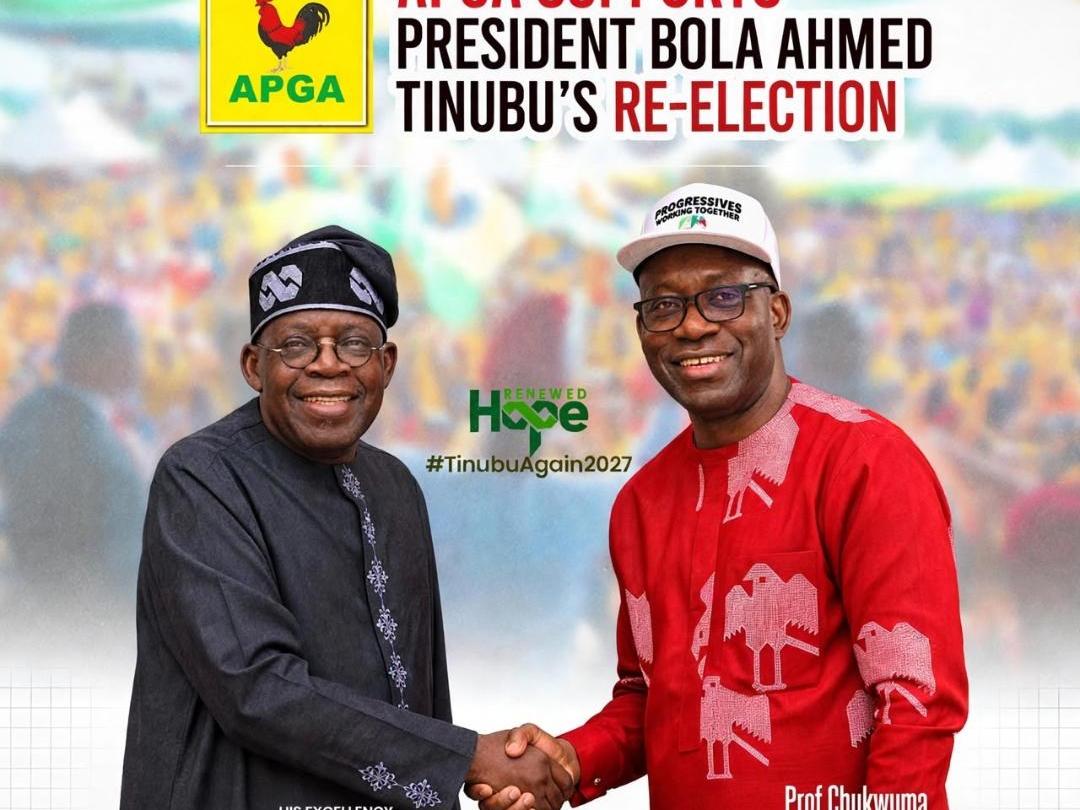
ABUJA — Anambra State Governor Chukwuma Charles Soludo has declared the support of the All Progressives Grand Alliance (APGA) for President Bola Ahmed Tinubu’s re-election bid, describing the forthcoming political contest as an opportunity for progressive political forces to unite behind what he called a new Nigeria.
Soludo, who spoke at the inauguration of the All Progressives Congress (APC) Presidential Campaign Council in Abuja, said APGA was backing Tinubu because the President represented the principles of national unity, security and shared prosperity which the party considered essential to Nigeria’s future.
The governor said the country had never witnessed the level of political and elite consensus he believed was currently emerging around a sitting president’s re-election and the direction of economic reforms.
According to him, the presence of about 33 governors at the campaign council’s inauguration demonstrated the extent of political support for Tinubu, although he did not provide a breakdown of the governors’ party affiliations or their individual positions on the re-election campaign.
“Mr President, to the best of my knowledge, there is no time in Nigeria’s history that there has been a greater consensus—a political and elite consensus,” Soludo said.
He added that the gathering represented an unprecedented moment in the country’s political history, arguing that the degree of support for a sitting president’s second term had no parallel in his understanding of previous political experiences.
The governor’s remarks underscored APGA’s decision to align itself with Tinubu’s re-election campaign, despite the party’s separate political identity and its longstanding presence in Nigeria’s multiparty system.
APGA Positions Itself with Progressive Political Forces
Soludo used the occasion to emphasise APGA’s claim to a place within Nigeria’s progressive political tradition, insisting that any effort to build a broad progressive coalition must recognise the party’s history.
“If you count progressives and you don’t count APGA, it is not complete,” he said, recalling that APGA was registered in 2002, 12 years before the APC emerged in 2014.
The governor’s reference to the parties’ founding dates was intended to establish APGA’s historical credentials as a progressive political organisation and reinforce his argument that the party should be considered part of a broader alliance supporting Tinubu.
His declaration also highlighted the distinction between political party identity and electoral cooperation. Although APGA and the APC remain separate political organisations, Soludo said their shared interests in national unity, security and economic prosperity provided grounds for working together.
He had previously called for progressive political forces across the country to unite, and he presented the campaign council’s inauguration as an opportunity to translate that appeal into political cooperation.
“This is an opportunity we must not miss. We must come together for the new Nigeria that we dream about,” he said.
The governor did not outline specific arrangements through which APGA’s support would be coordinated with the APC or explain how the alliance would operate at the state and grassroots levels. His speech, however, made clear his intention to maintain political cooperation with the President beyond the campaign period.
Soludo Defends Tinubu’s Economic Reforms
Beyond the political implications of APGA’s support, Soludo devoted considerable attention to Tinubu’s economic policies, describing the administration’s reform programme as difficult but necessary.
He argued that there was an unprecedented degree of agreement among Nigeria’s political and economic elite about the direction of the country’s economic reforms.
“In terms of the economic management of this country, there has never been any time in our history when there has been a greater elite consensus about the trajectory of economic reform,” he said.
Soludo maintained that the President had demonstrated the courage to pursue a difficult course and said APGA was aligning itself with that direction because of the need to establish a more sustainable economic foundation for the country.
Although the governor did not identify individual reforms in his speech, his comments placed economic policy at the centre of his argument for Tinubu’s re-election.
The statement comes against the backdrop of continuing national debate over the consequences of major economic policy changes, including the removal of the petrol subsidy and the foreign-exchange reforms introduced by the Tinubu administration.
Supporters of the reforms have argued that they are necessary to reduce fiscal distortions, improve the functioning of markets and create conditions for sustainable investment. Critics, however, have drawn attention to the pressure on household incomes, transport costs, food prices and business operations.
Soludo did not directly address those criticisms or provide economic indicators to substantiate his assertion that a broad elite consensus had emerged around the reform programme.
Instead, he framed the policy direction as a necessary stage in a longer process of economic transformation, arguing that abandoning the course could undermine the progress he believes has been made.
His position suggests that he sees continuity in economic policymaking as a central consideration in the debate over the country’s political leadership beyond the current presidential term.
From Economic Stability to Shared Prosperity
Soludo said he expected Tinubu’s second term, if secured, to focus on accelerating the transformation of the Nigerian economy.
He described the proposed next stage as a transition from stability and reform to shared prosperity, presenting it as the phase in which the benefits of policy changes should become more widely felt.
“In the second term, I believe there will be an acceleration in the transformation—going from stability and reform to shared prosperity,” he said.
The governor characterised this anticipated phase as “pragmatic progressivism”, a term he used to describe the approach he believes should guide Nigeria’s development.
His formulation places emphasis on sustaining reforms while seeking more tangible economic benefits for citizens. It also raises the question of how the government would translate macroeconomic adjustments and policy changes into improvements in employment, purchasing power, public services and living standards.
For millions of Nigerians facing the consequences of higher living costs, the practical meaning of shared prosperity will depend on whether economic growth translates into improved household welfare and greater opportunities for businesses and workers.
Soludo did not specify targets, timelines or policy instruments for achieving the transition he envisaged. Nevertheless, his remarks indicated that he expects the administration’s next phase to build on its existing economic direction rather than undertake a fundamental change of course.
The governor’s position also places the question of policy continuity at the centre of the political argument for a second term, with the expectation that reforms introduced during the first term would produce more broadly distributed benefits in the years ahead.
‘Why Change A Winning Team?’
Making a direct case for continuity, Soludo asked why the country should change its political and economic direction if the current approach was beginning to work.
“That, we must entrench in Nigeria. Why change a winning team? If it is not broken, why fix it?” he asked.
The remarks reinforced his endorsement of Tinubu’s re-election and presented continuity as the preferred route to consolidating the administration’s reform agenda.
However, the characterisation of the existing policy direction as a winning formula remains Soludo’s assessment. The broader debate over the administration’s performance will also be shaped by competing evaluations of economic growth, inflation, employment, public debt, security and the distribution of the costs and benefits of reform.
For the President and his supporters, the argument for continuity rests on the prospect that reforms requiring difficult adjustments in their early stages could yield more substantial gains over time. Opponents, on the other hand, may question whether the current pace and design of the reforms adequately protect vulnerable households or deliver relief quickly enough.
Soludo’s speech did not engage directly with those counterarguments. His emphasis was on the need to preserve the existing policy direction and accelerate its implementation rather than reverse course.
Governor Pledges Continued Partnership with Tinubu
The Anambra governor concluded by reaffirming APGA’s commitment to working with Tinubu during the campaign and throughout the governance process.
“I say to you, Mr President: we are with you. We are a partner in this journey back to Aso Rock, and we will remain your partner in the governance process,” he said.
The statement went beyond a declaration of support for the President’s re-election bid, suggesting that Soludo envisages continued cooperation between APGA and the Tinubu administration after the election.
Such cooperation could have implications for the relationship between the federal government and Anambra State, as well as for political alignments among parties that maintain separate organisational structures but share interests in particular national policies.
Soludo’s speech, however, did not specify whether the partnership would be formalised through a written agreement, a joint political platform or other institutional arrangements.
His declaration nevertheless made his position clear: APGA would work with Tinubu on the basis of the governor’s stated priorities of national unity, security, economic reform and shared prosperity.
The remarks also underscored the significance of cross-party alliances in Nigeria’s evolving political landscape ahead of the 2027 general election, when parties will seek to build coalitions, mobilise supporters and present competing visions of national development.
For Soludo, the immediate task is to unite progressive forces around a common direction. His longer-term expectation is that the continuation of Tinubu’s economic programme would move the country beyond stabilisation and reform towards a period in which the benefits of economic change are more widely experienced.
Whether the political consensus he described will translate into sustained public support, and whether the anticipated transition to shared prosperity will materialise, will ultimately depend on developments in the economy, the government’s policy choices and the experiences of Nigerians themselves.