PublicSphere Live
Capital Market
NGX Rises 0.06% As Investors Defend ₦160.8trn Market Capitalisation Amid Weaker Turnover
Oil and gas, banking and insurance indices close higher, but weekly losses expose persistent selling pressure
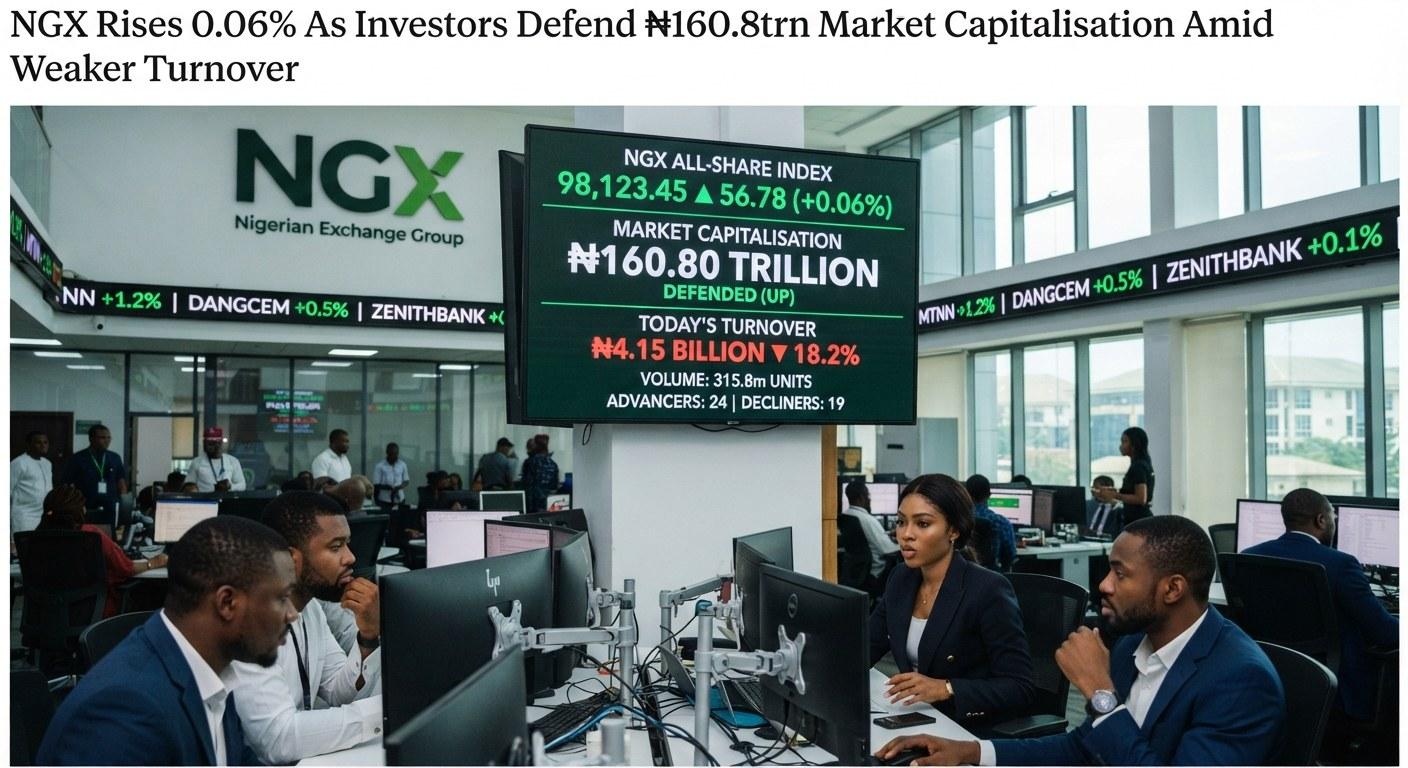
Nigeria’s equities market recorded a marginal recovery on Wednesday, October 14, 2026, as the benchmark All-Share Index (ASI) advanced by 0.06 per cent, supported by gains across several major sectoral indices, even as trading activity weakened and investors continued to navigate a market characterised by selective buying, profit-taking and divergent stock performances.
The Nigerian Exchange Limited (NGX) All-Share Index rose by 160.02 points to close at 247,673.65, while total market capitalisation remained at approximately ₦160.8 trillion, equivalent to about $121 billion. The modest advance offered some relief after recent market fluctuations, but its limited scale suggested that investors were yet to establish a sufficiently strong bullish direction to drive a broader recovery.
Trading data showed that 313.90 million shares, valued at ₦14.19 billion, changed hands in 30,922 deals. Compared with Tuesday’s session, Wednesday’s turnover declined by 34 per cent, while trading volume and the number of deals each fell by 20 per cent.
The combination of a marginal index gain and declining transaction activity presented a mixed picture. Although buying interest was sufficient to lift the overall market, the reduction in turnover suggested that investors were committing less money to equities than they had on the preceding trading day.
Of the 134 equities that participated in trading, 31 appreciated, 17 declined, while the remaining 86 recorded no price change or otherwise did not contribute to the reported advances and declines. The resulting positive market breadth indicated that gainers outnumbered losers, although the relatively narrow index appreciation showed that the gains did not translate into a powerful market-wide rally.
ASI Gains, But Weekly Performance Remains Negative
The ASI’s 0.06 per cent appreciation represented a modest improvement in daily sentiment, but its performance over different investment horizons revealed a more complicated picture.
The benchmark recorded a one-week decline of 0.97 per cent, indicating that the market had lost ground over the preceding five trading sessions despite Wednesday’s positive close. Over four weeks, however, the index gained 1.38 per cent, while its year-to-date return stood at an impressive 59.16 per cent.
These figures demonstrate the distinction between short-term market corrections and the broader performance of Nigerian equities in 2026. The negative weekly return suggests that some investors have been reducing exposure or locking in profits, while the positive four-week and year-to-date figures indicate that the market has retained a substantial portion of its earlier gains.
The year-to-date appreciation of nearly 60 per cent remains significant, particularly for investors who entered the market earlier in the year. Nevertheless, such gains should not be interpreted as evidence that every listed company has performed well. Stock selection remains critical because returns differ considerably across companies and sectors.
The reported market capitalisation of ₦160.8 trillion also provides an indication of the market’s overall scale, but it should not be confused with the amount of fresh money invested during Wednesday’s session. Market capitalisation reflects the prevailing prices of listed shares multiplied by their relevant share counts, and can remain broadly stable even when daily turnover contracts sharply.
For portfolio managers, the immediate question is whether the ASI can sustain its advance over subsequent sessions or whether Wednesday’s improvement will prove to be a temporary interruption in a short-term correction.
Sectoral Indices Show Selective Buying Interest
The sectoral performance figures revealed a generally positive daily session among the major indices reported, although the strength of the gains varied considerably.
The NGX Oil and Gas Index led the listed sectoral benchmarks, appreciating by 0.57 per cent. The performance was particularly noteworthy because the index had lost 3.26 per cent over one week, despite recording a substantial year-to-date gain of 126 per cent.
The sector’s annual performance makes it one of the market’s strongest performers in 2026. However, its recent weekly weakness suggests that investors may be reassessing valuations after the substantial appreciation recorded earlier in the year. Wednesday’s advance could indicate renewed buying interest, but a single positive session is insufficient to establish that a sustained recovery has begun.
The oil and gas sector remains important to the Nigerian investment landscape because of its links to crude production, refining, petroleum distribution and the broader energy value chain. Expectations surrounding domestic refining capacity, petroleum product supply, energy prices and corporate earnings can influence investor sentiment towards companies in the sector. Nevertheless, the index’s daily movement should not be attributed to any single factor without company-level evidence.
The NGX Insurance Index gained 0.36 per cent, while its one-week performance remained negative at 1.04 per cent. Its year-to-date return stood at minus 9 per cent, making it the only one among the major indices listed in Wednesday’s report with a negative annual performance.
This divergence deserves attention. While the broader market has delivered substantial gains in 2026, insurance equities have struggled to keep pace. The sector’s performance may reflect differences in investor appetite, company-specific earnings expectations, capital requirements, valuation concerns and perceptions of the industry's ability to convert regulatory changes and business growth into stronger shareholder returns.
The daily appreciation offers a positive signal, but it does not erase the sector’s annual underperformance. Investors assessing insurance stocks will need to examine individual companies’ financial strength, investment income, underwriting performance and prospects for sustainable profitability rather than relying solely on the index’s daily movement.
The NGX Banking Index advanced by 0.14 per cent. Despite this relatively modest daily gain, the index had declined by 3.55 per cent over one week, while maintaining a year-to-date appreciation of 68.27 per cent.
The figures suggest that banking equities have experienced short-term pressure following strong gains earlier in the year. Profit-taking could be one explanation, although the trading summary alone does not establish the precise cause. Investors are likely to remain attentive to banks’ earnings, asset quality, capital positions, dividend prospects and the effects of prevailing interest rates on margins and funding costs.
The banking index’s annual performance remains strong, but its weekly loss indicates that the sector is not immune to the broader market’s changing risk appetite.
The NGX Pension Index rose by 0.13 per cent on Wednesday. It recorded a weekly decline of 2.43 per cent but retained a year-to-date gain of 80.79 per cent. The index therefore displayed a substantial divergence between its recent performance and its longer-term advance.
The NGX Main Board Index gained 0.09 per cent, with a weekly decline of 0.77 per cent and a year-to-date appreciation of 43.01 per cent. Meanwhile, the NGX Top 30 Index advanced by 0.06 per cent, matching the ASI’s daily percentage gain. It declined by 1.03 per cent over one week but remained up 60.58 per cent year to date.
Taken together, these figures suggest that Wednesday’s recovery was relatively broad among the reported benchmarks, but did not yet reverse their recent weekly losses. The continued strength of their year-to-date performances points to a market that has delivered substantial gains over the year while becoming more selective in the short term.