 PublicSphere Live
Features
Zenith Bank and The Girl Child: Why Empowering a Girl Today Is an Investment in Nigeria’s Tomorrow
When a girl is given the opportunity to remain in school, understand her body, protect her dignity, acquire useful skills, develop financial discipline and grow into adulthood with confidence, the beneficiary is not merely that individual girl. Her family benefits. Her future children benefit. Her community benefits. Ultimately, society benefits.
There are investments whose returns can be counted in naira and kobo, and there are investments whose dividends may not appear immediately on a balance sheet but can alter the trajectory of families, communities and even nations. The empowerment of the girl child belongs firmly in the second category.
When a girl is given the opportunity to remain in school, understand her body, protect her dignity, acquire useful skills, develop financial discipline and grow into adulthood with confidence, the beneficiary is not merely that individual girl. Her family benefits. Her future children benefit. Her community benefits. Ultimately, society benefits.
It is against this wider understanding of human development that the girl-child initiatives of Zenith Bank Plc deserve close attention.
Among the bank’s interventions is its PAD-A-QUEEN initiative, undertaken in connection with the International Day of the Girl Child, with a particular emphasis on menstrual health, hygiene education, dignity and keeping girls in school. The programme illustrates an important truth that is sometimes lost in discussions about girl-child empowerment: empowerment does not always begin with a scholarship, a job or a leadership position. Sometimes, it begins with something as basic as ensuring that a teenage girl can sit confidently in a classroom when she is menstruating.
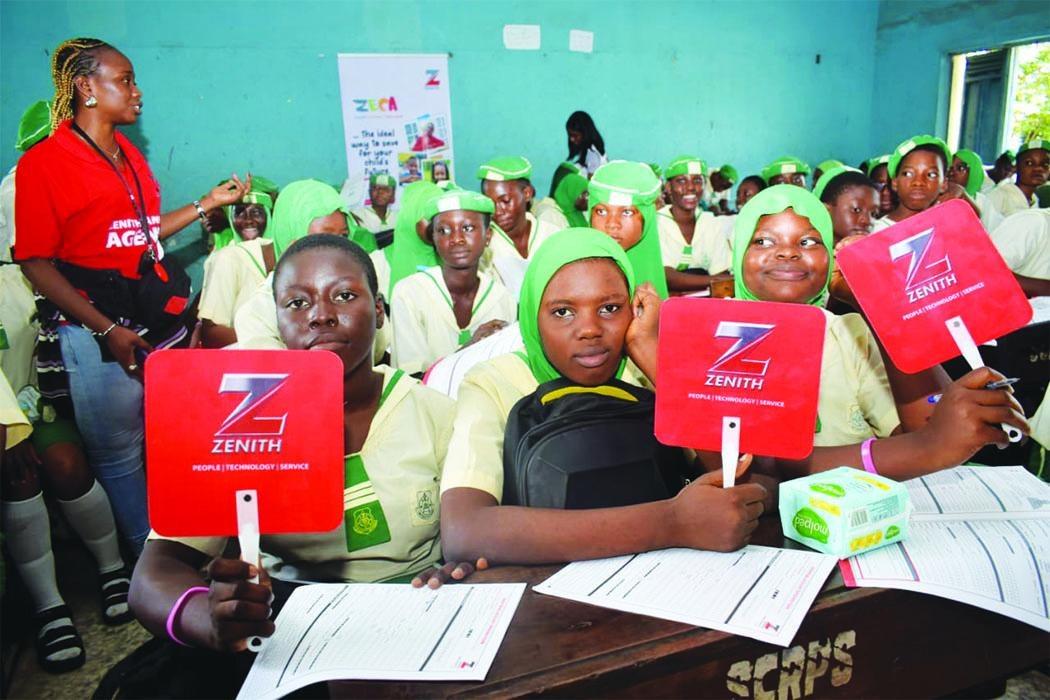
Zenith Bank’s 2025 Annual Report records that its PAD-A-QUEEN initiative reached 5,050 secondary-school girls and 65 teachers across six schools in Lagos State, providing gender-health and hygiene education, sanitary supplies and branded materials while equipping female teachers and counsellors to serve as mentors.
A separate 2026 account by the bank described the programme as having reached 5,000 girls in 10 schools, with sanitary pads, hygiene kits and menstrual-health education forming important components. The difference in the figures appears to reflect different programme/reporting cycles, but the underlying objective is consistent: to ensure that menstruation does not become an obstacle to a girl’s education, dignity or confidence. That objective is far more profound than it might initially appear.
The Girl Child Is More Than a Beneficiary
The phrase “girl child” is frequently used in development discourse, political speeches and corporate social responsibility programmes. But behind the phrase is a human being passing through one of the most consequential periods of life.
The adolescent girl is moving from childhood towards adulthood. She is forming her identity, developing her intellectual capacity, confronting social expectations and, in many cases, experiencing profound physical and emotional changes. The decisions made by families, schools, communities, governments and institutions during this period can have consequences lasting decades.
The United Nations recognises this reality in its annual International Day of the Girl Child, observed on October 11. The UN says every girl deserves the freedom to learn, grow, make her own choices and define her future. Its 2026 campaign places particular emphasis on ending child marriage and investing in girls’ rights.
This is not simply an international development slogan. For Nigeria, the issue is immediate.
UNICEF’s analysis of children and adolescents in Nigeria shows that girls continue to face pressures including early marriage, adolescent pregnancy, sexual abuse, gender-based violence and discriminatory social expectations. The report states that 30.3 per cent of women aged 20–24 had married before age 18, based on MICS 2021 data, while the adolescent birth rate remained high.
Education is another critical fault line. UNICEF says approximately one in every five of the world’s out-of-school children is in Nigeria and that gender, geography and poverty all contribute to educational marginalisation. In the north-east and north-west, female primary net attendance rates are particularly low.
The implication is unmistakable: empowering girls cannot be reduced to giving them occasional gifts. It requires removing the barriers that prevent them from acquiring the education, confidence, health knowledge, economic capability and social protection necessary to determine their own futures.
That is where programmes such as Zenith Bank’s intervention become significant.
The Period That Can Interrupt a Future
For adults, menstruation can appear to be a routine biological occurrence. For an adolescent girl encountering it for the first time, however, it can be frightening, confusing and deeply embarrassing, particularly where accurate information is absent.
Imagine a teenage girl sitting in a classroom and suddenly discovering that she has stained her school uniform. She may be afraid that her classmates will laugh at her. She may not know whom to approach. She may not have a sanitary pad. She may be afraid to walk to the school toilet. She may eventually leave school for the day.
One missed day may seem insignificant but repeated absence can become a pattern.
UNICEF reports that inadequate menstrual-hygiene facilities, insufficient access to menstrual products, lack of privacy and social stigma can affect girls’ attendance, participation, dignity and confidence. Its global data indicate that in Nigeria, about 22 per cent of adolescent girls aged 15–19 surveyed in the relevant dataset did not participate in school, work or social activities during their last menstrual period.
This is why the provision of sanitary products should not be dismissed as charity.
It is an educational intervention.
It is a health intervention.
It is a dignity intervention.
And, ultimately, it is an economic intervention.
A girl who remains in school has a greater opportunity to acquire qualifications and skills. A girl who develops confidence has a better chance of speaking up when she is threatened or abused. A girl who understands menstrual health is less likely to be trapped by myths and misinformation. A girl who receives mentorship can begin to imagine herself not merely as somebody’s daughter or future wife, but as a professional, entrepreneur, scientist, banker, doctor, engineer, teacher, public servant or leader.
This is the deeper significance of PAD-A-QUEEN.
From Sanitary Pads to Self-Respect
The most important feature of the initiative is that it does not stop at the distribution of sanitary products. Zenith Bank has described the programme as incorporating menstrual-health education, confidence-building and the dismantling of myths and taboos surrounding menstruation. Teachers and counsellors are also brought into the process so that the conversation can continue after the corporate intervention has ended.
That is important. A box of sanitary pads can solve an immediate problem just as knowledge can solve a recurring problem ,while mentorship can change behaviour. A supportive school environment can change an entire experience of adolescence. This distinction is what separates a serious empowerment programme from a publicity exercise.
The bank’s approach recognises that the girl needs both the material resource and the intellectual confidence to use it effectively.
This matters because menstruation remains surrounded by silence in many communities. Girls can receive conflicting messages about what they can and cannot do during their periods. Some are made to feel embarrassed about a natural biological process. Others may lack basic knowledge about menstrual hygiene.
UNICEF’s work in Nigeria similarly stresses that menstrual-health education must go beyond products to include accurate information, safe facilities, confidence and an environment free from stigma. (UNICEF)
The significance of Zenith Bank’s intervention therefore lies not merely in the pad. It lies in the conversation that accompanies the pad.
Why The Teacher Matters
Another important dimension of the programme is the involvement of teachers and counsellors.
A girl may receive assistance during a Zenith Bank outreach, but she returns to her school every day. If she subsequently has a problem, there must be someone within that environment whom she can trust.
This is why the decision to equip female teachers and counsellors as mentors is particularly valuable. The teacher can become the bridge between a programme and its long-term impact.
She can identify a girl who is withdrawing from class. She can notice a student whose attendance is deteriorating. She can answer questions about menstruation. She can provide emotional support. She can refer a vulnerable child to appropriate assistance where necessary. In other words, the programme begins to build an ecosystem rather than simply stage an event, and that is precisely how meaningful corporate social responsibility should work.
The Bigger Question: What Does Empowerment Really Mean?
There is a tendency to define empowerment in narrow terms.
Give a girl a computer and she is empowered.
Give her a scholarship and she is empowered.
Teach her a skill and she is empowered.
These things matter. But genuine empowerment is broader.
It means creating circumstances in which a girl can develop agency—the ability to make informed choices about her life.
That requires education.
It requires health.
It requires safety.
It requires confidence.
It requires access to information.
It requires financial literacy.
It requires protection from violence and exploitation.
It requires freedom from discriminatory norms.
And it requires society to see girls as people with rights and ambitions, rather than merely as future wives and mothers.
Zenith Bank’s broader child-focused CSR portfolio demonstrates that the institution appears to understand this wider picture.
In 2025, its financial-literacy programme reached 3,622 students across 22 local government areas, with 137 employees serving as volunteer educators. The programme focused on savings, responsible financial behaviour and income generation.
The bank has also supported educational infrastructure, ICT centres, vocational facilities, school renovations and targeted assistance for girl-child education. Its Children’s Account, ZECA, is designed to introduce children to saving and financial discipline from an early age.
Taken together, these initiatives reveal a philosophy that goes beyond a single intervention.The bank is attempting to contribute to the formation of a financially literate, educated and confident younger generation.
Why Banks Should Care About the Girl Child
There is also a compelling economic argument. Banks are institutions at the heart of economic development. They mobilise savings, finance businesses, support investment and facilitate transactions. But the financial system cannot reach its full potential if large sections of the future population grow up without adequate education or financial knowledge.
Today’s schoolgirl is tomorrow’s customer, entrepreneur, employee, investor, professional and business owner. She may eventually establish a manufacturing company, operate a technology enterprise, become a medical practitioner, run a farm, lead a financial institution or serve in government.
The economic return on educating and empowering her can therefore be immense. The United Nations itself describes investment in adolescent girls as not only a question of rights and gender equality but also a sound economic choice.
This is why Zenith Bank deserves commendation for approaching girl-child empowerment as part of a broader social-investment philosophy. The bank is not waiting for government alone to solve every problem. It is using its institutional resources to address a specific social barrier.
Beyond The Pad: The Girl Needs a Future
There is, however, an important point that should not be lost.
A sanitary pad can help keep a girl in school today, but society must ensure that there is a school worth remaining in.
The girl needs competent teachers.
She needs safe classrooms.
She needs adequate toilets and water.
She needs protection from sexual harassment.
She needs access to healthcare.
She needs digital skills.
She needs career guidance.
She needs financial literacy.
She needs protection against child marriage and other harmful practices.
She needs parents who believe in educating daughters.
She needs communities that do not regard ambition in a girl as rebellion.
And she needs institutions that will continue to invest in her even after the cameras have disappeared.
This is why Zenith Bank’s decision to incorporate teachers and counsellors into the programme is worthy of particular recognition. Sustainability is the real test of empowerment.
The best corporate intervention is not necessarily the one that generates the biggest headline. It is the one whose effect remains after the headline has disappeared.
A Corporate Model Worth Encouraging
Zenith Bank deserves praise for recognising that corporate citizenship is not restricted to writing cheques for charitable causes. A modern corporate institution operates within society and has responsibilities to that society.
The bank’s intervention in girl-child empowerment demonstrates how private capital can be directed towards social challenges without losing sight of measurable outcomes.
Reaching thousands of girls with sanitary products and education is significant. Bringing teachers and counsellors into the process is significant. Connecting girl-child initiatives with broader education, financial literacy, digital inclusion and health interventions makes the impact even more substantial.
In 2025, the bank reported that PAD-A-QUEEN reached more than 5,000 secondary-school girls, while its wider CSR activities covered financial literacy, education, healthcare, vocational training and other areas. (Zenith Bank)
That scale deserves recognition.
But perhaps the most important achievement cannot be captured by a statistic.
It is the moment when a young girl who once felt embarrassed about menstruation discovers that there is nothing shameful about her body.
It is the moment when she walks into her classroom without fear.
It is the moment when she raises her hand to answer a question.
It is the moment when she begins to believe that university is possible.
It is the moment when she opens her first savings account and understands that money can be managed rather than merely spent.
It is the moment when she looks at a female professional and says to herself: I can become that.
That is empowerment.
The Girl Today, The Woman Tomorrow
Nigeria cannot afford to treat its girls as an afterthought. The country is too young, too ambitious and too challenged by its development needs to waste the potential of half its population.
Every girl pushed out of school represents a loss of potential.
Every girl forced into early marriage represents a future interrupted.
Every girl who stays away from school because she cannot afford menstrual products represents an avoidable failure.
Every girl who grows up believing that her dreams are less important because she is female represents a society that has failed to recognise its own wealth.
The reverse is equally true.
Every girl who remains in school is an investment.
Every girl who becomes financially literate is an investment.
Every girl who learns to speak confidently is an investment.
Every girl protected from abuse is an investment.
Every girl who acquires a professional qualification is an investment.
Every girl who becomes an entrepreneur is an investment.
Every girl who eventually becomes a leader is an investment.
And this is why initiatives such as Zenith Bank’s PAD-A-QUEEN deserve to be encouraged, expanded and replicated.
The bank has shown that corporate social responsibility can address a problem that is intimate, practical and deeply connected to educational outcomes.
The initiative also sends a message to other businesses: there is no need to wait for a grand national crisis before contributing to human development. Sometimes, changing society begins with solving a problem that one girl encounters every month.
Zenith Bank should therefore be commended for placing the dignity and welfare of the girl child within the centre of its social-investment agenda. But commendation should be accompanied by an even greater expectation.
The programme should continue to grow. It should reach more schools, particularly in communities where poverty, inadequate sanitation, insecurity and cultural barriers place girls at greater risk of dropping out. It should deepen mentorship, financial literacy, digital education and career guidance. It should encourage more conversations involving parents and boys, because creating a supportive environment for girls cannot be the responsibility of girls alone.
Most importantly, the philosophy behind the programme should remain clear: the girl child is not a charity case. She is an asset.
She is a potential scientist.
A potential entrepreneur.
A potential doctor.
A potential engineer.
A potential teacher.
A potential banker.
A potential policymaker.
A potential president.
But before she can become any of these things, she must first be allowed to grow, learn, remain healthy, feel safe and believe in herself.
That is why the significance of Zenith Bank’s girl-child empowerment initiative extends far beyond sanitary pads, school visits or corporate branding.
At its heart, it is about restoring something that every girl should possess from the beginning—dignity, confidence and the freedom to imagine a future without unnecessary barriers.
And when a society gives its girls that freedom, it does not merely empower girls.
It empowers the nation.