 PublicSphere Live
Aviation
EDITORIAL: Igbokoda Air Disaster: Mourning the Dead, Demanding Answers
Editorial on aviation accident at Igbokoda, Ondo, State , which killed all the passengers
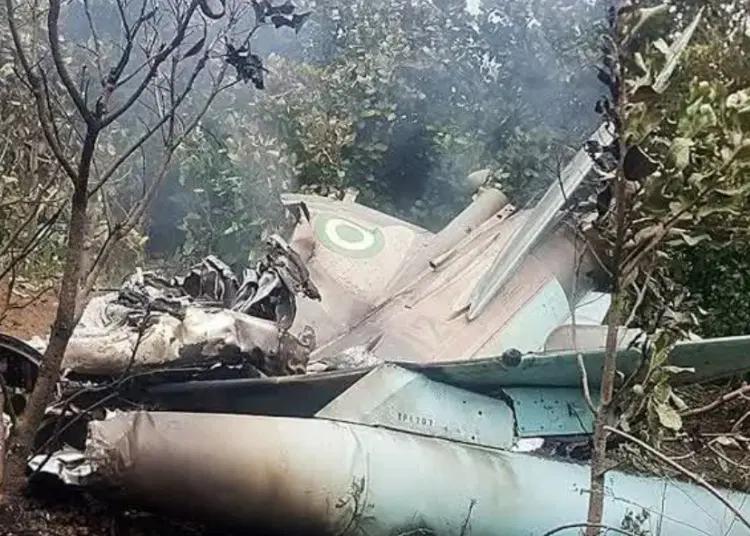
There are moments in the life of a nation when words appear painfully inadequate, when the enormity of a tragedy is such that even the most carefully chosen expressions of grief seem incapable of capturing the depth of the loss. Monday's crash of a Nigerian Air Force ATR-42 aircraft in the Igbokoda area of Ondo State is one of such moments.
A routine military flight that began in Benin City and was heading towards Lagos ended in unimaginable devastation near a naval base in the riverside community of Igbokoda. The aircraft disappeared from radar after air traffic controllers lost contact with it, and the wreckage was subsequently located in the difficult terrain around the community. There were no survivors.
The Nigerian Air Force has now confirmed that 25 people were aboard the aircraft, comprising five crew members and 20 passengers. This differs from the initial figure of 32 given by the Federal Government on Monday, which put the number at 25 passengers and seven crew members. The latest official figure should be regarded as the operative account, but the discrepancy must itself be explained as part of the investigation because the country is entitled to know precisely who was aboard the aircraft and how the manifest was compiled.
Whatever the final accounting, the fundamental truth remains unchanged: Nigeria has lost too many of her sons and daughters in one terrible incident. That is the reality with which the Nigerian Air Force, the Armed Forces, the Federal Government and the families of the victims must now live.
We mourn with them.
We mourn with the Chief of the Air Staff, Air Marshal Sunday Kelvin Aneke, and the officers, airmen and airwomen of the Nigerian Air Force. We mourn with the families who received the most devastating telephone calls imaginable. We mourn with the communities from which the victims came and with Nigerians who may never have known the deceased personally but recognise that every life lost was a member of the national family.
These were not merely names on a passenger manifest. They were fathers and mothers, sons and daughters, husbands and wives, brothers and sisters, colleagues and friends. They were people with unfinished responsibilities, uncompleted dreams and families waiting for their return.
Instead, they are coming home in coffins.The nation must therefore first pause to grieve.
President Bola Tinubu has appropriately declared three days of national mourning and directed that national flags be flown at half-mast throughout the country. He has also directed the Nigerian Air Force to immediately commence a thorough investigation into the cause of the crash.
This is appropriate and commendable. But while the nation mourns, it must also insist on answers.
The declaration of mourning cannot be the end of the matter. It must be the beginning of a serious national examination of what happened at Igbokoda and what can be done to ensure that a tragedy of this nature is not repeated.
At this stage, nobody should pretend to know what caused the aircraft to crash.
There have already been various accounts and eyewitness descriptions, but none should be elevated into an established cause until the investigators have examined the evidence. An aircraft accident cannot responsibly be explained through social media speculation, political commentary or the testimony of people who saw only the final moments of the incident.
The aircraft was reportedly on a routine mission from Benin City to Lagos when contact was lost at about 9:13 a.m. The wreckage was later found close to the naval base at Igbokoda, with reports indicating that the aircraft had come down near a river and was partly submerged. Witnesses described hearing a loud sound before seeing the aircraft go down. These details are important, but they are only pieces of a much larger puzzle.
The investigators must therefore reconstruct the final minutes of the flight.
What was the aircraft's mechanical condition before take-off? What did its maintenance records show? When was its last major inspection? What did the cockpit instruments indicate? What was the weather like along the route? Was there any communication between the crew and air traffic controllers immediately before contact was lost? Did the aircraft experience an engine, electrical, structural or navigational problem? Was there any warning from the crew? Was the aircraft operating within all prescribed parameters?
These and many other questions must be answered by evidence, not conjecture.
And because this was a military aircraft, the investigation must be conducted with the seriousness expected of a professional military institution.
The Defence Headquarters has ordered an investigation, while the Nigerian Safety Investigation Bureau has made it clear that because the aircraft was military, investigative responsibility rests with the Nigerian Air Force, although the NSIB is prepared to provide technical assistance, including investigators and its Flight Safety Laboratory for the recovery and analysis of flight-recorder data if requested.
There should be no hesitation in bringing in whatever expertise is necessary.
There is nothing undignified about asking for assistance when human lives have been lost. Indeed, a truly professional institution should welcome every credible technical resource capable of helping establish the truth.
If the flight recorder can be recovered, it should be recovered. If specialist expertise is required to interpret the data, it should be deployed. If the aircraft's maintenance history needs to be independently examined, that should be done. If operational procedures require scrutiny, they should be scrutinised without fear or favour.
The objective must not be to protect an institution.
The objective must be to protect lives.
This is particularly important because the men and women of the Nigerian Armed Forces routinely operate under dangerous conditions. They fly missions in difficult environments, transport personnel and equipment, conduct surveillance and reconnaissance and participate in operations where the consequences of mechanical or operational failure can be catastrophic.
They therefore deserve the very best aviation safety standards available to the country.
The Nigerian Air Force should never be placed in a position where its personnel have to choose between accomplishing a mission and questioning whether the equipment available to them is safe enough to undertake it.
Military discipline is important. Operational readiness is important. National security is important. But none of these should be placed in opposition to aviation safety.
Indeed, the safety of military personnel should itself be regarded as an essential component of national security.
This is why the outcome of the Igbokoda investigation matters enormously.
If mechanical failure is established, the maintenance system must be examined. If human error contributed to the accident, the relevant training and procedures must be reviewed. If weather conditions played a role, flight-planning and weather-monitoring procedures must be assessed. If an organisational or procurement failure is identified, those responsible systems must be corrected.
And if the investigation establishes that the crash resulted from an unforeseeable combination of circumstances, the country must still learn from the incident.
Aviation accidents should produce lessons. Otherwise, mourning becomes repetitive rather than transformative.
The Federal Government must therefore ensure that the eventual investigation report does not become another official document that attracts attention for a few days before disappearing into the bureaucracy.
The victims deserve better.
Their families deserve better.
The Nigerian Air Force deserves better.
And Nigeria deserves better.
The families must also be treated with dignity throughout this painful process. The release of the identities of those who died must be handled with sensitivity, and every bereaved family should receive the support and information to which it is entitled. The public should equally resist the ugly tendency to circulate graphic images and unverified information from accident scenes. Grief should not become material for social-media sensationalism.
The conflicting casualty figures also demonstrate why official communication is particularly important in moments of national tragedy. On Monday, the initial government account indicated that 32 people were aboard the aircraft; the Nigerian Air Force subsequently confirmed 25. The Air Force has now released the names of the five crew members and 20 passengers.
The public deserves a clear explanation of how the discrepancy occurred.
Transparency does not weaken the Armed Forces.
It strengthens public confidence in them.
President Tinubu's three-day national mourning should therefore be observed not merely as a formal government proclamation but as an opportunity for the country to reflect on the sacrifices made by members of the Armed Forces.
When the national flag flies at half-mast, Nigerians should remember that behind the symbolism are real families whose lives have been permanently altered.
We should remember that those who serve Nigeria in uniform do not belong only to their respective services. They belong to the nation.
Their sacrifices are national sacrifices.
Their deaths are national losses.
But there is another responsibility that comes with mourning: accountability.
Nigeria has witnessed too many tragedies in which public grief was intense in the immediate aftermath but institutional memory proved remarkably short. That pattern must not be repeated with Igbokoda.
We must mourn the dead, but we must also learn from their deaths.
We must console the Nigerian Air Force, but we must also demand that every relevant question be answered.
We must support the Federal Government, but we must also expect it to ensure that the investigation is thorough, credible and consequential.
And we must pray for the families, while ensuring that they are not abandoned once the television cameras leave and the headlines disappear.
The Igbokoda tragedy should therefore mark the beginning of a renewed national commitment to military aviation safety.
Let the investigation follow the evidence wherever it leads.
Let nobody be protected from legitimate scrutiny, but let nobody be condemned without evidence.
Let the investigators determine the cause.
Let the government act on the findings.
Let the Nigerian Air Force strengthen whatever systems require strengthening.
And let the nation remember the fallen not only through speeches and ceremonies, but through concrete measures that make it less likely that other families will one day receive the same devastating news.
For now, Nigeria mourns.
We extend our deepest condolences to the families of the victims, to the Nigerian Air Force, the Defence Headquarters, the Federal Government, the Ondo State Government and the communities affected by this terrible tragedy.
May Almighty God grant eternal rest to those who lost their lives in the Igbokoda crash and grant their families and colleagues the fortitude to bear this irreparable loss.
But when the three days of mourning are over, the questions must remain.
Nigeria must not allow the silence that follows mourning to become the silence that buries the truth.